


India's 7.8% GDP Number: The Manipulation Charge Fails. The Reliability Question Does Not.
By A Special Correspondent
First publised on 2026-09-03 02:41:39
About the Author

Two different arguments have been bundled together in India's GDP controversy, and they need to be separated. The first does not survive scrutiny. The second deserves serious attention.
The most explosive claim made against the government, that the 7.8 percent growth figure was engineered through statistical sleight of hand, does not survive scrutiny. But the controversy does not end there. Beneath the political noise sits a real and unresolved question about whether India's new national accounts methodology is producing numbers reliable enough to carry the weight being placed on them.
The claim that collapsed
On August 31, MoSPI released Q1 FY2026-27 data showing real GDP growth of 7.8 percent and real GVA growth of 8.2 percent, well above the RBI's own forecast of 7 percent. Nominal GDP grew 10.3 percent. Modi called it exemplary growth. Sitharaman called it proof of reform working. The opposition called it fiction.
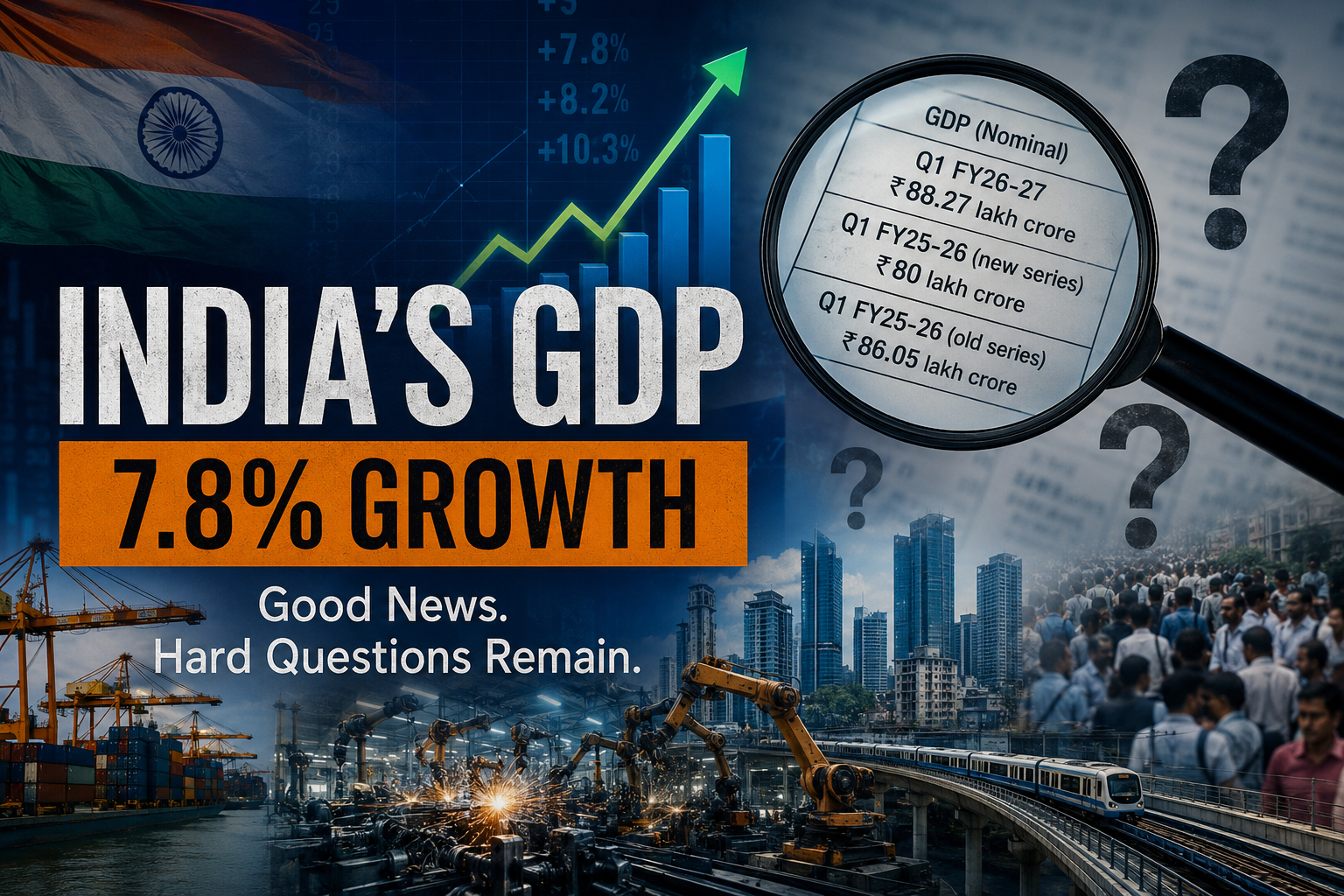
Former finance secretary Subhash Chandra Garg supplied the number that gave the fiction charge its teeth. He calculated that if the new Q1 FY2026-27 nominal GDP figure of roughly 88.27 lakh crore is measured against last year's original figure of roughly 86.05 lakh crore, growth comes out to 2.6 percent, not 10.3 percent. Congress seized on this. Jairam Ramesh called the numbers greatly distorted. Sam Pitroda asked whose growth this was.
The claim does not hold. The 86.05 lakh crore figure comes from the old GDP series, built on the 2011-12 base year. The 88.27 lakh crore figure comes from the new series, built on the 2022-23 base year. Under the new series, last year's comparable quarter has been restated at roughly 80 lakh crore. Measuring this year's new-series figure against last year's new-series figure gives the reported 10.3 percent nominal growth and 7.8 percent real growth. Measuring a new-series numerator against an old-series denominator is not a valid growth calculation, and SBI Ecowrap was right to reject it. The government is correct on this narrow point, and no amount of political urgency changes the arithmetic.
The broader economic indicators are at least consistent with a strong-growth economy. Private consumption grew 7.1 percent. Manufacturing grew 9.2 percent. Financial services grew 12.1 percent. Credit growth ran near 18.3 percent. Private-sector capital investment rose 11.9 percent year-on-year, and gross fixed capital formation rose to 34.3 percent of GDP from 31.4 percent a year earlier. Independent forecasters who were initially skeptical of the 7.8 percent figure have since revised their full-year FY27 estimates upward, toward a consensus near 7.2 percent, with a range of 6.9 to 7.5 percent. Forecasters do not typically move toward a number after scrutinising it unless the underlying data supports the move. The fabrication charge, as stated, is not credible.
The question that remains
None of this settles the matter, and treating it as settled would be its own distortion. Three issues deserve continued scrutiny, and they are technical rather than political.
The first is the scale of the overhaul itself. India has simultaneously changed its base year from 2011-12 to 2022-23 and introduced considerably more granular deflators, including double-deflation techniques in key sectors. A methodology change of this size, combined with historical revisions this large, makes it genuinely difficult for anyone outside MoSPI to separate real economic improvement from the mechanical effect of the new framework. This is not evidence of manipulation. It is evidence that outside verification has become harder, and that is a legitimate concern in its own right.
The second is the deflator problem. Real GDP is nominal output with price effects stripped out. MoSPI itself has had to explain why manufacturing shows a negative implicit deflator even as consumers report ongoing inflation. That outcome is not automatically wrong under the new methodology. But it is counterintuitive enough that independent economists are justified in examining the underlying calculations rather than accepting the headline number on faith.
The third is the statistical discrepancy between the production-side and expenditure-side estimates of GDP. MoSPI has acknowledged that this discrepancy is unusually large in the latest release and has said it may narrow as better data arrives. A large discrepancy does not by itself mean GDP is overstated. It does mean the number carries more uncertainty than the confident tone of the press release suggests.
What Rajan and Basu are actually asking
The more consequential questions being raised by economists such as Raghuram Rajan and Kaushik Basu are not dependent on the Garg argument. Rajan has explicitly questioned whether the growth numbers are real and asked why such rapid growth is not producing more good jobs and stronger investment. Basu pointed to India's investment rate, which rose above 38 percent around 2007 and remained there until 2013 before falling below 34 percent, where it has stayed since. These are not arithmetic objections. They are questions about whether a strong topline number is consistent with weak investment, soft consumer confidence and a labour market that does not look like the labour market of a 7.8 percent economy. Those questions survive the collapse of the manipulation charge, because they were never dependent on it.
The verdict, stated plainly
India's economy is credibly growing at close to 7.8 percent this quarter. The claim that this figure was manufactured through a base-year trick is false, and it should stop being repeated. The claim that this figure settles the debate about the health of the Indian economy is also false, and that should stop being repeated too. GDP growth is not the same thing as broad-based prosperity. Employment, real wages, household consumption and investment intentions will decide whether this number means anything to the people it is supposed to describe. The honest position sits between the two slogans currently on offer. It is not an economic miracle. It is not a fabrication. It is a number that deserves to be believed and questioned at the same time. MoSPI's own revision process is reason enough to treat the first estimate as provisional rather than definitive. The 7.8 percent deserves to be taken seriously. It also deserves to be tested against subsequent revisions, investment, employment, consumption and other evidence of economic activity. The numbers will become more, not less, meaningful as the underlying data improve.
Note: The lead image is AI-generated