

IndiGo Meltdown: Arrogance And Mismanagement
 Editor-in-Chief of indiacommentary.com. Current Affairs analyst and political commentator. Author of Cyber Scams in India, Digital Arrest, The Money Trap and The Human Hack
View all posts by this Author
Editor-in-Chief of indiacommentary.com. Current Affairs analyst and political commentator. Author of Cyber Scams in India, Digital Arrest, The Money Trap and The Human Hack
View all posts by this Author
By Sunil Garodia
First publised on 2025-12-08 11:33:30
About the Author
Editor-in-Chief of indiacommentary.com. Current Affairs analyst and political commentator. Author of Cyber Scams in India, Digital Arrest, The Money Trap and The Human Hack
View all posts by this Author
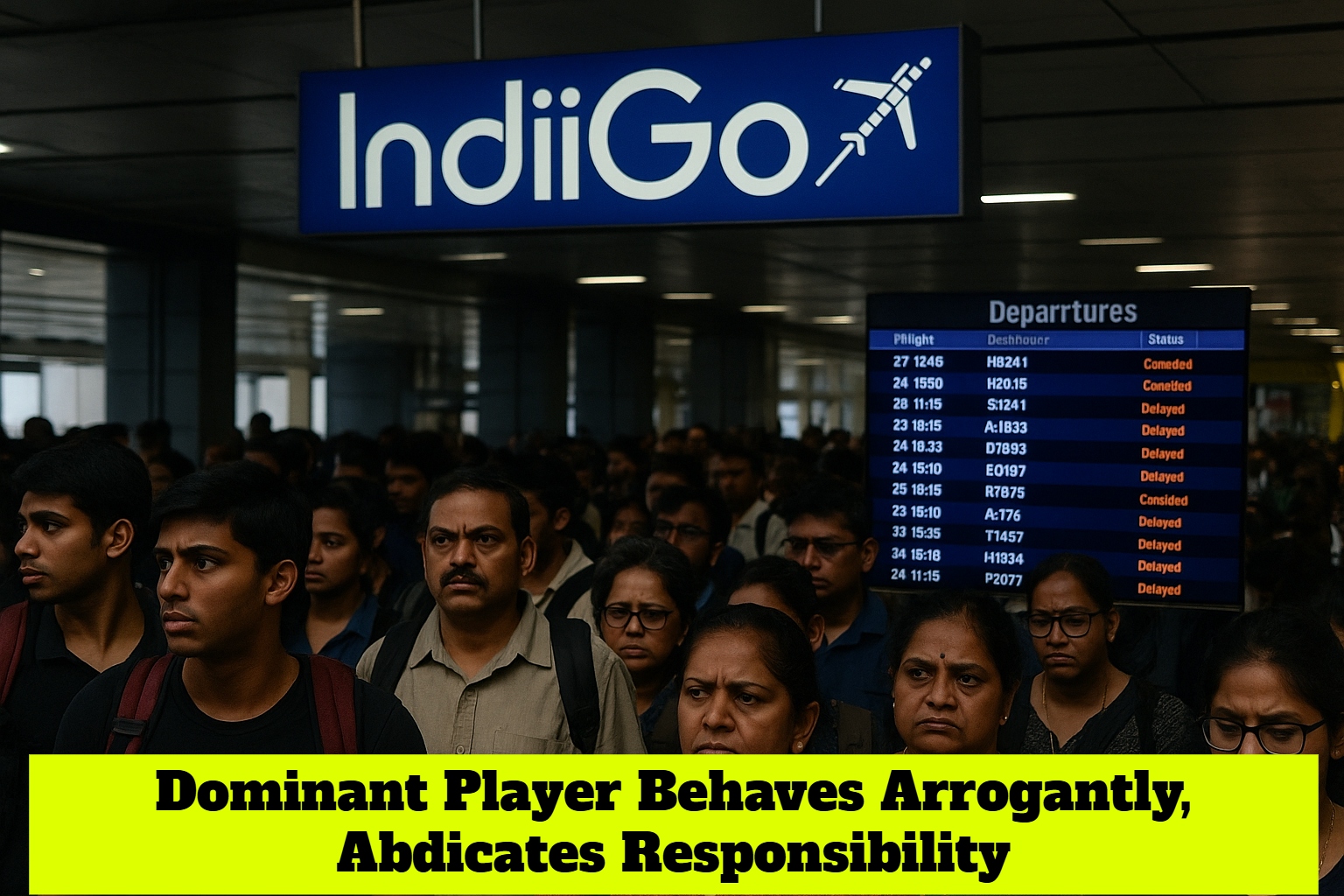
For a week, India's biggest airline has behaved like a public utility that forgot it has customers. Thousands of flights cancelled, lakhs of passengers stranded, airports converted into holding zones with people sleeping on floors clutching boarding passes. This is not disruption. This is systemic collapse. And it did not happen by accident.
The trigger is now undeniable. On December 1, tighter flight duty and rest rules for pilots came into force. These rules were designed to reduce fatigue and improve aviation safety. IndiGo, which controls nearly two-thirds of India's domestic air traffic, simply did not have enough rested pilots to legally operate the schedule it was selling. Flights fell off the network not because of weather, not because of mechanical failure, but because there was no legally available crew left to fly them.
What makes this scandalous is that these rules were not sprung overnight. Airlines had close to two years' notice. Two years to hire more crew. Two years to temper schedules. Two years to build operational buffers. IndiGo did none of that. It kept stretching aircraft utilisation, pushing pilot rosters to their limits and selling seats on the assumption that the old, looser rules would somehow continue forever. When the mathematics of the new safety norms finally kicked in, the house of cards collapsed.
And this is where the government's own failure becomes impossible to dodge. If airlines were given two full years' notice of the new fatigue rules, and if IndiGo had visibly frozen large-scale pilot hiring while continuing to push rosters to the legal edge, what stopped the regulator from asking - three months ago, or even six - what concrete steps the airline had taken to transition to the imminent regime? Why was there no readiness audit, no dry run, no demand for proof that manpower matched ambition? Waiting for the crash before demanding accountability is not regulation. It is abdication.
Now comes the most uncomfortable allegation. Sections of IndiGo's own pilots are claiming the chaos was effectively allowed to happen to force the government to dilute the new fatigue rules. That the airline chose to crash its own schedule into the wall so that regulators would panic and roll back safety standards in the name of "stability". This claim is yet to be proven, but the sequence is deeply troubling: new rules land, operations implode, and within days the regulator starts softening or "temporarily relaxing" the very safety limits it had declared essential.
Whether this was cynical strategy or gross miscalculation, the moral culpability sits squarely with IndiGo's top management and board. They chose a business model that runs on razor-thin margins of human endurance. They chose to dominate the market without building redundancy. They chose growth optics over operational resilience. And when the system buckled, they failed at the most basic level of crisis handling, leaving passengers uninformed, unsupported and effectively abandoned.
But New Delhi cannot wash its hands either. The aviation regulator saw this cliff coming from miles away. It could have demanded detailed readiness audits. It could have forced pre-emptive capacity cuts. It waited until terminals were choked with stranded passengers before issuing show-cause notices. Worse, by bending fatigue rules under pressure, it has signalled to the entire industry that safety norms in India are negotiable when a market leader starts bleeding. Avaiation minister Rammohan Naidu said in Parliament on December 8 that "very, very strict action" will be taken against IndiGo to "set an example". But why this action was not taken before the system collapsed remains a mystery.
This is also a policy failure years in the making. By allowing one private airline to capture a dominant share of the domestic market, the government converted a corporate miscalculation into a national transport crisis. When one company carries most of your skies, its internal dysfunction becomes a public emergency. Concentration risk is no longer theoretical. It has played out live at every major airport.
There is also an ugly attempt to shift blame towards pilots for finally refusing to fly while exhausted. That narrative is dangerous and dishonest. Fatigue rules exist because tired pilots crash airplanes. The burden of compliance lies with management, not with individuals who are already stretched. If any organised illegality is proven, the law should take its course. But until then, safety cannot be bargained away to protect quarterly profits.
If India is serious about preventing a repeat, cosmetic fixes will not do. IndiGo must be forced to operate with audited staffing buffers aligned to safety norms, not shareholder expectations. Passenger compensation and re-accommodation cannot be treated as charity; they must be enforced as obligation. The regulator must shift from reactive punishment to preventive supervision, with mandatory readiness testing before any major rule transition.
At a structural level, India needs to break its addiction to a single dominant carrier. Smaller airlines cannot grow if airport slots, fleet financing and fuel economics are tilted permanently in favour of one giant. Competition is not just about fares. It is about systemic resilience. When one airline falters, others must be capable of absorbing the shock.
Finally, India needs a binding passenger rights regime with teeth. Clear compensation for cancellations and long delays, enforceable hotel and meal support, and a mandatory obligation to reroute passengers even on rival airlines. When the cost of chaos is borne by the airline instead of dumped on the citizen, behaviour changes fast.
This crisis is not merely about operational failure. It is about a dangerous convergence of corporate arrogance, regulatory timidity and policy complacency. When a dominant private player is allowed to function without commensurate accountability, safety becomes a cost centre and passengers become collateral.
If IndiGo wants the power of a national carrier without the obligations of one, India will keep paying the price in cancelled flights, broken journeys and eroded trust. What we saw this week is not a one-off accident. It is a warning shot.