

Bigger Polluters, Bigger Penalties - Why the Supreme Court Is Right
 Editor-in-Chief of indiacommentary.com. Current Affairs analyst and political commentator. Author of Cyber Scams in India, Digital Arrest, The Money Trap and The Human Hack
View all posts by this Author
Editor-in-Chief of indiacommentary.com. Current Affairs analyst and political commentator. Author of Cyber Scams in India, Digital Arrest, The Money Trap and The Human Hack
View all posts by this Author
By Sunil Garodia
First publised on 2026-02-03 04:23:56
About the Author
Editor-in-Chief of indiacommentary.com. Current Affairs analyst and political commentator. Author of Cyber Scams in India, Digital Arrest, The Money Trap and The Human Hack
View all posts by this Author
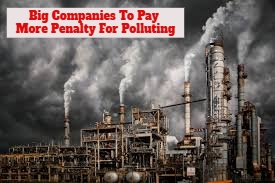
When the Supreme Court said larger companies could justifiably face heavier penalties for environmental violations, the objection came swiftly: is justice now being scaled by balance sheets rather than damage caused? The criticism sounds principled, but it rests on a mistaken assumption - that the Court has replaced damage-based liability with size-based punishment. It has done no such thing.
The Court's reasoning rests on a distinction that is central to environmental law but often lost in public debate: environmental compensation serves both restorative and deterrent functions, and these functions are not measured by identical yardsticks.
What the Supreme Court actually held
In upholding substantial environmental compensation imposed on real estate developers for proceeding without statutory environmental clearances, the Supreme Court observed that factors such as turnover, project cost, and scale of operations may be relevant in determining penalties. The logic is straightforward. A nominal or flat fine may be punitive for a small enterprise but meaningless for a large corporation. A sanction that does not hurt does not deter.
Importantly, the Court did not hold that larger companies must pay more irrespective of damage. It merely rejected the fiction that identical monetary penalties produce equal justice across vastly unequal economic actors.
Damage determines liability, not company size
Indian environmental law has long drawn a clear line between liability for damage and calibration of deterrence.
The first component of environmental compensation is restoration and restitution. This includes the cost of repairing ecological damage, restoring land and water bodies, and compensating affected communities for health, livelihood, and environmental loss. This component is entirely damage-centric. It flows from the "polluter pays" principle that has been embedded in Indian jurisprudence since the mid-1990s.
A small company that causes large-scale groundwater contamination or ecological destruction does not get a discounted liability because it is small. The cost of restoration follows the damage, not the balance sheet. Financial incapacity is not a defence. If the compensation required exceeds the company's net worth and leads to closure or insolvency, the law accepts that outcome. Environmental protection is not subordinated to corporate survival.
Where size becomes relevant
The second component is the deterrent or punitive element of environmental compensation. This is where economic capacity becomes relevant.
A uniform monetary penalty regime produces perverse results. What cripples a small firm may be a rounding error for a large corporation. If environmental penalties are absorbed as routine business costs, compliance becomes optional. Scaling penalties to economic capacity ensures equal impact, not unequal treatment.
This is not a violation of equality before law. It is an application of substantive equality, which requires that the law operate with real-world consequences in mind rather than artificial uniformity.
The "small company, big damage" concern
The most persistent fear is that small companies might escape serious liability even after causing massive environmental damage. That fear is misplaced.
Environmental law does not cap liability based on size. A small enterprise that causes enormous harm will face enormous compensation. Assets may be attached, operations shut down, and insolvency triggered. Size affects how deterrence is calibrated - not whether responsibility exists.
Rule of law strengthened, not weakened
The rule of law is not offended when courts acknowledge economic reality. It is offended when penalties become symbolic, arbitrary, or ineffective. By ensuring that liability tracks damage while deterrence tracks economic scale, the Supreme Court has reinforced proportionality, effectiveness, and fairness.
Environmental law was never meant to preserve polluters; it was meant to protect the environment. By ensuring that liability follows damage and deterrence follows economic reality, the Supreme Court has not weakened equality before law - it has made it work. Damage determines responsibility; size merely determines whether the law has teeth.