

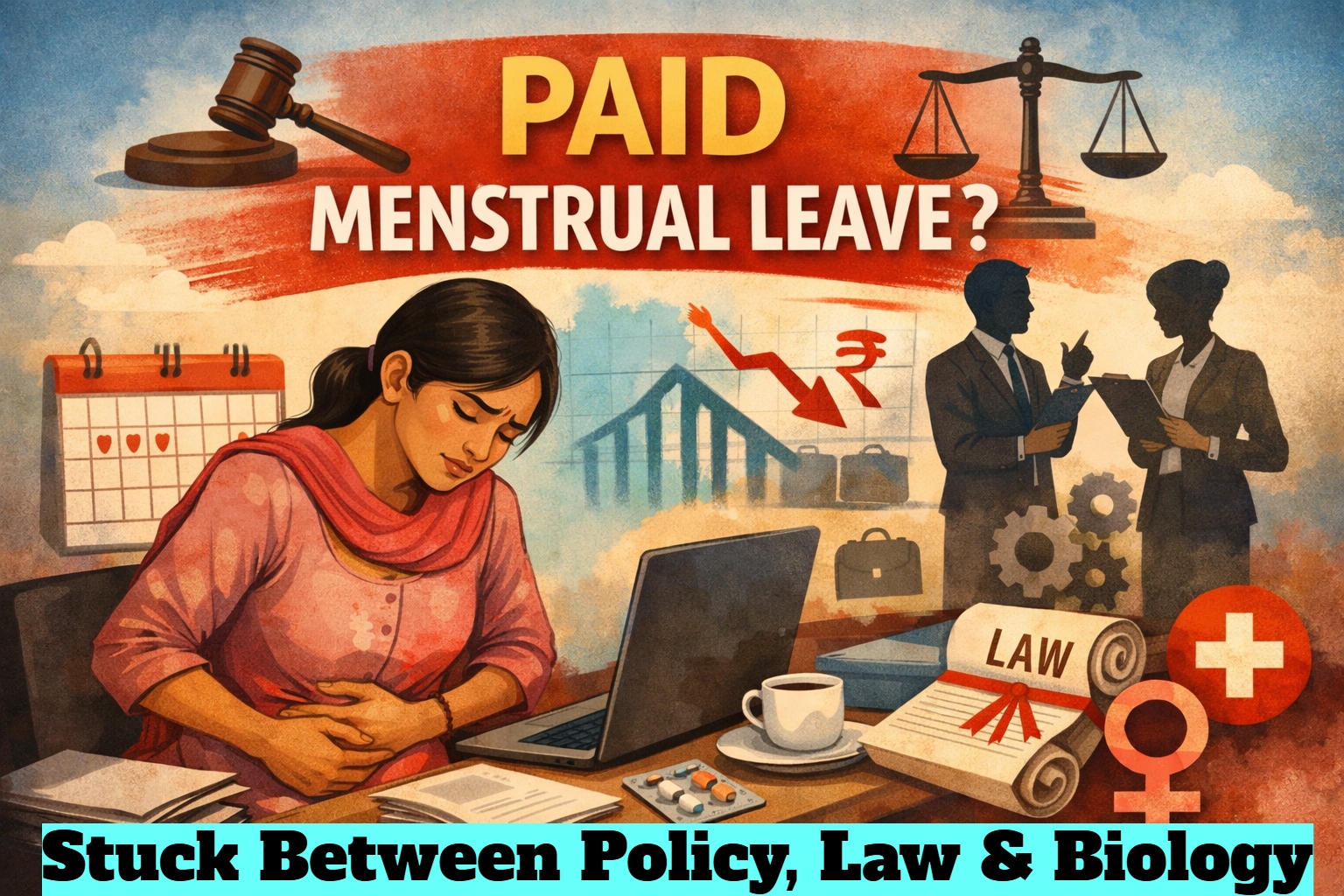
Paid Menstrual Leave: Stuck Between Policy, Law & Biology
 Editor-in-Chief of indiacommentary.com. Current Affairs analyst and political commentator. Author of Cyber Scams in India, Digital Arrest, The Money Trap and The Human Hack
View all posts by this Author
Editor-in-Chief of indiacommentary.com. Current Affairs analyst and political commentator. Author of Cyber Scams in India, Digital Arrest, The Money Trap and The Human Hack
View all posts by this Author
By Sunil Garodia
First publised on 2026-03-18 13:05:05
About the Author
Editor-in-Chief of indiacommentary.com. Current Affairs analyst and political commentator. Author of Cyber Scams in India, Digital Arrest, The Money Trap and The Human Hack
View all posts by this Author
The Supreme Court's refusal to mandate menstrual leave nationwide was not a dismissal of women's health. It was a wager that compulsion, in this case, could cause more harm than it cures. In a labour market where women's participation remains low and hiring biases persist, any additional statutory burden risks being quietly priced into employment decisions.
This tension is not unique to India. Across the world, governments have experimented with menstrual leave, but the outcomes have been uneven and instructive.
Countries such as Japan and South Korea have long had provisions allowing women to take time off during menstruation. Yet, these policies are often underutilised. The reason is not lack of need, but workplace culture. Many women hesitate to invoke such leave for fear of being seen as less capable or less committed. A right on paper does not automatically translate into acceptance in practice.
More recently, Spain became one of the first European countries to introduce paid menstrual leave as part of a broader reform of reproductive health policy. The move was widely hailed as progressive, but it has also reopened familiar concerns. Employers, particularly in small and medium enterprises, have raised questions about costs and operational disruption. Even supporters of the policy acknowledge that its long-term impact will depend less on legislation and more on how workplaces internalise it.
Menstrual leave sits at the intersection of health, culture and economics. A rigid mandate may recognise the first, but it cannot by itself resolve the latter two.
India's challenge is sharper. Unlike advanced economies with higher female workforce participation and stronger social security nets, India's labour market is still negotiating the basics of inclusion. Women already face structural disadvantages shaped by expectations around maternity, caregiving and flexibility. In such a setting, a compulsory menstrual leave policy could reinforce the perception that hiring women entails additional costs. That perception, however unjust, has real consequences.
At the same time, to dismiss menstrual health as a private matter would be equally flawed. For many women, menstruation involves significant physical discomfort. Conditions such as dysmenorrhea (painful, often crampy menstruation) can affect productivity in ways that are neither trivial nor rare. A framework that ignores this reality risks reducing equality to a formal slogan.
The Constitution itself offers guidance. Equality before the law coexists with the possibility of targeted protections. Indian labour law has long reflected this balance, most notably through maternity benefits. The 2017 Maternity Benefit Amendment offers a partial precedent: employers raised identical objections then - cost, disruption, competitive disadvantage - yet compliance held because maternity is a defined, bounded event amenable to actuarial planning. Menstruation is monthly, variable in severity, and individually experienced, which makes it a policy challenge of similar sensitivity but far less tractable design.
Legal compulsion without cultural readiness can blunt the very objective it seeks to achieve, a pattern visible from East Asia to Europe.
India would therefore be better served by a calibrated approach. Instead of a blanket mandate, policymakers could encourage flexible leave structures that allow employees to draw from a common pool without mandatory disclosure. Workplace health support, including access to medical consultation and awareness programmes, would address the issue more directly. Equally important is the need to normalise conversations around menstrual health, breaking the silence that still surrounds it in many parts of the country.
The question is not whether menstrual leave is justified, but how it is designed. Equality in the workplace cannot be reduced to identical treatment, nor can it be secured by policies that inadvertently deepen bias.
The Court's position reflects a caution that global experience seems to validate. The task now is not to abandon the issue, but to approach it with greater precision. Policies must be designed to support women without making them appear costlier to employ.
A policy designed to ease the workplace must not become the reason women are kept out of it.
Note: The lead image is designed by AI. The caption is ours