

The Wangchuk Climbdown
 The India Commentary view
View all posts by this Author
The India Commentary view
View all posts by this Author
By Our Editorial Team
First publised on 2026-03-18 12:18:39
About the Author
The India Commentary view
View all posts by this Author
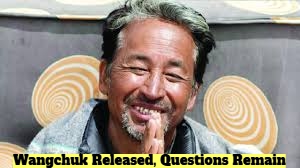
The Centre's decision to revoke Sonam Wangchuk's detention under the National Security Act (NSA) is less a correction than a retreat under pressure, legal, political and moral.
Wangchuk walked out of detention on March 14, nearly six months after being picked up following protests in Ladakh that turned violent and left four dead. The government had justified the move by linking his speeches to unrest in a strategically sensitive region. That claim now sits on shaky ground, not because new facts have emerged, but because the State itself has chosen not to defend them.
The timing is the story. The revocation came days before the Supreme Court was set to examine the legality of the detention. Governments do not lightly withdraw NSA orders, especially not in cases framed as national security concerns. When they do, it usually signals one thing. The evidentiary and procedural foundation may not survive judicial scrutiny.
Even as the Centre defended the detention earlier, it argued that Wangchuk's custody had helped restore normalcy in Ladakh. If that was indeed the case, what changed. Either the threat no longer exists, which raises questions about its original assessment, or the State has reassessed the sustainability of its legal position.
More fundamentally, the case exposes a familiar pattern, the use of preventive detention as a substitute for political engagement. The NSA allows the State to detain individuals without trial for extended periods, with limited safeguards and no conventional bail process. It is a law designed for exceptional threats. Its repeated deployment against activists and dissenters suggests a lowering of that threshold.
Wangchuk is not an obscure agitator. He is a public figure whose demands, statehood and Sixth Schedule protections, reflect a broader unease in Ladakh after its conversion into a Union Territory without a legislature. The protests that followed were not conjured in isolation. They were rooted in anxieties over land, identity and political voice. Even after his release, Ladakh groups have reiterated that their movement is not anti-national, but constitutional.
That distinction matters. Democracies are tested not by how they treat conformity, but by how they respond to dissent, especially dissent that is organised, peaceful and grounded in constitutional claims. By invoking the NSA, the State effectively collapsed that distinction, equating protest with threat.
The government may argue that the protests did turn violent. That is true. But the leap from a law and order breakdown to national security detention must be justified with precision, not presumption. Preventive detention is not meant to be a blunt instrument deployed after the fact. It is a narrowly tailored power meant to pre-empt demonstrable threats. The difference is not semantic. It is constitutional.
There is, however, one constructive outcome. The episode may yet force a judicial reckoning. If the Supreme Court proceeds to lay down clearer principles governing the use of the NSA, it would serve a larger public purpose. Preventive detention laws in India have long operated in a grey zone, legally sanctioned, but often loosely applied.
The Centre now has an opportunity to reset. Revoking one detention order is not enough. It must address the underlying political demands in Ladakh through dialogue, not detention. It must also demonstrate that extraordinary laws will be used with restraint, not convenience.
Because the real issue is no longer Wangchuk's incarceration. It is the precedent his detention attempted to set, and the one its withdrawal has quietly undone.