

oppn parties Mindless and Unchecked Hindu Vigilantism is Criminal
News Snippets

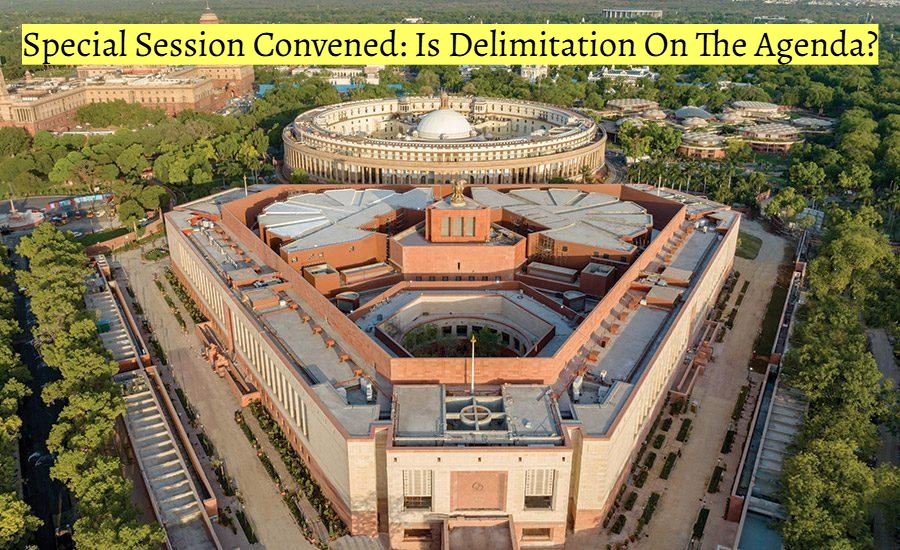
  • The Union government announced a four-day sitting of Parliament from November 30 to December 3, with the Lok Sabha scheduled to reconvene on November 30 and the Rajya Sabha on December 2. Parliamentary Affairs Minister Kiren Rijiju said the purpose was to transact essential government business, but speculation over possible legislation on delimitation has intensified
  • Opposition parties marked Constitution Day with demonstrations in several states, demanding accountability from Chief Election Commissioner Gyanesh Kumar and raising allegations of irregularities in electoral-roll revision. Congress president Mallikarjun Kharge led the Samvidhan Raksha campaign in Lucknow.
  • The Supreme Court ruled that the adjudicating authority under the Prevention of Money Laundering Act must include a judicial member when confirming property attachments, although its chairperson need not necessarily be a judicial member
  • The Supreme Court quashed the Bihar government's 2023 decision granting premature release to former MP Anand Mohan, convicted in the 1994 murder of IAS officer G Krishnaiah, and directed him to surrender within one month. The Court also struck down the prison-rule amendment that had enabled his release, holding the decision legally unsustainable
  • The Supreme Court directed the Food Safety and Standards Authority of India to prepare revised front-of-package nutrition-labelling regulations within 10 weeks, requiring separate warnings for products high in sugar, salt and saturated fat. The Court rejected the regulator's earlier proposed framework and directed it to recalculate nutrient thresholds
  • India's foodgrain production reached a record 378.54 million tonnes in 2025-26, an increase of 20.81 million tonnes over the previous year, according to the Agriculture Ministry's final estimates released on November 26. The government also estimated kharif foodgrain production for 2026-27 at 167.14 million tonnes
  • Tamil Nadu Governor R N Ravi urged Chief Minister C Joseph Vijay to intervene in filling vacant university vice-chancellor positions and address pending university convocations
  • Indian money markets are signalling the possibility of a 50-basis-point RBI interest-rate increase at the December 2-4 monetary policy meeting, although most economists continue to expect a 25-basis-point hike. October retail inflation rose to 6.09%, exceeding the RBI's upper tolerance limit of 6%. Rising Treasury bill yields and interest-rate swaps indicate concerns about the persistence of inflation
  • The Reserve Bank of India has authorised the National Stock Exchange to introduce futures contracts linked to corporate bond indices, following an earlier clearance from SEBI. The proposed instruments will allow investors to hedge corporate bond portfolios and take positions on movements in bond valuations and credit spreads
  • Indian equity markets closed higher for the second consecutive session, with the Sensex gaining 390.31 points (0.46%) to 84,328.59 and the Nifty 50 advancing 65.25 points (0.25%) to 25,884.50
  • Kerala produced one of the day's outstanding performances in the Syed Mushtaq Ali Trophy, scoring 268 for four against Himachal Pradesh before restricting their opponents to 201 for six to win by 67 runs. Mumbai also registered a commanding 86-run victory over Uttarakhand, while Vidarbha defeated Chhattisgarh by 34 runs
  • Defending champions Treesa Jolly and Gayatri Gopichand advanced to the quarter-finals of the Syed Modi International Super 300 badminton tournament in Lucknow with a 21-9, 21-8 victory over compatriots Shreya Balaji and Pranavi Natarajan. In women's singles, Tanvi Sharma, Unnati Hooda, Anmol Kharb and Tasnim Mir also entered the last eight, giving India a strong presence in the knockout stages
  • Indian athletes enjoyed a productive second day at the BIMSTEC Under-23 Athletics Championships in Bhubaneswar. Vaibhav won the men's discus gold with a throw of 51.97 metres, ahead of compatriot Bharatpreet Singh, who secured silver with 49.63 metres. Roshan Shaikh also won the men's 110-metre hurdles, while Tamil Nadu's Sadhana Ravi captured the women's triple-jump gold with a leap of 13.24 metres
  • Rising Stars: Sri Lanka crush India by 8 wickets in the semifinals as bowlers lose their way after the batters score a competitive 317
  • MEA says notice for discrepancy in place of birth was issued to Saurav Das of CJP and he was advised not to use passport for 7 days
Supreme Court rebukes Vijay government in Tamil Nadu, says it acted in contempt, orders lighting of lamp at Deepathoon and suspended the board of trustees of Tamil Nadu's Arulmigu Subramaniaswamy temple /////// Big victory for Mamata Banerjee - Calcutta HC removes Ritabrata Banerjee of rival faction as Leader of Opposition in the Bengal assembly, says the Speaker must think afresh and provide proper reasoned order
oppn parties
Mindless and Unchecked Hindu Vigilantism is Criminal

By Sunil Garodia
First publised on 2016-07-20 13:24:21

About the Author

Sunil Garodia Editor-in-Chief of indiacommentary.com. Current Affairs analyst and political commentator. Author of Cyber Scams in India, Digital Arrest, The Money Trap and The Human Hack
The cow vigilante case in Gujarat, where self-styled protectors of Gau-mata stripped and thrashed four young dalits to punish them for “killing” a cow, reinforces one’s belief that by not acting against assorted splinter Hindutva forces in a befitting manner, the NDA government has allowed the mushrooming of thousands of such small groups who are not affiliated to any organization and are not answerable to anyone. They adopt this holier than thou attitude and shun mainstream Hindu organizations like the RSS or the Bajrang Dal for being too soft on those they consider enemies of Hinduism. They work as loners, and dish out their instant brand of retribution. Some months back, one such group had attacked a church in Chattisgarh. As of now, preventing killing of cows tops the agenda of such groups. Who knows what will catch their fancy next. These groups are highly dangerous as little is known about them. The government has to act fast and decisively against them as and when they are caught to let others like them know that such guerilla attacks will not be tolerated. The prime minister must also warn those who indulge in such acts in one of his Mann Ki Baat speeches.

Sonia Gandhi, for once, is not wrong when she says that this government condones social terror. If one considers the cascading effect of such condoning, one is sure that it is criminal. How and why have these groups come into being? What emboldens them to carry out their nefarious activities without fear? The answers to these questions are quite easy if one has been following recent events. At any point in most communities, there are several hotheads who are captivated by the doctrine of “them” and “us” and how “we” are superior to “them.” They get a lift when mainstream votaries of the doctrine start their propaganda war and carry out actions to try and assert their superiority. But the mainstream groups can only go thus far and no further. This disillusions these highly committed but unattached persons and they take it upon themselves to “help the cause” by doing what the larger groups cannot. They find like-minded persons, form a group and start attacking “them.”

Of course it helps to have a “friendly” government in place. The fear of prompt and punitive action against them is largely diminished. They are also secure in the knowledge that there will not be a sustained combing operation against them. They know they can carry out one such act, lie low for some time and strike again. There is an old saying in Hindi that “morey sainya bhaey kotwal, ab dar kahe ka” (loosely translated as when my friend is the sheriff, whom do I need to fear). This is what is happening. In the meantime, hate speeches by supposedly responsible politicians and self-styled godmen keeps refueling their commitment to the “cause” and even gives birth to more such groups.

But as a political party, the BJP must realize that these groups are harming its electoral prospects all over the country. If PM Modi is committed to sabka saath sabka vikas, he cannot allow these groups to sow seeds of mistrust in the minds of large sections of India’s population. In the run up to the 2014 Lok Sabha elections, Amit Shah had sold the growth idea to the dalit youth in UP. The results were spectacular for the BJP. Hence, the party should realize that even if it seeks the consolidation of the Hindu vote (which in itself is despicable in a secular country, as it again leads to the ‘us’ and ‘them’ scenario), no such consolidation is possible without the dalits, who are as much Hindu as the upper castes and who command a sizeable chunk of votes. Issues such as the Rohith Vemula suicide and the instant case in Gujarat will take the dalits away from the BJP, making it difficult for it to first win UP in 2017 and then the reelection in 2019. There is an urgent need of ridding the country of majoritarian terror, and it is in the interest of the BJP to do so.