


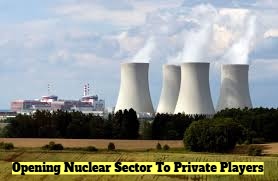
Nuclear Opening By India: What Private Participation Could Mean
 By our team of in-house writers.
View all posts by this Author
By our team of in-house writers.
View all posts by this Author
By admin
First publised on 2025-11-28 14:18:12
About the Author
By our team of in-house writers.
View all posts by this Author
Policy Reforms in Nuclear Sector
Prime Minister Narendra Modi's recent announcement that India will open the civil nuclear sector to private players marks a major shift in the country's energy strategy. For decades, nuclear power in India has been the exclusive domain of government-owned entities, mainly the Nuclear Power Corporation of India Limited. This monopoly was rooted in the Atomic Energy Act of 1962, which restricted nuclear operations to the public sector for reasons of national security, safety, and strategic control.
The new proposal, expected to take shape through the Atomic Energy Bill 2025, signals that the government is ready to rethink that model. India aims to expand its nuclear capacity from under ten gigawatts today to one hundred gigawatts by 2047. Reaching that target will require both capital and speed. Private participation promises both, along with innovation and a broader industrial ecosystem.
Why India is Considering Private Players
Opening the nuclear sector is driven by three clear motivations. First, the country needs large-scale, low-carbon electricity to meet rising demand while staying aligned with climate commitments. Second, the financial burden of building reactors is too heavy for the government alone. Third, there is a global shift toward newer technologies such as small modular reactors, which offer lower upfront costs and shorter construction timelines. These designs are attracting private innovators around the world, and India wants to be part of that wave.
Private participation could help compress long project timelines, introduce world-class project management practices, and bring in competitive efficiency. It can also stimulate domestic manufacturing of reactors and components, creating high-skill jobs and strengthening Indiaâs technological base.
What the World's Nuclear Leaders Do
In most advanced nuclear economies, the sector is a mix of public oversight and private operation. The United States allows private companies to build and run nuclear plants under a tight federal regulatory regime. Canada, South Korea, the United Kingdom, France, and Japan all follow variations of this model, where the government sets the standards, monitors compliance, and retains strategic control, while private companies focus on generation, innovation, and operations.
Two global trends stand out. The first is the rise of independent, empowered nuclear regulatory authorities that function without interference. These bodies set safety norms, issue licences, enforce compliance, and publish transparent reports. The second is the growing emphasis on modular and advanced reactors that are easier to build, more cost-effective, and designed with passive safety features. Many countries support these technologies through public-private partnerships, tax incentives, and co-funded research programs.
What India Must Do to Make This Shift Safe and Profitable
India will need a strong framework to bring private companies into a sector as sensitive as nuclear energy. The first step is regulatory reform. The country needs a regulator with full statutory independence, clear authority, and transparent processes. Safety audits, environmental impact assessments, and incident reporting must be consistent and publicly accessible. Without trust in oversight, neither the public nor investors will feel secure.
Liability laws must also be clarified. India's existing liability framework has long been cited as a barrier to investment. Private operators need predictable rules, clear allocation of responsibility, and a well-capitalized insurance pool to cover potential accidents. Without such clarity, no private firm will risk participating in long-horizon nuclear projects.
Technology choices will matter as well. Small modular reactors and advanced reactor designs should be encouraged through targeted incentives. Their smaller footprint, lower cost, and built-in safety features make them better suited for private operators entering a complex field for the first time. These technologies also allow plants to be built in phases, reducing financial risk.
India should also consider a hybrid model for ownership and operation. The government can retain control over fuel supply, mining, waste disposal, and security-sensitive functions. Private companies can take responsibility for construction, maintenance, and operation under strict regulatory supervision. This approach allows India to safeguard strategic interests while benefiting from private efficiency.
Another essential factor is human capital. Private companies entering the field will need access to trained engineers, reactor operators, inspectors, radiation safety experts, and emergency responders. An industry-wide skill-development program, built in partnership with universities and public-sector institutions, will be necessary.
Finally, India should deepen its engagement with the international nuclear community. Technology partnerships, reactor co-development, fuel cycle management expertise, and shared safety practices will help India adopt the most advanced and reliable systems available.
Managing Risks Without Slowing Progress
Critics argue that nuclear energy is too sensitive for private players. Their concerns revolve around safety culture, cost-cutting tendencies, security threats, and the consequences of any accident. These are valid worries. The solution is not to shut the door on private participation, but to build a system where no operator can take shortcuts, and where transparency is the norm rather than the exception.
If the government manages to balance commercial incentives with strict oversight, India can avoid the pitfalls seen in other countries where nuclear projects ran over budget or suffered from lapses in safety.
A Turning Point for India's Energy Future
The decision to open the nuclear sector is bold. It could speed up reactor construction, bring innovation to the forefront, and help India reach its long-term climate and energy goals. It could also transform the country into a global hub for next-generation nuclear technologies.
But this opportunity comes with serious responsibilities. India must build a regulatory, legal, and technological foundation that protects national security, prioritizes public safety, and makes the sector profitable and predictable for private investors.
If the upcoming policy reforms deliver these elements, this shift could become a landmark moment for Indiaâs energy future.
(This article is partly generated with AI and edited comprehensively by humans)