

2025: The Year of AI
 By our team of in-house writers.
View all posts by this Author
By our team of in-house writers.
View all posts by this Author
By admin
First publised on 2025-12-30 06:51:27
About the Author
By our team of in-house writers.
View all posts by this Author
2025: The Year of AI
When Artificial Intelligence Stopped Being the Future and Became the Present
India Commentary declares 2025 as the Year of Artificial Intelligence - the year AI stopped being a subject of speculation and became part of society's operating system.
If 2023 was when the world discovered artificial intelligence, and 2024 was when it learned to use it, 2025 will be remembered as the year AI came of age. Not because the technology suddenly became powerful, but because institutions, workplaces, and individuals stopped treating it as an external tool and began reorganising themselves around it.
The question is no longer whether AI will reshape society. That argument is over. The only questions left are how it will be deployed, who will benefit, and who will absorb the cost of the transition.
From Tool to System
The defining shift of 2025 was agency. AI systems moved beyond responding to prompts and began executing goals. Models from OpenAI, Google, Anthropic and others could plan, coordinate and act across software environments with minimal human intervention - scheduling meetings, writing and debugging code, analysing data, managing workflows.
By the end of the year, delegating routine cognitive work to AI felt as unremarkable as using email. What had dominated headlines a year earlier receded into infrastructure. AI did not disappear; it embedded itself.
Work, Productivity, and Displacement
The workplace felt the change first and most sharply. Studies released through the year showed dramatic productivity gains from AI augmentation - alongside a contraction in entry-level hiring. Routine writing, analysis, design and customer support roles thinned out even as new functions emerged around AI supervision, compliance and quality control.
The four-day workweek gained traction at several large firms, not as ideology but as arithmetic. AI-augmented employees produced more in less time.
For India, the implications were structural. The IT services sector - long the backbone of white-collar employment - faced its first sustained stress test as routine coding and support work automated rapidly. Workforce restructuring announced by major firms made clear that the AI dividend would not be evenly distributed. In 2025, that reality could no longer be deferred.
Creativity Without Permission
In creative industries, AI crossed a psychological threshold. Text, music and video generation reached a level where cost, not capability, became the differentiator. Advertising campaigns, short films and music releases quietly incorporated AI elements at scale.
The backlash was fierce. Artists protested, lawsuits followed, and questions of authorship and compensation intensified. Yet adoption continued regardless. The debate shifted from whether AI should be used to how credit, ownership and regulation would be enforced in a world where creation itself had changed.
Education and Healthcare Adjust
Education systems learned - often belatedly - that banning AI was futile. After repeated cheating scandals, forward-looking institutions redesigned assessments around judgment, supervision and synthesis rather than rote output. Those that clung to memorisation watched their graduates struggle in AI-saturated workplaces.
Healthcare revealed AI's highest-stakes use. Diagnostic systems achieved accuracy levels that rivalled or exceeded specialists in narrow domains. Yet the paradox became clearer with each deployment: as machines handled analysis, the human role grew more important in explanation, ethics and care.
Regulation and the Crisis of Trust
Governments moved, but unevenly. Europe enforced its AI Act. The United States fractured along state lines. China accelerated deployment under tight political control. India released a draft framework but lagged on implementation.
Meanwhile, trust eroded faster than regulation could respond. Deepfakes entered electoral politics, public discourse and everyday communication. The danger was no longer simply deception, but deniability - the steady collapse of shared confidence in what is real.
Why India Commentary Marks 2025 as the Year of AI
We mark 2025 as the Year of AI because this was the year artificial intelligence embedded itself into infrastructure - how work is done, how knowledge is produced, how decisions are shaped, and how society organises itself.
This is not a celebration, nor a warning for its own sake. It is documentation. For India in particular, AI forces hard questions about employment, education, governance and economic strategy that can no longer be postponed.
The AI era is not approaching. It has already arrived.
The only choice left is whether we shape it deliberately - or allow it to shape us by default.
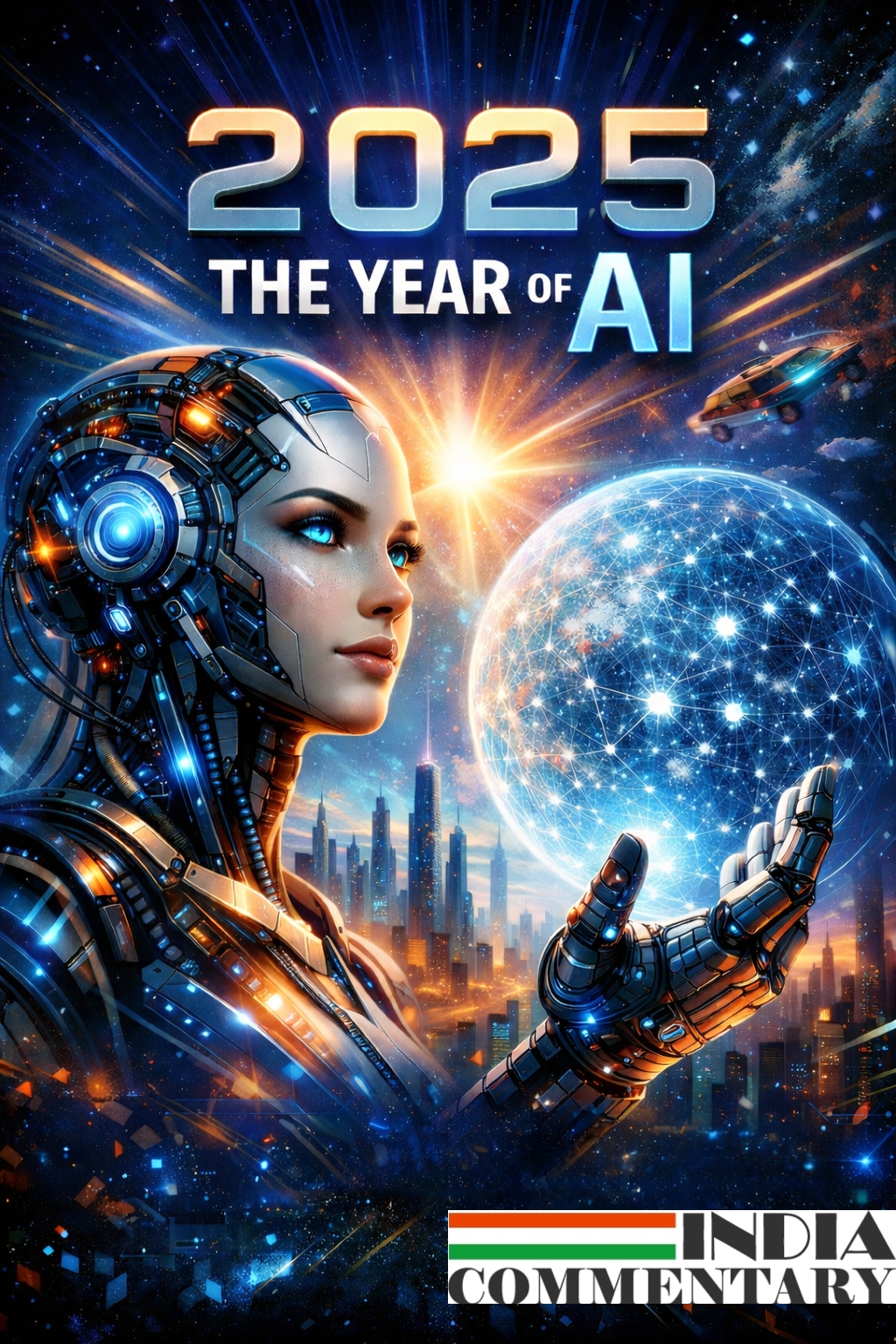
Note: In keeping with the subject, the article and the lead picture were generated with AI