

The Sanchar Saathi Outrage And Our Convenient Silence On Bloatware
 Editor-in-Chief of indiacommentary.com. Current Affairs analyst and political commentator. Author of Cyber Scams in India, Digital Arrest, The Money Trap and The Human Hack
View all posts by this Author
Editor-in-Chief of indiacommentary.com. Current Affairs analyst and political commentator. Author of Cyber Scams in India, Digital Arrest, The Money Trap and The Human Hack
View all posts by this Author
By Sunil Garodia
First publised on 2025-12-08 05:39:39
About the Author
Editor-in-Chief of indiacommentary.com. Current Affairs analyst and political commentator. Author of Cyber Scams in India, Digital Arrest, The Money Trap and The Human Hack
View all posts by this Author
For a few days this week, India's digital policy looked uncomfortably like Russia's. A quiet order from the Department of Telecommunications directed smartphone makers to pre-install the government's Sanchar Saathi "cybersecurity" app on all new phones within 90 days - and to push it to existing devices through updates. Reports suggested the app would be non-removable.
The backlash was swift. Privacy advocates warned of a surveillance backdoor. Tech companies balked. Within days, the government stepped back, clarified that Sanchar Saathi is "optional", and rolled back the mandatory pre-installation requirement. That retreat was welcome. A state-mandated, undeletable app with sweeping permissions has no place on citizens' phones in a constitutional democracy.
But there is a striking paradox in how we are framing this debate.
We are furious when the Centre tries to push its app onto our phones. We are strangely calm - even indifferent - when handset makers and telecom operators do exactly the same thing, stuffing our devices with their own or paid third-party apps that we never asked for, often cannot remove, and which quietly harvest our data for profit.
If privacy is the principle, it cannot be applied selectively.
Sanchar Saathi itself is not the villain. As a platform, it brings together functions such as blocking lost or stolen phones, checking how many SIM cards are issued in your name, and reporting fraud calls or messages. In a country sinking under the weight of digital scams, these are legitimate public-interest utilities.
The problem was never the idea of a telecom-security app. The problem was compulsion, opacity and the attempted creation of an undeletable, all-permission government presence on over a billion devices - via an executive instruction, not an open legislative process. That is where fears of surveillance, mission creep and political misuse become real, even if the present version of the app does nothing of the sort today.
But let us be honest for a moment about what we already tolerate from private actors, often without even glancing at the permissions screen.
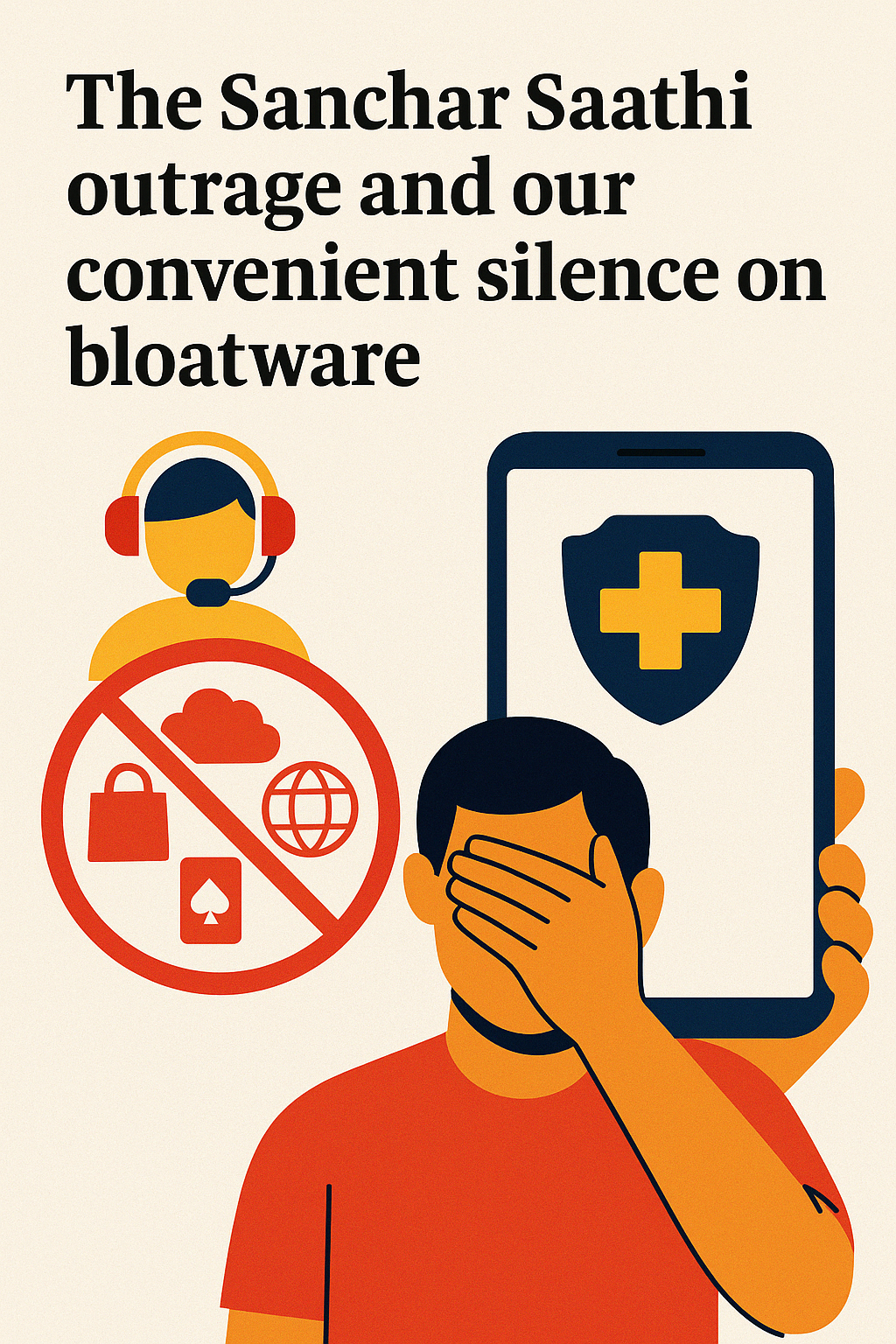
Anyone who has bought a budget or mid-range Android phone in India knows this problem intimately. The phone switches on, and before the first call is made, it is already crawling with vendor stores, "cloud" apps, browsers you never asked for, gambling games, shopping apps and battery "optimisers" that refuse to leave. Many cannot be uninstalled without technical tricks that most users will never attempt.
These are not harmless irritants. Security researchers have repeatedly flagged pre-installed apps as a major vulnerability precisely because they enjoy deeper system-level access than normal downloads. They run silently in the background, collect metadata, and widen the attack surface for hackers - all without informed consent. The user is told to fear state surveillance, but is rarely told how much data is already moving out of the phone every day in the name of "personalisation" and 'user experience".
We have seen where this leads globally. Budget smartphones sold in parts of West Asia and Africa were recently found to be shipping with embedded system apps that users could not uninstall and which allegedly collected sensitive information, including biometric data, without transparent disclosure. In the United States, telecom carriers have openly pitched advertisers on the opportunity to pay for pre-installation slots on devices. The business model is no secret: your phone is also an advertising surface.
So when we say "Sanchar Saathi will be used to watch us", intellectual honesty demands we complete the sentence - "as will many of the apps already sitting quietly on our phones, except they do it for profit, not policy."
What the Centre briefly attempted - embedding a permanent state presence inside every smartphone - has an uncomfortable global parallel. Russia has legally mandated preloaded domestic software on all devices sold there, and more recently ordered the pre-installation of a state-backed messaging app integrated with government services. The argument is national security. The result is a digitally fenced population.
India flirted with that model for a moment. Thankfully, it stepped back. But if we truly care about digital rights, our ambition cannot be limited to saying no to "Russian-style" state apps while tolerating Silicon Valley- and Shenzhen-style commercial surveillance.
Some democracies have begun to correct this imbalance. South Korea forced carriers to allow deletion of most preloaded apps except those strictly necessary for core functions. The European Union's Digital Markets Act now compels "gatekeeper" platforms to let users uninstall default apps and change settings freely instead of being trapped in pre-decided ecosystems.
India, by contrast, remains stuck in an executive-order culture. One day an app is pushed in the name of security. The next day it is withdrawn after outrage. The larger structural question is never addressed: who truly controls the Indian smartphone - the user, the government, or the handset company's monetisation partners?
The Sanchar Saathi episode should not end as just another short-lived controversy. It should force three hard policy shifts.
First, cybersecurity measures that touch every citizen's device must follow due process and public consultation. No secretive directives circulated to manufacturers. No fait accompli.
Second, there must be a clear, technology-neutral rule: every non-essential app - whether pushed by the state, the phone maker, the carrier or a commercial partner - must be removable. Deep permissions must be opt-in, not buried in fine print.
Third, and most uncomfortable, we need to confront our own selective outrage. We cannot shout "Big Brother" when the Centre is involved and fall silent when companies we admire exploit the same architecture of coercion more quietly.
The government was wrong to try and mandate Sanchar Saathi. But mobile companies are equally wrong when they turn phones into data-harvesting kiosks tied to advertising contracts and ecosystem lock-ins. One is about power. The other is about profit. For the citizen on the receiving end, the loss of control feels exactly the same.
If privacy is the line in the sand, then it must be drawn against everyone - ministers, manufacturers, telecom companies and the app marketeers who make money off our indifference.
Note: Lead image created with AI