

An Agreement Is Not a Suggestion: The Government Must Choose Between Keeping Its Word and Losing the Streets Again
 Editor-in-Chief of indiacommentary.com. Current Affairs analyst and political commentator. Author of Cyber Scams in India, Digital Arrest, The Money Trap and The Human Hack
View all posts by this Author
Editor-in-Chief of indiacommentary.com. Current Affairs analyst and political commentator. Author of Cyber Scams in India, Digital Arrest, The Money Trap and The Human Hack
View all posts by this Author
By Sunil Garodia
First publised on 2026-07-27 16:19:59
About the Author
Editor-in-Chief of indiacommentary.com. Current Affairs analyst and political commentator. Author of Cyber Scams in India, Digital Arrest, The Money Trap and The Human Hack
View all posts by this Author
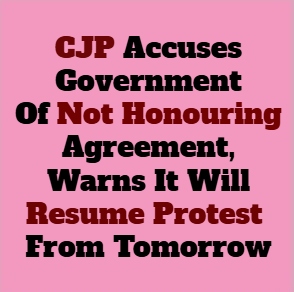
The warning from the CJP that it will return to Jantar Mantar from tomorrow should concern the Union government, not because another protest is unusual in a democracy, but because it suggests that a settlement announced barely days ago is already beginning to unravel. Governments negotiate to end crises, not merely to pause them. When a protest is called off because the State promises to withdraw prosecutions, release detainees and end harassment, that promise ceases to be a political assurance and becomes an administrative duty. If the Centre fails to honour that duty, the country may soon find itself back where it started, in a confrontation that serves neither the government nor the students.
That is the unmistakable message in the Cockroach Janta Party's announcement that it will resume its agitation from Tuesday unless the Union government fulfils the commitments it made to end the thirty-seven-day standoff. According to the CJP, the agreement envisaged the withdrawal of FIRs against student protesters, the release of those detained and an end to police action against participants in the movement. Instead, the organisation alleges that arrests have continued in states such as Bihar and West Bengal while students in Delhi and Uttar Pradesh continue to face surveillance and harassment. Whether every allegation ultimately proves correct is almost beside the point. What matters is that an agreement reached to restore normalcy is already being questioned by one of its signatories.
The logic of the government's obligation is neither novel nor complicated. Agreements reached in moments of political crisis derive their value not from the press conference announcing them but from the administrative machinery that follows. A settlement implemented only in speeches is no settlement at all. Once the government has publicly undertaken to withdraw cases and end coercive action, the burden shifts to it to ensure that the promise translates into orders on the ground.
Where the Centre and its own party units govern, the road from assurance to compliance runs through a single instrument: executive direction. Police forces answerable to governments led by the ruling party do not require constitutional innovation to review or withdraw cases falling within the agreed framework. They require instructions. Bihar sits squarely in this category. So, since the BJP's victory in the 2026 Assembly election, does West Bengal under Chief Minister Suvendu Adhikari. If protesters continue to be detained in states governed by the very party whose central leadership announced the settlement, that is not a jurisdictional puzzle. It is a failure to honour an agreement, plain and simple.
West Bengal, in fact, exposes the central contradiction more sharply than any constitutional debate could. The state government has reportedly maintained that no genuine CJP member or student protester is among those facing prosecution and that those arrested are separatist Kamtapuri elements, Jamaat affiliates or other anti-national actors whose cases bear no relation to the student movement. Were that assertion made by a government that had no connection with the Delhi settlement, it would at least raise a question of differing political assessments. Coming from a BJP government whose own party leadership entered into the agreement, it raises a more uncomfortable question. If the Centre promised relief to student protesters while a BJP state claims none of those in custody are student protesters at all, who determines where that line is drawn?
That question cannot be answered through political labels. Otherwise, every state government would possess a ready-made escape route from any future settlement. It would merely have to redefine those in custody as something other than protesters. An agreement that can be defeated simply by changing the description of the accused is no agreement at all.
No settlement of this kind requires the State to abandon prosecutions for genuine acts of violence. Agreements of this nature are ordinarily understood to protect those whose only offence was participation in peaceful protest. If an individual is alleged to have committed arson, assault or acts amounting to terrorism, those allegations should proceed through the ordinary criminal process, settlement or no settlement. The difficulty arises when governments invoke such labels indiscriminately, sweeping an entire batch of protest-related arrests under a description grave enough to place them beyond the settlement's reach, in order to avoid implementing the agreement itself.
If the State's official position is that those in custody are Jamaat-linked or otherwise anti-national rather than caught up in the agitation, then it follows that the State believes there are no student cases left to withdraw. That is a claim that deserves judicial scrutiny, not political acceptance. Allegations of extremist association require case-specific evidence, intelligence inputs, surveillance records or other admissible material, not labels applied wholesale to everyone arrested during a protest. If the evidence exists, it should be placed before a magistrate. If it does not, the label cannot substitute for proof.
The episode also poses an uncomfortable challenge for the CJP itself. An organisation that successfully compelled the Union government to negotiate is now discovering that securing a promise is easier than ensuring its implementation. Sonam Wangchuk's fast, JP Nadda's handshake and the written assurance reportedly promised by Tuesday will mean little if governments led by the same political party continue to prosecute those whom the Centre had undertaken to protect. The CJP's pressure must therefore remain focused not merely on New Delhi but on ensuring that every BJP government implements what the party's national leadership agreed to.
The country genuinely cannot afford another prolonged confrontation over an issue that should already have been resolved. The earlier agitation extracted a significant political and administrative price from the government. Reopening the same conflict because implementation failed to match reconciliation would be an entirely self-inflicted wound.
Governments are entitled to prosecute genuine criminals. They are not entitled to promise an amnesty with one hand while quietly undoing it with the other. A settlement announced before television cameras but ignored in police stations is no settlement at all. It is simply an invitation to return to the streets.