

Anahat Singh Wins the Title Indian Squash Never Could
By A Special Correspondent
First publised on 2026-07-27 07:42:03
About the Author

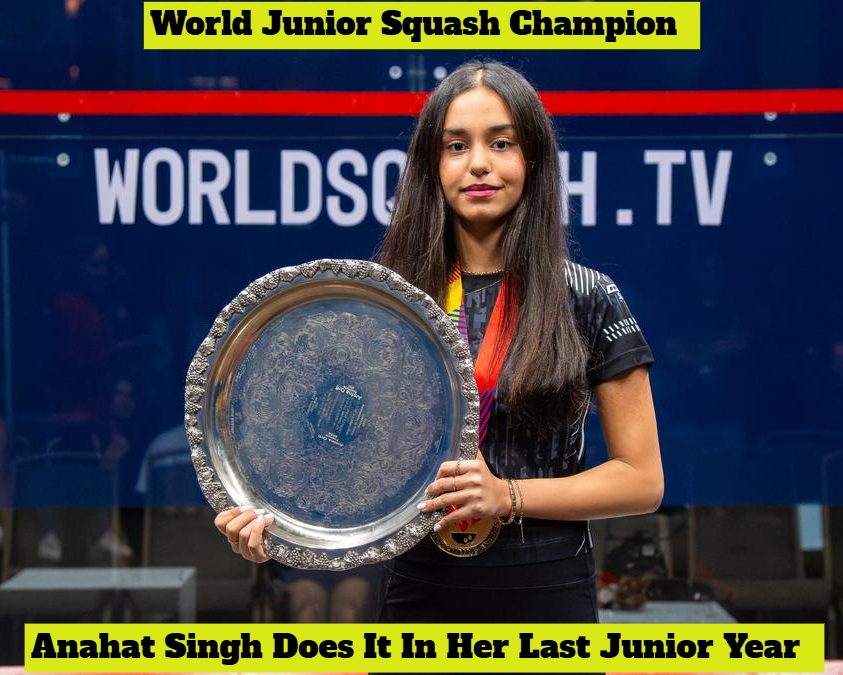
For sixteen years, the World Junior Squash Championship for girls had an unofficial owner. Egypt did not merely dominate the event; it owned it, producing champion after champion with the kind of assembly-line regularity that Indian sport reserves for its excuses. On Saturday in Niagara-on-the-Lake, an eighteen-year-old from Delhi named Anahat Singh walked onto court as the top seed, beat Ruqayya Salem 11-3, 11-7, 11-9, and did something no Indian, man or woman, had managed in the history of the tournament: she won it. Not a bronze. Not a plucky final-four exit dressed up as progress by a press release. The title itself.
The scale of it deserves to be stated plainly before the inevitable garlanding begins. Anahat did not sneak past a depleted draw. She beat three Egyptian players in succession, Habiba Rizk in the quarterfinal, Barb Sameh in the semifinal, and Salem in the final, dropping just two games across six matches in the process. The last non-Egyptian to win this title was an American, Amanda Sobhy, back in 2010. India's previous best was Joshna Chinappa's runner-up finish in 2005, a result that stood unmatched for two decades because nobody came close to matching it. Anahat did not merely beat that mark. She retired it.
There is a certain grim comedy in the timing of her achievement. This was, by her own account, her last realistic shot at the title, having spent four years losing in the quarters and semis to a tournament she half-joked was cursed for her. It is also, not coincidentally, the year she has effectively graduated to the senior circuit, where she already sits at World No. 20. The junior crown arrived not as a beginning but as the final seal on a chapter she had already outgrown.
What happens next will be instructive, and not necessarily in a way Indian sport will enjoy examining. Squash makes its Olympic debut at Los Angeles 2028, which means Anahat's rise has been synchronised, almost too neatly, with the sport's arrival on the one stage that reliably shakes loose government attention and corporate sponsorship in this country. It is worth asking what India's squash establishment, its federation, sponsors and sports administrators, was doing for Anahat during the years she was losing quarterfinals to Egyptian opponents nobody outside the sport had heard of. Champions in India have a way of discovering their federations only after winning, and federations have a matching habit of discovering their champions only after the same moment.
None of this is Anahat's problem to solve, and it would be unfair to let institutional inertia crowd out what was, on its own terms, a complete performance. She debuted for India at fourteen, became the country's youngest Commonwealth Games squash player and youngest Asian Games medallist in the sport, and has now added a junior world title that Indian squash spent twenty years failing to produce. The question worth sitting with is not whether she deserves the praise now arriving from the Prime Minister's office downward. She plainly does. The question is whether that praise will translate into the unglamorous, unphotographed work of building courts, coaches and competitive pathways for the next Anahat Singh, or whether it will do what such praise usually does in Indian sport: arrive on schedule, photograph well, and vanish the moment the cameras do.