

Aravallis: Licence To Pillage, Granted By Government, Stopped By Supreme Court
 Editor-in-Chief of indiacommentary.com. Current Affairs analyst and political commentator. Author of Cyber Scams in India, Digital Arrest, The Money Trap and The Human Hack
View all posts by this Author
Editor-in-Chief of indiacommentary.com. Current Affairs analyst and political commentator. Author of Cyber Scams in India, Digital Arrest, The Money Trap and The Human Hack
View all posts by this Author
By Sunil Garodia
First publised on 2026-01-02 12:50:56
About the Author
Editor-in-Chief of indiacommentary.com. Current Affairs analyst and political commentator. Author of Cyber Scams in India, Digital Arrest, The Money Trap and The Human Hack
View all posts by this Author
The Supreme Court's decision to stay its November 20 order on the Aravallis is not just a procedural pause. It is a rebuke to a way of thinking that treats one of the world's oldest mountain systems as a cartographic inconvenience.
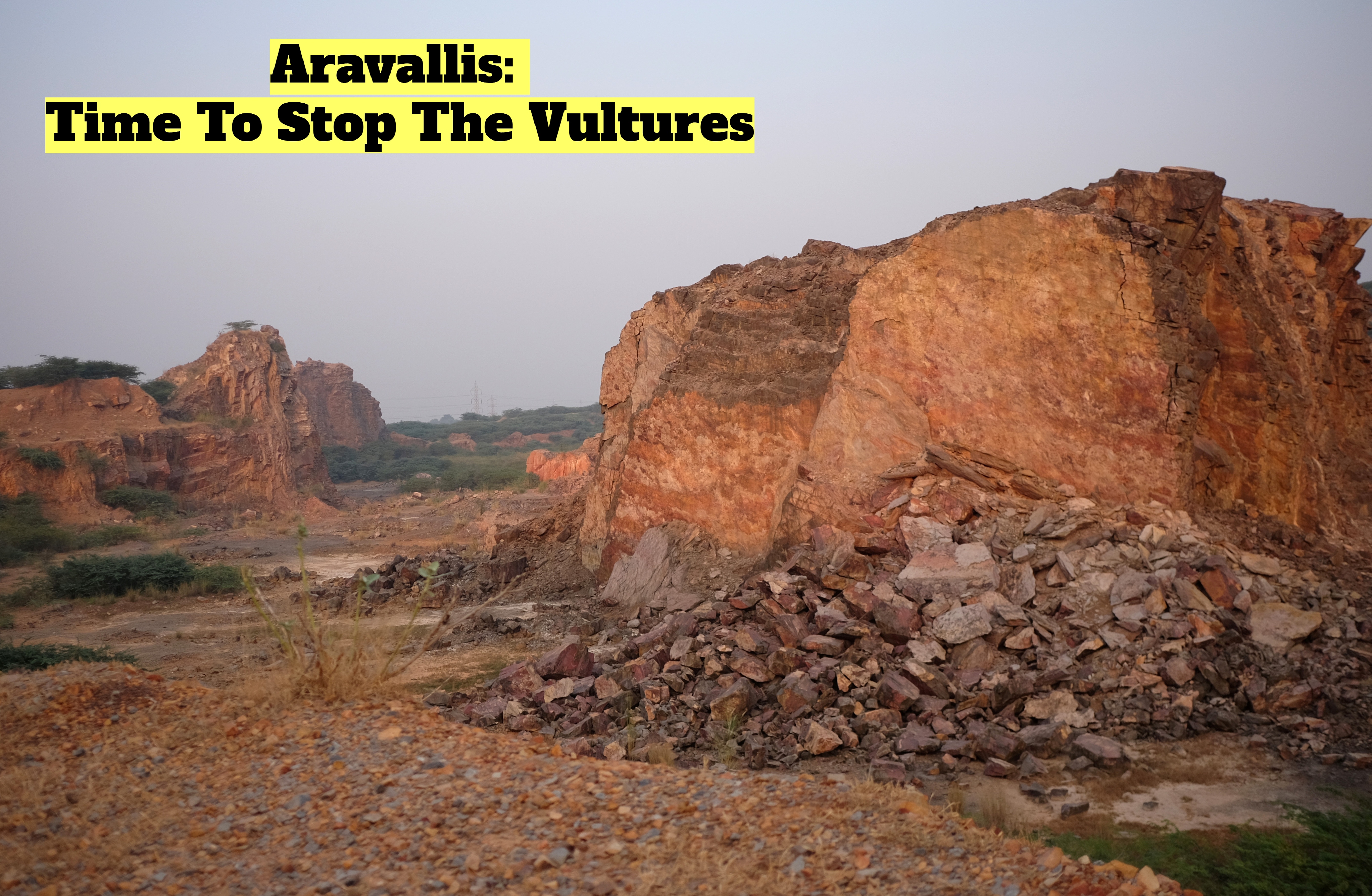
For months, the Union government has argued for a narrow, technocratic definition of the Aravallis. The now-suspended 100-metre elevation rule, drafted by a panel under the environment ministry, reduced a 650-km living ecosystem into a scatter of hillocks that barely qualify as mountains. It was a definition tailor-made to fail nature and favour extraction. If it had stood, vast tracts of the range would have been declared fair game for mining and construction, with the state retaining plausible deniability behind a ruler and a contour line.
That this approach collided with decades of settled jurisprudence should have been obvious. The Supreme Court of India has repeatedly held that the Aravallis must be seen as an integrated ecological system: hills, ridges, plateaus, forests and valleys functioning together. This understanding grew out of the Court's expansive forest doctrine since the mid-1990s and was sharpened by lived evidence. Fragment the system, and you fragment its protections. Elevation is not ecology.
The government's defence has been that a clear definition is needed to end regulatory chaos and stop illegal quarrying. That premise is sound. The execution is not. A definition that excludes more than 90 per cent of the range, as the Forest Survey of India warned, does not fix a deficit. It legalises it. The Court's own amicus curiae and the Central Empowered Committee said as much, cautioning that the rule would open the floodgates to mining. The protests in Rajasthan were not ideological theatre. They were a response to a policy that would have erased protections overnight.
This is not the first time such sleight of hand has been attempted. In 2010, the Court rejected a similar 100-metre threshold proposed by a state government because it ignored ecological integrity. In 2018, the Court recognised what residents of north India already know: even small Aravalli hills act as a barrier against pollution flowing into the Indo-Gangetic plain. Today, with winter smog choking cities and towns alike, that insight has become brutally concrete. Undercut the Aravallis and you thicken the air over millions of lungs.
The political geography of the problem makes the government's stance even harder to defend. The Aravallis run through Rajasthan, Haryana and Delhi - regions with a long record of bending environmental rules to accommodate mining, real estate and infrastructure. The Court's interventions over the years have been less about judicial overreach and more about compensating for executive reluctance. When the referee steps back, the game is rarely fair.
The three-judge bench led by Surya Kant was right to take suo motu notice of the backlash and to put the 100-metre rule in abeyance. The proposed expert committee now has a chance to restore common sense. It should begin with first principles: ecosystems do not respect arbitrary cut-offs, and conservation cannot be reduced to elevation alone. Mapping must reflect geology, hydrology, forest cover and connectivity, not just convenience.
The deeper problem, though, lies beyond this episode. The government's approach reveals a pattern: redefine, dilute, and then declare victory over "clarity". It is a familiar playbook in environmental governance. Instead of strengthening enforcement, it shrinks the field of protection. Instead of confronting illegal mining, it redraws the map so that mining no longer appears illegal.
The Aravallis are nearly two billion years old. They stabilise soils, recharge aquifers, moderate climate and shield a densely populated region from pollution. To treat them as a technicality is to misunderstand their value and to gamble with the future of north India. The Supreme Court's pause is a necessary course correction. Whether it becomes a lasting one will depend on whether the government abandons its minimalist definitions and accepts a simple truth: you cannot save a mountain system by pretending most of it does not exist.
It is clear that in India, whenever a settled question is sought to be re-examined by a panel, the changes suggested will mostly be ones dictated by corrupt politicians and bureaucrats, and designed by vultures in the form of miners, developers and other assorted pillagers who care a hoot neither for the country nor its ecological systems.