


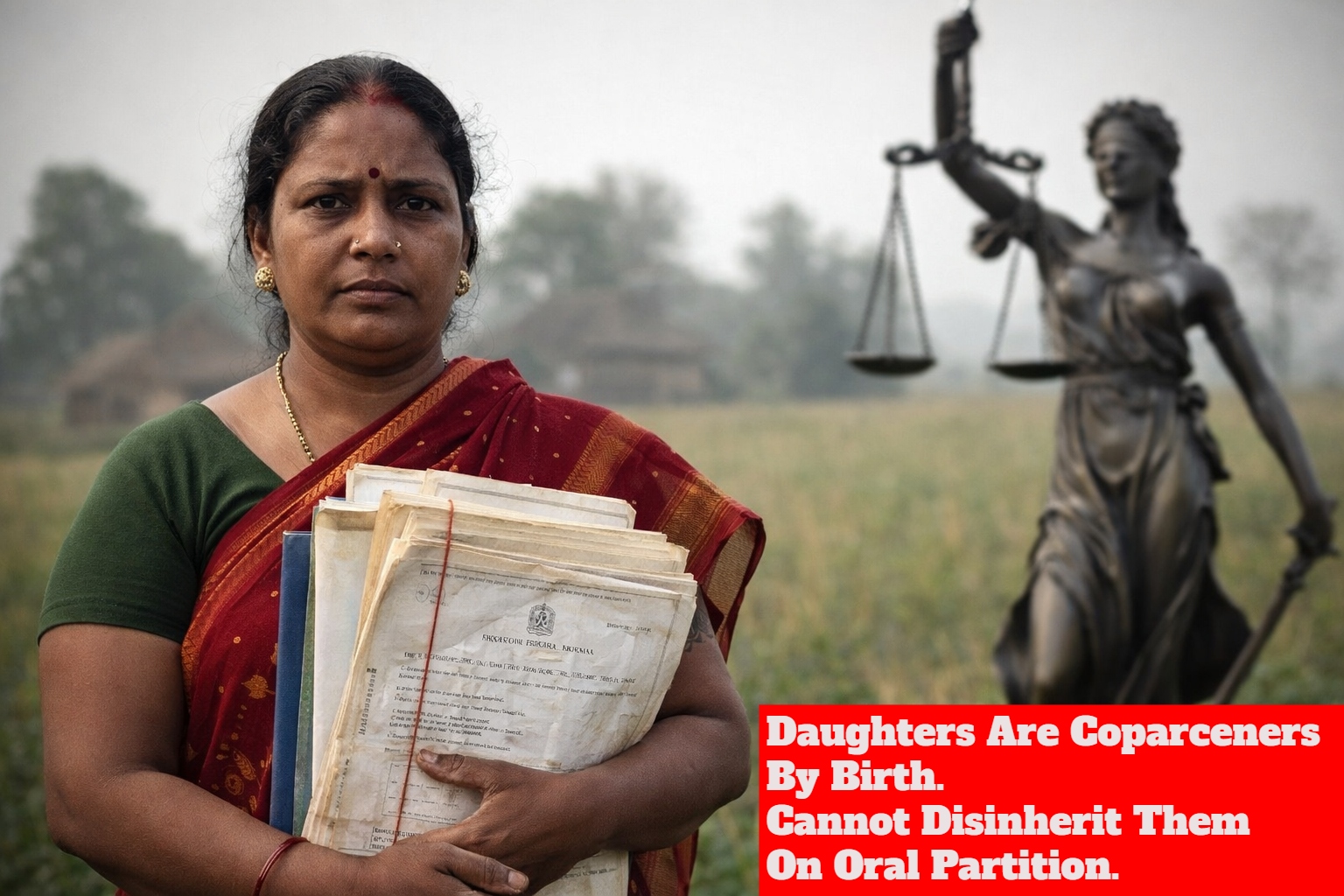
No Tricks Will Work As Daughters Are Coparceners By Birth
 Editor-in-Chief of indiacommentary.com. Current Affairs analyst and political commentator. Author of Cyber Scams in India, Digital Arrest, The Money Trap and The Human Hack
View all posts by this Author
Editor-in-Chief of indiacommentary.com. Current Affairs analyst and political commentator. Author of Cyber Scams in India, Digital Arrest, The Money Trap and The Human Hack
View all posts by this Author
By Sunil Garodia
First publised on 2026-02-04 11:48:01
About the Author
Editor-in-Chief of indiacommentary.com. Current Affairs analyst and political commentator. Author of Cyber Scams in India, Digital Arrest, The Money Trap and The Human Hack
View all posts by this Author
A recent judgment of the Chhattisgarh High Court has once again exposed a legal fiction that continues to deny women their rightful inheritance: the so-called oral partition. The court held, unequivocally, that a daughter cannot be denied her share in ancestral property on the basis of an alleged oral or informal family arrangement. In doing so, it reinforced settled law and pushed back against a practice that survives largely because courts once tolerated it.
The case involved a daughter claiming her share in ancestral agricultural land after her fatherâs death. The male heirs resisted the claim by asserting that the property had already been divided orally many years earlier and that the daughter stood excluded. There was no registered partition deed, no court decree, and no contemporaneous record - only assertions.
The High Court rejected this defence outright. It held that only partitions effected through a registered instrument or a court decree prior to 20 December 2004 can defeat a daughter's coparcenary rights. Oral partitions, however old or convenient, carry no legal weight.
This position flows directly from Section 6 of the Hindu Succession Act, 1956, as amended in 2005. The amendment made daughters coparceners by birth, granting them the same rights as sons in ancestral property. Parliament, conscious of how informal arrangements were routinely used to sideline women, deliberately recognised only documented partitions executed before the cut-off date. Everything else was excluded.
The Supreme Court put the matter beyond doubt in Vineeta Sharma v. Rakesh Sharma (2020). It held that a daughter's right is inherent by birth and does not depend on whether the father was alive when the amendment came into force. Crucially, the Court warned against accepting oral partition claims, noting that they are often raised only when a woman asserts her statutory rights.
Despite this clarity, oral partitions continue to be pleaded across trial courts, especially in rural and semi-urban India. They function less as genuine historical facts and more as post-hoc justifications for exclusion. Daughters are pressured to "adjust", and when they refuse, memory conveniently replaces documentation.
The Chhattisgarh High Court's ruling matters because it shuts the door on this evasion. It affirms that property rights are legal entitlements, not family favours. It also reinforces that delay, silence, or social pressure cannot be used to defeat equality granted by statute.
More broadly, the judgment signals a judicial shift away from accommodating "family arrangements" that perpetuate discrimination. Courts are no longer willing to trade constitutional equality for social convenience.
The message is clear: custom cannot override statute, and patriarchy cannot hide behind oral claims. A daughter's right to ancestral property is not negotiable. It is a birthright - and the law will enforce it.
Note: The lead picture is AI-generated and just an illustrative image.