

Fire At Goa Night Club: Policy Failure By Design
 The India Commentary view
View all posts by this Author
The India Commentary view
View all posts by this Author
By Our Editorial Team
First publised on 2025-12-09 02:25:47
About the Author
The India Commentary view
View all posts by this Author
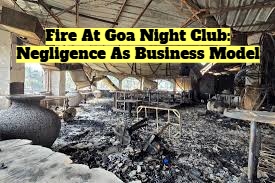
The fire at a packed nightclub in Goa is being called a tragedy. It is that. But it is also something far more disturbing: a direct outcome of a system where safety is negotiable and negligence is routine. What killed people was not just flame, but smoke, panic, delayed access and a reckless tolerance for risk in a confined, high-density space.
Most victims did not burn to death. They suffocated. That single fact exposes the real failure - of ventilation, evacuation design, fire readiness and emergency access. These are not unforeseeable risks in indoor nightlife venues. They are precisely the dangers regulators are supposed to neutralise before a single licence is issued.
Under the Bharatiya Nyaya Sanhita, causing death by negligence squarely applies when conduct shows reckless disregard for human life. Unsafe indoor effects, hazardous electrical loads, and the failure to anticipate smoke entrapment in a crowded enclosure are not technical lapses. They amount to gross criminal negligence. Where operators knowingly tolerate such conditions for profit, the moral and legal line moves perilously close to culpable homicide.
The Supreme Court in Jacob Mathew v. State of Punjab made it clear that criminal negligence arises when conduct displays a gross indifference to safety. That threshold is not abstract here. It is visible in every ignored precaution, every softened inspection, every diluted fire clearance.
Goa's nightlife economy thrives on density, darkness, alcohol and electricity - a combustible mix even on the safest day. Yet fire audits are ritualistic, emergency drills theoretical, and enforcement episodic. Clearances become paperwork, not protection. When disaster strikes, arrests come quickly. Accountability rarely does.
This fire was not caused only by a spark. It was caused by choices - to cut costs, to overlook hazards, to treat compliance as inconvenience. The flame merely completed the logic.
If this episode too ends with symbolic prosecutions and real impunity, the message will be unmistakable: in India, mass death is still treated as acceptable collateral in the business of entertainment.That is not tragedy. That is policy failure by design.