

IPL 2026 Auction: Big Money, Clear Priorities, and a Shift in Team Thinking
 Linus tackles things head-on. He takes sides in his analysis and it fits excellently with our editorial policy. No 'maybe's' and 'allegedly' for him, only things in black and white.
View all posts by this Author
Linus tackles things head-on. He takes sides in his analysis and it fits excellently with our editorial policy. No 'maybe's' and 'allegedly' for him, only things in black and white.
View all posts by this Author
By Linus Garg
First publised on 2025-12-16 13:12:46
About the Author
Linus tackles things head-on. He takes sides in his analysis and it fits excellently with our editorial policy. No 'maybe's' and 'allegedly' for him, only things in black and white.
View all posts by this Author
The IPL 2026 player auction, held today (December 16), underlined how decisively the league has moved into a phase where role clarity and flexibility matter more than reputation alone. While there were predictable bidding wars and a few headline-grabbing prices, the larger story of the day lay in how franchises chose to spend and, just as importantly, where they held back.
Across the table, teams showed a sharper understanding of squad balance, workload management, and the demands of modern T20 cricket. The excesses that once defined IPL auctions were visible only in flashes. For the most part, this was a disciplined exercise.
The defining moment came when Kolkata Knight Riders secured Cameron Green for a record fee, making him the most expensive overseas player in IPL history. The price reflected more than recent form. Green represents a rare combination in the T20 market: a top-order batter, a seam-bowling option, and an athlete who allows teams to rebalance their XI without compromising depth. For KKR, the bid was strategic rather than symbolic. Recent seasons have exposed their lack of middle-order stability and bowling flexibility, and Green addresses both issues in a single signing. The size of the investment also signalled a broader trend across the league: franchises are increasingly willing to concentrate resources on multi-dimensional players instead of spreading budgets thinly.
If overseas stars dominated the headlines, Indian players shaped the substance of the auction. Several uncapped and fringe domestic cricketers attracted aggressive bidding, particularly fast bowlers and all-rounders with strong domestic credentials or recent IPL exposure. Delhi Capitals' decision to invest heavily in a young pace prospect from Jammu and Kashmir stood out not merely for the price, but for what it represented. The IPL talent map is widening, and franchises now appear comfortable backing players from beyond traditional cricketing centres, provided the skill set is clearly suited to T20 conditions.
Chennai Super Kings, meanwhile, stayed true to their established philosophy. Their willingness to spend on young Indian players suggested long-term succession planning rather than short-term fixes. It was a reminder that CSK continue to view auctions less as a shopping spree and more as a mechanism to sustain continuity across seasons.
One of the more revealing aspects of the auction was how sharply the market corrected itself. Several players who had commanded extraordinary sums in previous editions were picked up at significantly reduced prices, while others went unsold. This was not a judgement on ability as much as a re-calibration of value. Franchises showed little interest in paying for reputation alone. What mattered instead was positional clarity, bowling phase utility, injury history, and likely availability across the season.
Team strategies reflected this new realism. Kolkata Knight Riders pursued impact players aggressively, prioritizing match-winners over bench depth. Chennai Super Kings focused on building a pipeline of Indian talent. Delhi Capitals balanced experience with high-upside domestic picks. Royal Challengers Bengaluru redistributed their budget more evenly after several top-heavy auctions in the past. Rajasthan Royals, Gujarat Titans, and Lucknow Super Giants largely stayed out of bidding frenzies, opting instead for targeted, role-specific additions.
Across franchises, there was a noticeable reluctance to overspend on specialist batters unless they offered exceptional strike-rate value or flexibility across positions. Bowling depth, particularly among Indian quicks, was treated as a premium asset.
Three broader trends emerged from the day. First, all-rounders remain the league's most valuable currency. Players who allow captains to shorten batting orders or rotate bowlers across phases continue to command disproportionate premiums. Second, the depth of Indian cricket is no longer treated as a constraint. Teams are increasingly comfortable trusting domestic players in high-pressure roles, reducing dependence on overseas slots. Third, discipline is replacing impulse. While the IPL will never lose its theatre, franchises now appear more data-driven and less reactive than in earlier seasons.
The IPL auction is often mistaken for spectacle divorced from cricketing logic. This year's event suggested the opposite. Beneath the big numbers was a league becoming more precise about what wins matches and sustains success over a long season. If the auction is any indication, IPL 2026 is likely to be shaped less by star power and more by balance, adaptability, and how intelligently teams deploy the resources they have just acquired.
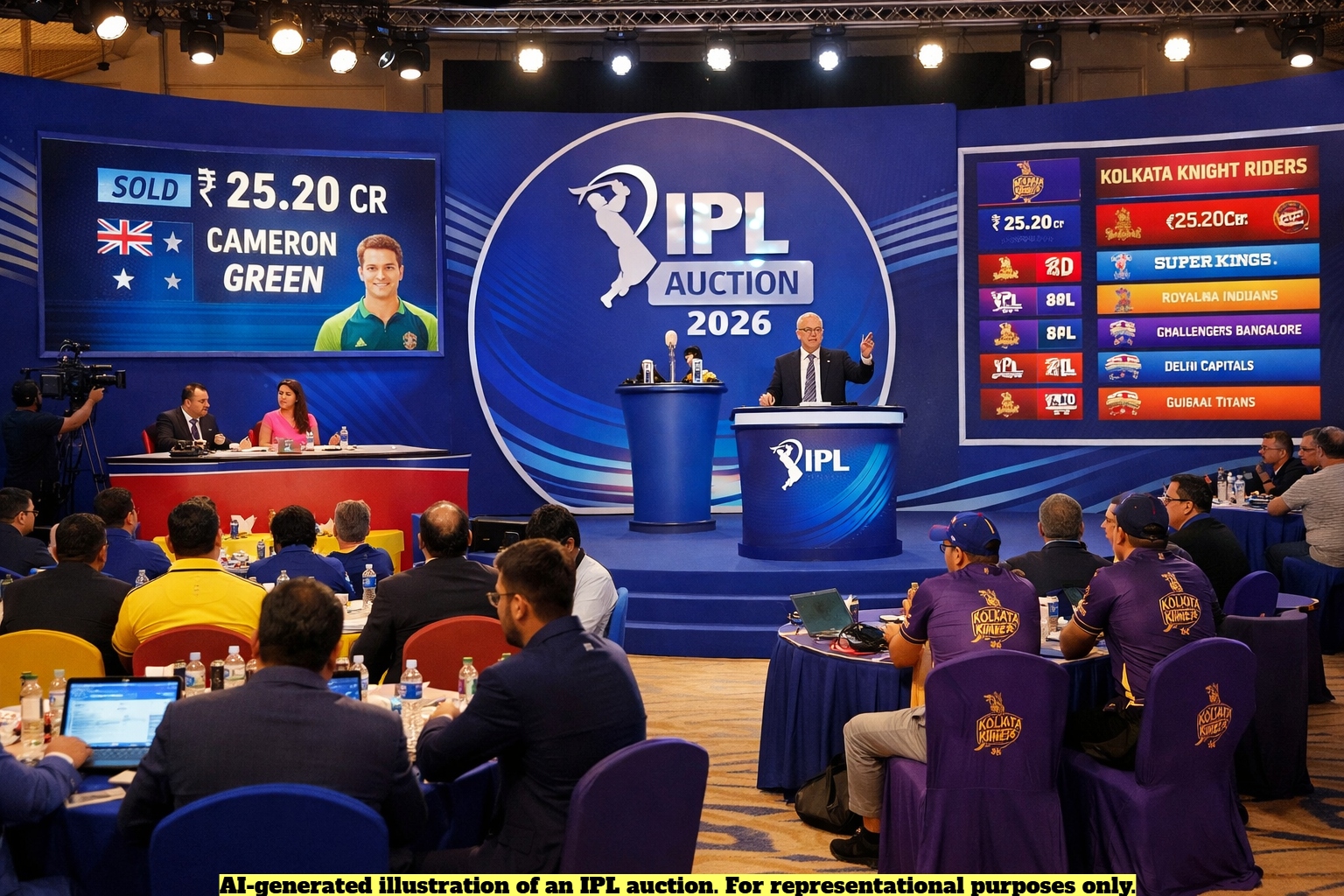
Lead image: An AI-generated illustrative image depicting a typical Indian Premier League auction setting, with franchise representatives bidding on players. The image is for representational purposes only and is not a photograph from the IPL 2026 auction.