

Rahul Gandhi's Audacity: The Man Who Forgot His Own History
 Editor-in-Chief of indiacommentary.com. Current Affairs analyst and political commentator. Author of Cyber Scams in India, Digital Arrest, The Money Trap and The Human Hack
View all posts by this Author
Editor-in-Chief of indiacommentary.com. Current Affairs analyst and political commentator. Author of Cyber Scams in India, Digital Arrest, The Money Trap and The Human Hack
View all posts by this Author
By Sunil Garodia
First publised on 2026-05-20 13:26:54
About the Author
Editor-in-Chief of indiacommentary.com. Current Affairs analyst and political commentator. Author of Cyber Scams in India, Digital Arrest, The Money Trap and The Human Hack
View all posts by this Author
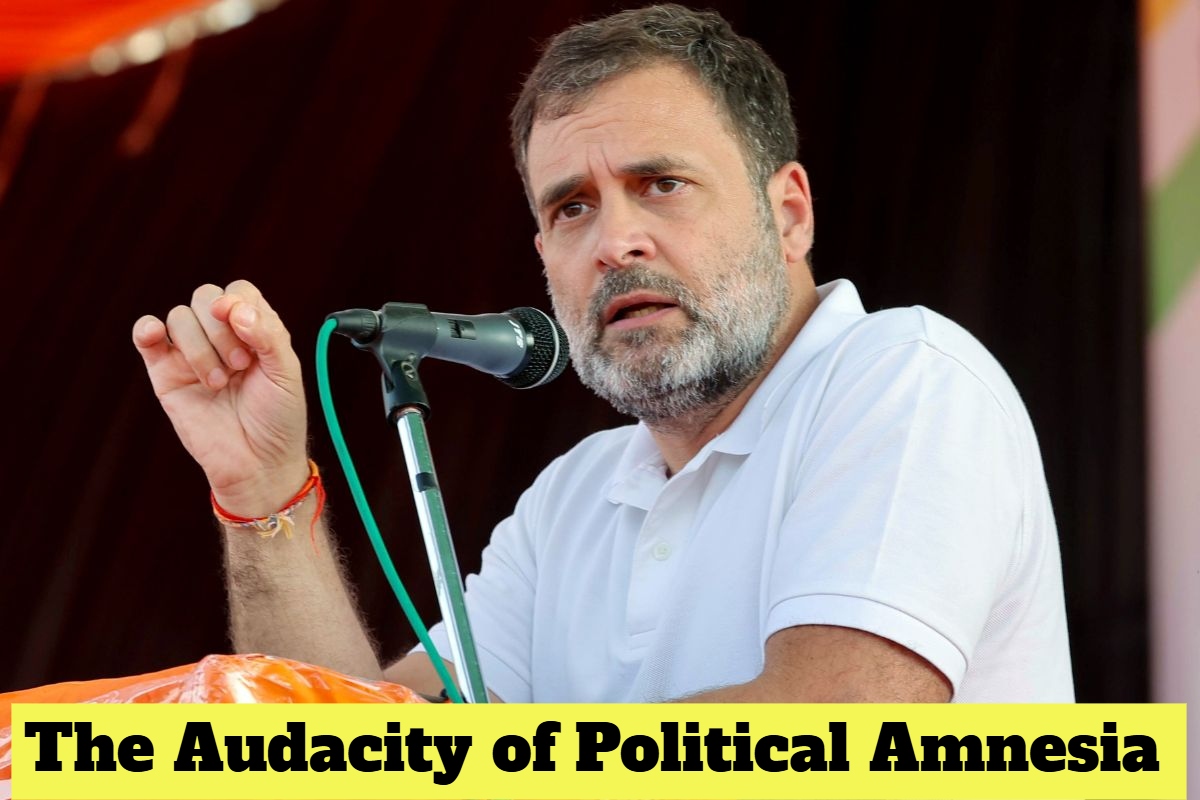
There is a peculiar audacity in political amnesia. It requires not merely the capacity to forget, but also the confidence to accuse others of the very sins one's own political inheritance committed on a far grander scale. Rahul Gandhi, addressing the Bahujan Swabhiman Sammelan in Amethi, called Prime Minister Narendra Modi, Home Minister Amit Shah and the RSS "traitors" who had "sold India and attacked the Constitution." Holding up a copy of the Constitution, he invoked Ambedkar, Mahatma Gandhi, Guru Nanak, Kabir and Narayan Guru while alleging that India's economic system had been handed over to a handful of industrialists. It was a performance delivered with theatrical conviction. It was also, as a matter of documented history, an exercise in breathtaking projection.
The Emergency: When the Constitution Was Not Merely Threatened
Rahul Gandhi says an attack on the Constitution is unfolding before our eyes. Let us revisit an attack on the Constitution that unfolded before the eyes of the entire nation and was carried out by his own political family. On June 25, 1975, Indira Gandhi, following the Allahabad High Court verdict invalidating her election, declared the Emergency. Fundamental Rights were suspended. Opposition leaders were arrested on a massive scale. The press faced censorship; newspapers carried blank spaces where dissenting voices had been silenced by executive diktat. The Supreme Court's infamous ADM Jabalpur judgment remains among the darkest moments in India's judicial history, holding that citizens could effectively be detained without meaningful recourse during the Emergency. Constitutional amendments followed in rapid succession, executive power became concentrated, and the bureaucracy increasingly learned that independence could become inconvenient.
The Emergency also produced one of independent India's most unusual experiments in informal authority. Sanjay Gandhi, despite holding no executive constitutional office, increasingly emerged as an influential extra-governmental power centre around whom ministers, bureaucrats and political functionaries revolved. His controversial five-point programme, particularly forced sterilisation drives and large-scale slum clearance initiatives, became symbols of executive excess operating with little democratic restraint. Power during the Emergency did not merely become centralised; it increasingly appeared to flow through channels that existed outside formal constitutional structures.
If there was ever a moment when constitutional principles were subordinated to political survival, this was it. The Constitution was not merely criticised or politically debated; it was functionally constrained in order to preserve power.
There is, however, another episode worth remembering because it concerns not Rahul Gandhi's family legacy but Rahul Gandhi himself. In September 2013, the Manmohan Singh government approved an ordinance intended to protect convicted legislators from immediate disqualification. The government publicly defended its position. Rahul Gandhi then walked into a press conference and described the ordinance as "complete nonsense", declaring that it should be "torn up and thrown away", before dramatically tearing a copy before television cameras. The extraordinary part was not disagreement within a party. Internal disagreements are common in democratic systems. The extraordinary part was the manner in which it unfolded: a decision formally approved by the government was publicly repudiated by the ruling party's most influential political figure, who held no executive office at the time. The episode raised questions not about disagreement itself, but about the relationship between political authority and institutional process.
Monopoly Wearing the Mask of Socialism
"Narendra Modi has handed over India's economic system to Adani and Ambani," Rahul Gandhi declared in Amethi. The charge of cronyism is a legitimate subject of political debate in any democracy. But it acquires a peculiar irony when it comes from the political heir of the party that built much of India's post-independence architecture of state-controlled patronage.
For decades, India operated under the Licence Raj, a system under which no major industrial activity could occur without extensive government approvals. This was presented to the public as socialism and economic justice. In practice, it frequently created a framework where access and relationships often mattered as much as entrepreneurship. Large industrial houses such as the Birlas and Tatas operated in a tightly regulated environment where competition was heavily controlled and new entrants frequently found themselves facing structural barriers. As political equations shifted, the beneficiaries of state patronage often shifted as well. Economic power in India was shaped through state intervention and government discretion rather than open competition. Ironically, it was P.V. Narasimha Rao, with Manmohan Singh as Finance Minister, who dismantled much of this structure in 1991 â an implicit acknowledgement that the old system had reached its limits.
For Rahul Gandhi to position himself as the principal critic of concentrated economic power while belonging to the political tradition that built the framework enabling such concentration is not merely ironic. It reflects a remarkable wager on public forgetfulness.
Economic Storms and Convenient Narratives
Rahul Gandhi also warned of an approaching "economic storm", predicting severe inflation and suggesting that Narendra Modi would once again evade responsibility when the consequences became visible. Economic slowdowns and inflationary pressures are legitimate concerns and no government is immune from criticism. But presenting every emerging economic risk as the direct product of domestic political failure oversimplifies realities that are increasingly global in nature.
The world economy operates within interconnected systems where events thousands of kilometres away have immediate domestic consequences. Conflict in West Asia and instability around critical maritime routes such as the Strait of Hormuz can sharply affect crude oil prices, freight costs and supply chains. India imports a significant portion of its energy requirements and therefore remains vulnerable to external shocks not entirely within the control of any government in New Delhi. To attribute complex economic pressures entirely to domestic political decisions risks reducing economics into campaign rhetoric.
The Audacity of Political Amnesia
Rahul Gandhi is not lacking in education, access or political opportunity. His problem appears elsewhere: in confronting what his own political inheritance actually represents in India's historical record. He invokes Ambedkar while belonging to a party whose political relationship with Ambedkar was frequently marked by disagreement and distance. He speaks of institutional integrity while belonging to a political tradition permanently marked by the Emergency. He attacks concentration of economic power while emerging from a system that frequently used state power to determine economic winners and losers.
A politician who raises the Constitution with one hand while selectively forgetting uncomfortable parts of his own political inheritance is not presenting the nation with a complete account of history. He is presenting a mirror tilted at a convenient angle and hoping that if he speaks loudly enough about the reflection, nobody will turn around and examine what stands behind it.
Attacking political opponents is a legitimate exercise in any democracy. But when the attack rests on historical claims that one's own record directly contradicts, it invites scrutiny of that record. Political memory can sometimes be managed. History cannot. Unlike political slogans, it keeps its own records.