

States Transgressing Limit By Introducing Doorstep Ration Schemes, Says Calcutta HC
 Editor-in-Chief of indiacommentary.com. Current Affairs analyst and political commentator. Author of Cyber Scams in India, Digital Arrest, The Money Trap and The Human Hack
View all posts by this Author
Editor-in-Chief of indiacommentary.com. Current Affairs analyst and political commentator. Author of Cyber Scams in India, Digital Arrest, The Money Trap and The Human Hack
View all posts by this Author
By Sunil Garodia
First publised on 2022-09-29 06:01:31
About the Author
Editor-in-Chief of indiacommentary.com. Current Affairs analyst and political commentator. Author of Cyber Scams in India, Digital Arrest, The Money Trap and The Human Hack
View all posts by this Author
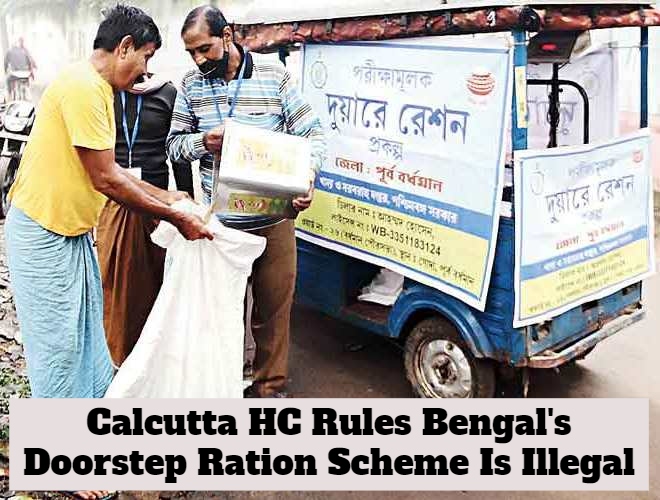
A division bench of the Calcutta High Court has ruled that the Duare Ration (doorstep delivery of ration) introduced by the West Bengal government has no legal sanction. Setting aside an order by a single judge bench of the same court, the bench of Justices Chitta Ranjan Dash and Aniruddha Roy said that "the Duare Ration scheme is ultra vires the National Food Security Act, 2013 (NFSA) and therefore a nullity in the eye of law". The state government may move the Supreme Court against the order.
Despite the Supreme Court praising the Duare Ration scheme and urging other states to emulate Bengal, the doorstep ration schemes of both the Delhi and the Bengal governments have fallen foul of law. The Delhi HC had earlier this year struck down a similar scheme of the Delhi's AAP government. Now, the Calcutta HC, while striking down the Duare Ration scheme, has categorically stated that the state has "transgressed the limit" of delegation under the NFS Act. It further said that "if the NFS Act is amended by the wisdom of Parliament for doorstep delivery of food grains to the beneficiaries or invest any such power to the state government, then only such a scheme can be made by the state and that can be said to be in sync with the enabling act."
Hence, on the face of it and as per the law as it exists at present, the states introducing doorstep ration delivery schemes are obviously transgressing the limit as per the letter of the law. It is now upon the Supreme Court to decide whether concessions can be made as per the spirit of the law to allow such doorstep delivery by states. Obviously, the scheme has many benefits and attractions. But it also has scope for leakages and corruption. The Centre can also study if safeguards can be built-in and the NFS Act suitably amended to allow states to introduce the scheme.