

The Foreign Hand Is Not an Answer
 The India Commentary view
View all posts by this Author
By Our Editorial Team
First publised on 2026-10-23 23:59:23
About the Author
The India Commentary view
View all posts by this Author
The protests on India's streets have domestic causes. The government's duty is to answer them, not question the motives of those who raise them.
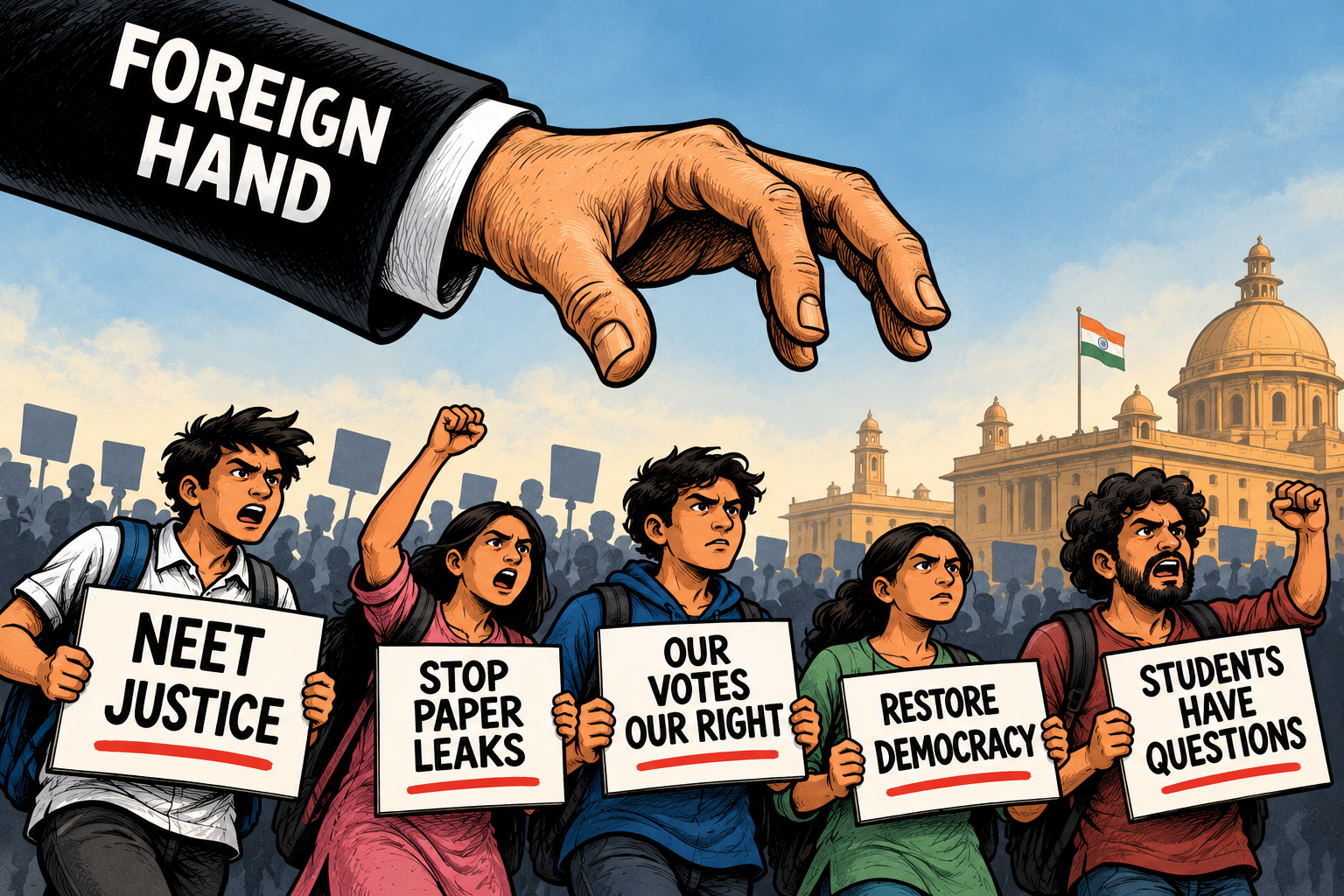
RSS chief Mohan Bhagwat said in Nagpur on 20 October that a storm had blown in from the West. Citing France, Bangladesh and Nepal, he warned of attempts at regime change in India. He also said protests should seek solutions, not sow hatred. That last point is correct. But in August, he had described democratic protest as legitimate and students' grievances as genuine. Two months later, he has placed those protests in the shadow of alleged foreign interference.
The grievances are documented. NEET-UG 2026 was held on 3 May and cancelled on 12 May following allegations of a paper leak. The CBI registered an FIR, and investigators reportedly found about 120 questions in a circulated guess paper matching the examination. Even ABVP, the Sangh Parivar's student wing, demanded accountability. No foreign hand is needed to explain that anger.
The same scrutiny applies to the Special Intensive Revision. Students and opposition parties accuse Chief Election Commissioner Gyanesh Kumar of irregularities and mass deletion of voters. They demand his resignation. The Election Commission and the BJP deny the charges. Neither allegation nor denial settles the matter. A citizen struck off the roll needs an explanation, not speculation.
Foreign funding is not, by itself, proof of foreign direction. Contributions must comply with the law, but their source cannot substitute for evidence of how the money was used. The Kerala High Court has held that funding a peaceful protest is not, by itself, grounds to deny an NGO's FCRA renewal. In Kudankulam, inquiries did not establish a direct link between certain NGOs and the agitation. Insinuations against Rahul Gandhi are repeated more often than they are substantiated.
Indira Gandhi's government also invoked threats to the nation amid unrest in the 1970s. The Emergency that followed remains a warning against treating dissent as a threat to be contained rather than a grievance to be addressed.
The remedy is transparency. The Election Commission should publish deletion rules and constituency-wise lists, provide a simple appeal and permit independent audits. The Centre should disclose the NEET investigation's progress, fix a firm re-examination date and hold National Testing Agency officials accountable. Police should not detain students merely for peaceful marches. Article 19 protects speech and peaceful assembly, subject to constitutional restrictions.
If anyone has broken the law, the government should name them and produce evidence. Until then, protesters deserve answers, not suspicion.