

oppn parties Who Said India Is Not Finding, Isolating, Testing And Treating Covid-19 Cases?
News Snippets

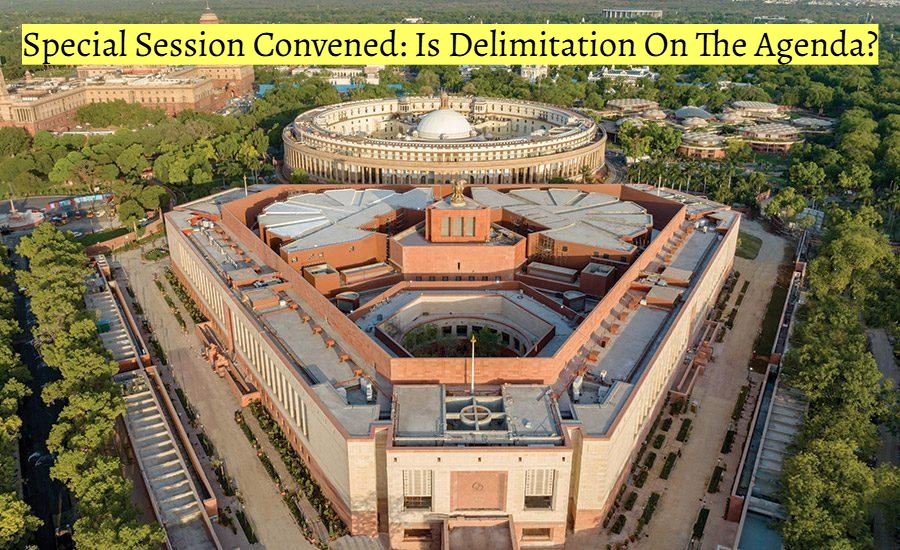
  • The Union government announced a four-day sitting of Parliament from November 30 to December 3, with the Lok Sabha scheduled to reconvene on November 30 and the Rajya Sabha on December 2. Parliamentary Affairs Minister Kiren Rijiju said the purpose was to transact essential government business, but speculation over possible legislation on delimitation has intensified
  • Opposition parties marked Constitution Day with demonstrations in several states, demanding accountability from Chief Election Commissioner Gyanesh Kumar and raising allegations of irregularities in electoral-roll revision. Congress president Mallikarjun Kharge led the Samvidhan Raksha campaign in Lucknow.
  • The Supreme Court ruled that the adjudicating authority under the Prevention of Money Laundering Act must include a judicial member when confirming property attachments, although its chairperson need not necessarily be a judicial member
  • The Supreme Court quashed the Bihar government's 2023 decision granting premature release to former MP Anand Mohan, convicted in the 1994 murder of IAS officer G Krishnaiah, and directed him to surrender within one month. The Court also struck down the prison-rule amendment that had enabled his release, holding the decision legally unsustainable
  • The Supreme Court directed the Food Safety and Standards Authority of India to prepare revised front-of-package nutrition-labelling regulations within 10 weeks, requiring separate warnings for products high in sugar, salt and saturated fat. The Court rejected the regulator's earlier proposed framework and directed it to recalculate nutrient thresholds
  • India's foodgrain production reached a record 378.54 million tonnes in 2025-26, an increase of 20.81 million tonnes over the previous year, according to the Agriculture Ministry's final estimates released on November 26. The government also estimated kharif foodgrain production for 2026-27 at 167.14 million tonnes
  • Tamil Nadu Governor R N Ravi urged Chief Minister C Joseph Vijay to intervene in filling vacant university vice-chancellor positions and address pending university convocations
  • Indian money markets are signalling the possibility of a 50-basis-point RBI interest-rate increase at the December 2-4 monetary policy meeting, although most economists continue to expect a 25-basis-point hike. October retail inflation rose to 6.09%, exceeding the RBI's upper tolerance limit of 6%. Rising Treasury bill yields and interest-rate swaps indicate concerns about the persistence of inflation
  • The Reserve Bank of India has authorised the National Stock Exchange to introduce futures contracts linked to corporate bond indices, following an earlier clearance from SEBI. The proposed instruments will allow investors to hedge corporate bond portfolios and take positions on movements in bond valuations and credit spreads
  • Indian equity markets closed higher for the second consecutive session, with the Sensex gaining 390.31 points (0.46%) to 84,328.59 and the Nifty 50 advancing 65.25 points (0.25%) to 25,884.50
  • Kerala produced one of the day's outstanding performances in the Syed Mushtaq Ali Trophy, scoring 268 for four against Himachal Pradesh before restricting their opponents to 201 for six to win by 67 runs. Mumbai also registered a commanding 86-run victory over Uttarakhand, while Vidarbha defeated Chhattisgarh by 34 runs
  • Defending champions Treesa Jolly and Gayatri Gopichand advanced to the quarter-finals of the Syed Modi International Super 300 badminton tournament in Lucknow with a 21-9, 21-8 victory over compatriots Shreya Balaji and Pranavi Natarajan. In women's singles, Tanvi Sharma, Unnati Hooda, Anmol Kharb and Tasnim Mir also entered the last eight, giving India a strong presence in the knockout stages
  • Indian athletes enjoyed a productive second day at the BIMSTEC Under-23 Athletics Championships in Bhubaneswar. Vaibhav won the men's discus gold with a throw of 51.97 metres, ahead of compatriot Bharatpreet Singh, who secured silver with 49.63 metres. Roshan Shaikh also won the men's 110-metre hurdles, while Tamil Nadu's Sadhana Ravi captured the women's triple-jump gold with a leap of 13.24 metres
  • Rising Stars: Sri Lanka crush India by 8 wickets in the semifinals as bowlers lose their way after the batters score a competitive 317
  • MEA says notice for discrepancy in place of birth was issued to Saurav Das of CJP and he was advised not to use passport for 7 days
Supreme Court rebukes Vijay government in Tamil Nadu, says it acted in contempt, orders lighting of lamp at Deepathoon and suspended the board of trustees of Tamil Nadu's Arulmigu Subramaniaswamy temple /////// Big victory for Mamata Banerjee - Calcutta HC removes Ritabrata Banerjee of rival faction as Leader of Opposition in the Bengal assembly, says the Speaker must think afresh and provide proper reasoned order
oppn parties
Who Said India Is Not Finding, Isolating, Testing And Treating Covid-19 Cases?

By Sunil Garodia
First publised on 2020-03-26 13:21:00

About the Author

Sunil Garodia Editor-in-Chief of indiacommentary.com. Current Affairs analyst and political commentator. Author of Cyber Scams in India, Digital Arrest, The Money Trap and The Human Hack

WHO Director-General Tedros Adhanom Ghebreyesus said that the lockdowns being implemented by several countries to combat COVID-19 will not be enough to eradicate the virus from the world. He also said that countries will have to "find, isolate, test and treat". But who gave him the idea that countries like India were under lockdown only and not doing other things like finding, isolating, testing and treating (FITT) suspects or infected persons? And it is no rocket science to know that the virus will only be eradicated when all infected cases are finally treated and no new cases are reported for at least 14 days thereafter. If random cases come up even after that, the danger of community transmission would become almost negligible as such cases can be isolated easily and treated promptly. 

Ghebreyesus is thinking only as a health service administrator. He is also viewing the problem purely from a Western viewpoint. When governments in hugely populated countries like India are faced with an epidemic like Covid-19, their first priority is the safety of their citizens. A densely populated country is a sitting target for community transmission of any infectious disease. Hence, the biggest issue with the government is to keep the population away from each other. When warnings and partial lockdowns were not successful, the only way forward was a complete lockdown.

FITT is impossible when people are coming in from abroad and are also moving either within their own areas or all across the country. For, those coming from other countries have been found to flout the self-isolation advice, increasing the risk. Hence, it was absolutely necessary to pin people where they were. The government is now trying to find who all have come in contact with those who are already infected and is isolating them. It has already found 900 persons who came in contact with the infected Delhi mohalla clinic doctor and his family and has quarantined them. It was possible only because these people were pinned to one location due to the lockdown. Otherwise, they would have moved about and the 900 could have been 9000 or even 90000.

Further, once people are pinned for 21 days, the asymptomatic cases will show outward symptoms and be tested and treated. 134 crore people cannot be tested overnight by making them stand in a queue. There has to be a reason for testing. The government of India is moving in the right direction (we can forget the criticism that it delayed the lockdown or that 21 days is too much). To assume or infer that the lockdown is only what the government has done to combat Covid-19 is to assume that it is being run by irresponsible people or that health service administrators in India do not know anything. Before drawing conclusions from an act of any government in such emergencies, people have to think like overall administrators in addition to the field of their expertise.