
oppn parties A Bench in Chennai Is Not the Answer to a Bench in Every Capital

News Snippets

  • The Supreme Court issued notice to the Centre and the Election Commission on a petition challenging Section 16 of the Chief Election Commissioner and Other Election Commissioners Act, 2023, which grants the CEC and Election Commissioners protection from legal proceedings for acts performed in their official duties. The petition argues that such blanket immunity could leave citizens without an effective remedy for alleged wrongdoing by the Commission
  • The Supreme Court told voters whose names were deleted from Delhi's draft electoral rolls not to be apprehensive about seeking re-enrolment through Form 6, after the Election Commission assured it that such applicants would not be prosecuted merely because their names had appeared in earlier rolls
  • Congress leader Rahul Gandhi opened the party's campaign for the 2027 Punjab Assembly elections with an Insaaf rally in Sangrur, Chief Minister Bhagwant Mann's home district, accusing the AAP government of failing to control drugs, gangster violence and corruption. Congress president Mallikarjun Kharge outlined six commitments, including a drug-free Punjab, protection of farmers, employment for young people and action against corruption
  • Rahul Gandhi accused the AAP government of running Punjab through a remote control from Delhi and questioned Bhagwant Mann's ability to tackle drug abuse, making personal allegations about the Chief Minister's conduct during their time together in Parliament
  • RSS general secretary Dattatreya Hosabale alleged that forces within and outside India were trying to provoke young people and create unrest, suggesting that a conspiracy might be behind the Gen Z protests. He also said genuine youth grievances should be heard through dialogue rather than dismissed as anti-national, while defending the Special Intensive Revision of electoral rolls and the continuation of reservation for historically disadvantaged communities.
  • The Congress staged protests across Uttarakhand against the Dhami government's decision to transfer government-owned land and properties to private entities, focusing particularly on the proposed transfer of the George Everest estate
  • Mercedes-Benz has said that electric vehicles will account for 20% of all vehicle sales in 2027
  • Tamil Nadu Chief Minister C Joseph Vijay wrote to Prime Minister Narendra Modi seeking a permanent Supreme Court bench in Chennai, arguing that the cost and distance of travelling to New Delhi make access to the apex court difficult for litigants from southern states. He invoked Article 130 of the Constitution, which permits the Supreme Court to sit outside Delhi with presidential approval
  • India's Indian Cybercrime Coordination Centre warned banks, non-bank lenders, fintech companies and payment firms of financially motivated cyberattacks using artificial intelligence agents. The advisory said attackers were exploiting vulnerable software and payment APIs to compromise systems at machine speed, and recommended transaction limits, beneficiary-name verification and monitoring of unusual payment activity
  • Indian equity benchmarks extended their winning streak to five consecutive sessions on Wednesday, with the Sensex rising 383.55 points, or 0.50%, to close at 77,301.40 and the Nifty 50 gaining 149.75 points, or 0.63%, to settle at 23,960.60. Mid-cap and small-cap indices also advanced, while IT shares declined; Reuters attributed the broader rally partly to hopes of renewed foreign portfolio investment
  • India defeated New Zealand by five wickets in the rain-affected first ODI at Auckland, taking a 1-0 lead in the five-match series under the Duckworth-Lewis method. New Zealand were bowled out for 185 in 40.2 overs, and India completed the revised chase to secure the win. Kohli scored 74 while Arshadeep Singh picked up 4 for 70 and Anshul Kamboj got 2 for 22
  • Ranji Trophy: Delhi and Services match is evenly poised while Gujarat have an upper hand against Kerala. In the other match Jharkhand will fight for 1st innings lead against Odisha
  • Ranji Trophy: Bengal are with their backs to the wall against Maharashtra, with just 6 wickets in hand and a lead of 1 run
  • India stormed into the final of the Asian Champions Trophy hockey tournament with an 8-1 victory over South Korea in Mohali. The unbeaten Indian side will face Japan in the title match on November 5
  • Indian shuttlers Anmol Kharb and Tanvi Sharma advanced to the second round of the Korea Open Super 500 women's singles event on Wednesday. Anmol defeated Canada's Rachel Chan 21-19, 21-18, while Tanvi also progressed to the next round.
Centre effectively rolls back Agniveer scheme - opens path to absorb all Agniveers into defence forces ////// India thrash South Korea 8-1 to enter ACT hockey finals
oppn parties
A Bench in Chennai Is Not the Answer to a Bench in Every Capital

By Our Editorial Team
First publised on 2026-11-05 03:17:31

About the Author

Sunil Garodia The India Commentary view

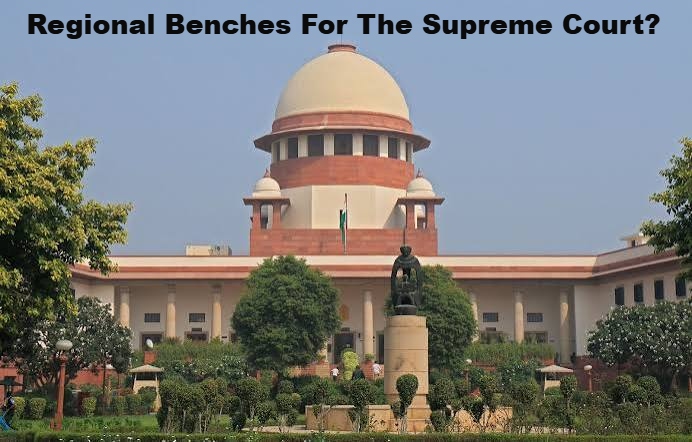
Tamil Nadu Chief Minister C Joseph Vijay has asked the Prime Minister for a permanent Supreme Court bench in Chennai. The grievance is real. The remedy he seeks is incomplete. The demand deserves a serious answer, and that answer is neither a flat refusal nor a quick concession.

The law is not the obstacle. Article 130 lets the Supreme Court sit outside Delhi at places the Chief Justice of India appoints, with the President’s approval. The power lies with the Chief Justice, not with the Prime Minister, so a letter to Mr Modi is political signalling and not a constitutional step. The Court itself, in 2015, dismissed a plea for a Chennai bench and said the time was not right. That was a decision about timing, not about constitutionality.

Nor is the idea fringe. The Law Commission recommended four regional benches in its 229th report: Delhi, Chennai or Hyderabad, Kolkata and Mumbai. A parliamentary committee has urged the use of Article 130 at four or five locations, and the Law Ministry has reportedly accepted that recommendation. Chennai has been on that list for years.

The fear that every state will then demand its own bench is legitimate, and the proposal’s own design answers it. The expert reports speak of zones, not states, and of a constitutional bench kept in Delhi. A fixed number of zonal benches, written down in advance with clear criteria, is a defensible limit. A bench for every capital, or two for Uttar Pradesh, is not. High Court bench politics in this country show what happens when no such limit exists. One concession invites the next.

The deeper problem is that Mr Vijay is arguing about location when the real question is jurisdiction. Foreign comparisons help only if they are read carefully. The United States, Canada and Brazil keep their apex courts in a single city. But they differ from India in their federal arrangements, legal traditions and the way their apex courts connect to the rest of the judiciary. Australia’s High Court sits in several cities, and Pakistan’s Supreme Court hears cases at registries in provincial capitals. So there is no universal rule on where an apex court must sit. The useful lesson concerns design. All three countries have appellate courts below the apex court and ways to limit what reaches it. India’s Supreme Court is also an ordinary court of appeal, open to special leave petitions in large numbers,without a national intermediate appellate tier between the High Courts and itself . That is why Delhi is overwhelmed. Moving the Court’s address without changing its role will not cut pendency. It will spread it.

The Centre and the Chief Justice should not treat this as a state’s special pleading. They should take up the Law Commission scheme as a whole: a small constitutional court in Delhi, a few regional appellate benches, and a fixed ceiling. Tamil Nadu is entitled to ask for Chennai. The country is entitled to a plan that does not stop at Chennai.