Delimitation: A Constitutional Test Modi Government Cannot Afford To Fail
 Editor-in-Chief of indiacommentary.com. Current Affairs analyst and political commentator. Author of Cyber Scams in India, Digital Arrest, The Money Trap and The Human Hack
View all posts by this Author
By Sunil Garodia
First publised on 2026-11-27 00:21:40
About the Author
Editor-in-Chief of indiacommentary.com. Current Affairs analyst and political commentator. Author of Cyber Scams in India, Digital Arrest, The Money Trap and The Human Hack
View all posts by this Author
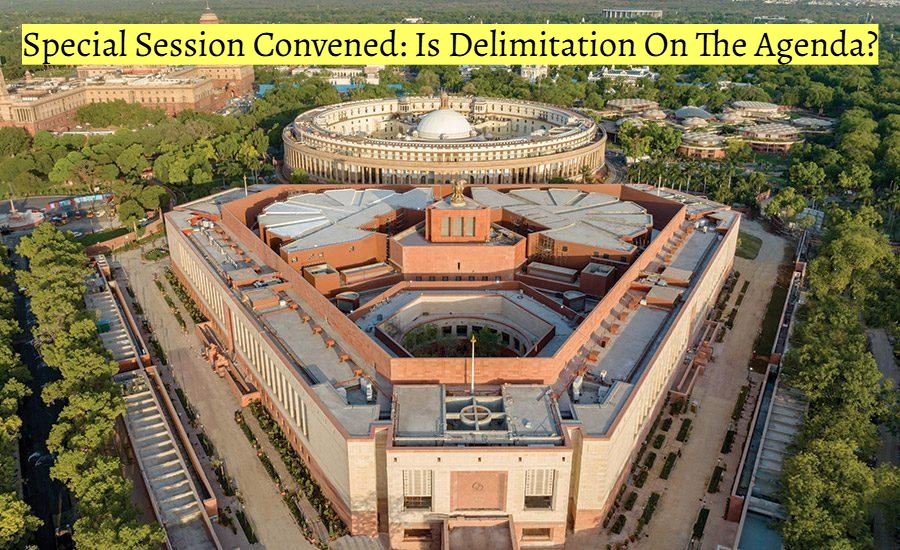
The decision to reconvene Parliament from November 30, with the Lok Sabha meeting first and the Rajya Sabha following on December 2, has revived speculation that the Modi government intends to bring back the contentious delimitation legislation. The government has officially described the proposed sittings as being for essential government business without disclosing the legislative agenda. But the political buzz is unmistakable. The question is whether the government has finally managed to secure the numbers needed to push through a constitutional amendment that it failed to get past the Lok Sabha in April.
The arithmetic is not complicated. A constitutional amendment requires a majority of the total membership of each House and a two-thirds majority of members present and voting. There is no escape through a joint sitting. In April, the Constitution (131st Amendment) Bill, which formed the core of the government's delimitation package, received 298 votes in favour and 230 against in the Lok Sabha. It needed 352 affirmative votes and fell 54 short.
The government has since had several months to work on the numbers, and government sources have claimed that the required support is in hand. But political claims are not parliamentary votes. Unless the government has secured firm commitments from opposition parties or persuaded enough members to abstain, the arithmetic remains unforgiving.
The NDA's strength has since risen to about 320, helped by defections from the Trinamool Congress and the Shiv Sena (UBT). That is still some 40 short of the 360 needed if all members vote. Much depends on the DMK, with 22 members, and the NCP (Sharadchandra Pawar), with eight. Even their support would leave the government looking for a few more votes or abstentions.
The opposition's objections cannot simply be dismissed as political obstruction. Delimitation is not merely an exercise in redrawing constituency boundaries. It determines the distribution of political representation and, consequently, the balance of power between states. Southern states, which have made considerable progress in population control, fear that a population-based redistribution could reduce their relative political influence while rewarding states that have experienced higher population growth.
That is a legitimate federal concern. A state should not find its political voice diminished because it has performed better in controlling population growth. The government must provide credible constitutional safeguards, not rely on informal assurances that the interests of southern states will be protected.
The government's answer is a uniform 50 per cent increase in every state's seats, an assurance it offered verbally in April but did not write into the Bill. Such a formula would broadly preserve proportions. It would also widen absolute gaps, with Uttar Pradesh going from 80 seats to 120 and Tamil Nadu from 39 to about 59. Any guarantee must therefore be written into the constitutional text, state by state, with its duration clearly stated.
There is also a larger question about the government's decision to link delimitation with the implementation of women's reservation. The Constitution (106th Amendment) Act, passed in 2023, provides for one-third reservation for women in the Lok Sabha and state legislative assemblies. Its implementation is linked to a delimitation exercise following the publication of relevant census figures. The government now wants to accelerate the process, but by tying women's reservation to a contentious redistribution of parliamentary representation, it has made a broadly supported reform hostage to a deeply divisive political and constitutional debate.
Why should women's representation become the bargaining chip in a dispute over the distribution of parliamentary seats? The government could have sought a wider political consensus on how to implement the reservation law. Instead, it has chosen to make delimitation the central issue and then portray opposition to its proposed approach as opposition to women's empowerment. That is a politically convenient argument, but not necessarily a convincing one.
The government has kept the Monsoon Session unprorogued since the Houses were adjourned on August 13, fuelling speculation that it used the long gap to negotiate the numbers. If so, it should have little difficulty in explaining the basis of its confidence.
But what happens if the Bill is defeated again? The political consequences would be considerable, because parliamentary arithmetic cannot be altered by political messaging. A second defeat would also strengthen the opposition's argument that the government is attempting to push through a major restructuring of political representation without adequate consultation or consensus. The government could instead introduce the legislation, hold discussions and postpone a vote if it finds the numbers uncertain. That would hardly be a triumph, since it would raise the question of why Parliament was reconvened for a tightly scheduled sitting if the government was not prepared to test its own claims.
The Modi government has a clear choice. It can demonstrate that it has built the constitutional consensus necessary for such a far-reaching exercise, or it can acknowledge that the concerns of states and opposition parties deserve a serious hearing. What it cannot reasonably expect is that a constitutional amendment of this magnitude will pass merely because the government wants it to.
A parliamentary majority is not the same as a constitutional consensus. The distinction is precisely what the government discovered in April. November 30 will reveal whether it has learnt the lesson.
Editorial disclosure: India Commentary uses AI tools as part of its research and writing process. All articles are reviewed and approved by their respective authors, who retain responsibility for their published content.