
Set The Rule, Publish The Road Ahead
 Editor-in-Chief of indiacommentary.com. Current Affairs analyst and political commentator. Author of Cyber Scams in India, Digital Arrest, The Money Trap and The Human Hack
View all posts by this Author
By Sunil Garodia
First publised on 2026-11-27 13:01:49
About the Author
Editor-in-Chief of indiacommentary.com. Current Affairs analyst and political commentator. Author of Cyber Scams in India, Digital Arrest, The Money Trap and The Human Hack
View all posts by this Author
The Supreme Court is right to put a warning on the front of the packet. The task now is to write that warning well and to say in advance how the rule will tighten. Public health needs a firm standard, and industry needs to know when it will move.
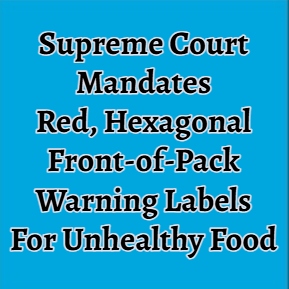
On November 26, a bench of Justices J.B. Pardiwala and K. Vinod Chandran rejected the framework proposed by the Food Safety and Standards Authority of India (FSSAI). A product high in fat, sugar or salt will have to carry a separate hexagonal warning for each, with a picture and plain words. Each hexagon is ordinarily to occupy at least 4 to 5 per cent of the front panel.
The Court has also sent the regulator back to its arithmetic. Thresholds must be recalculated on total sugars and saturated fat, along with salt, and not merely on what a manufacturer adds. Limits set too low would put a warning on almost everything and tire the consumer. Limits set too high would let harmful products pass as safe.
The ruling deserves support. Attractive packaging and health-sounding claims must not be allowed to hide what is high in sugar, salt or fat. A shopper cannot be expected to decode a nutrition table printed in small type on the back of a packet. A child certainly cannot. A warning that is seen at a glance serves the right to make an informed choice, which the Court has tied to the right to health.
This is not a ban on any food. An adult remains free to buy the sweetest biscuit or the saltiest snack. Public health does not require the State to decide what people may enjoy. It requires that they know what they are choosing.
The record raises serious questions about regulatory inertia. FSSAI has deliberated on front-of-pack labelling for more than a decade. Its 2022 draft proposed a star rating. Its later offerings included bolder text on the back and daily intake limits on the front, and the Court found that neither was front-of-pack labelling at all. A regulator that needs the Supreme Court to bring it this far owes the public an explanation.
Food companies can be expected to have concerns about the warnings, their design and their commercial effect. When the 2022 draft drew comments, food businesses largely wanted the regime to remain voluntary and warned of harm to livelihoods. Those concerns deserve a hearing. They cannot decide the thresholds, which must rest on science.
The worry over frequent changes in packaging is a real one. A label is not a sticker that can be swapped overnight. Artwork has to be redrawn, printing plates remade, approvals obtained and old stocks of printed material used up or scrapped. The bill falls hardest on small food businesses, and part of it can travel to the consumer.
Nor is this the only change in the queue. One set of amendments to the labelling regulations took effect on July 1, 2026. Another, notified this year, takes effect on July 1, 2027. The new warnings will follow. If the final rules are notified in 2027, compliance will become compulsory in 2028. Depending on what it sells, a firm could be redesigning packs again and again within a few years.
FSSAI has recognised the problem in principle. Its January 2026 policy provides that labelling amendments take effect on July 1, with at least 365 days' notice, except in emergencies. The Court has separately accepted a 365-day transition for the new warnings. It has also said that extensions should not ordinarily follow, and that FSSAI must prevent firms from using the interval to flood the market with unlabelled packs.
A common date and a year's notice are useful. They do not by themselves make the rules predictable. For that, India needs a published road map and a clear test for departing from it.
The thresholds are not meant to stand still. The Court has said that FSSAI must work towards lowering them progressively and in phases, and must not treat the exercise as a one-time measure. It noted that Chile and Mexico have tightened their criteria in stages. This is sound public health. It need not bring disorder to the packaging plant.
FSSAI should publish the schedule at the start. It can state the opening thresholds, the lower limits that will follow and the date on which each will apply. Firms would then have time to change recipes and could plan printing around known dates. The symbol, design and size should remain the same from one phase to the next. A pack would need new artwork only when a new limit changes the warnings it must carry.
FSSAI should settle the phased thresholds, design, size, wording and exemptions in one comprehensive regulation. The evidence behind every number should be published. Industry, doctors and consumer groups should contest those numbers now, during consultation, and not after the printing presses have run.
The regulation should also say when that schedule may be changed. Credible new evidence on health harm is one ground. Advances in food technology are another. So are new recipes or ingredients that carry fresh risks, or that help a product slip past a warning. The Court has itself asked the regulator to watch reformulation and to amend the rules where necessary if additives are used to defeat the warnings.
Stability cannot mean a freeze. The Court expects continuous effort and monitoring. Reviews at fixed intervals can test whether the next step in the schedule is still adequate. Changes outside it should be exceptional and supported by published evidence. A grave and proven risk must be acted on at once, whatever the calendar says.
When change is unavoidable, it should be bundled. Pending amendments on claims, declarations and warnings should reach industry together, wherever safety permits, so that one redesign does the work of several. This must not become a reason to push back the warnings the Court has now ordered. Small firms should also get model artwork, clear guidance and a window for queries well before the deadline.
The Supreme Court's role is to insist that the regulator protects public health and honours its timelines. Writing and updating technical standards remains FSSAI's job. The best way for the regulator to avoid repeated judicial correction is to produce a rule that is sound, reasoned and complete.
A warning label works when people learn to recognise it. That takes years of seeing the same symbol mean the same thing. India should keep the symbol constant, lower the limits on a published schedule and depart from that plan only when the evidence compels.
Editorial disclosure: India Commentary uses AI tools as part of its research and writing process. All articles are reviewed and approved by their respective authors, who retain responsibility for their published content.