
A Switch Is Not A Shield: The RBI's Fraud Draft Protects The Customers Who Need It Least
 Editor-in-Chief of indiacommentary.com. Current Affairs analyst and political commentator. Author of Cyber Scams in India, Digital Arrest, The Money Trap and The Human Hack
View all posts by this Author
By Sunil Garodia
First publised on 2026-11-24 05:18:01
About the Author
Editor-in-Chief of indiacommentary.com. Current Affairs analyst and political commentator. Author of Cyber Scams in India, Digital Arrest, The Money Trap and The Human Hack
View all posts by this Author
The Reserve Bank of India has handed customers tools that should have reached them years ago. The draft is sound in intent and flawed in reach. Its protections work only if a customer switches them on before the fraud, and the one safeguard that brings in a second person does not cover UPI.
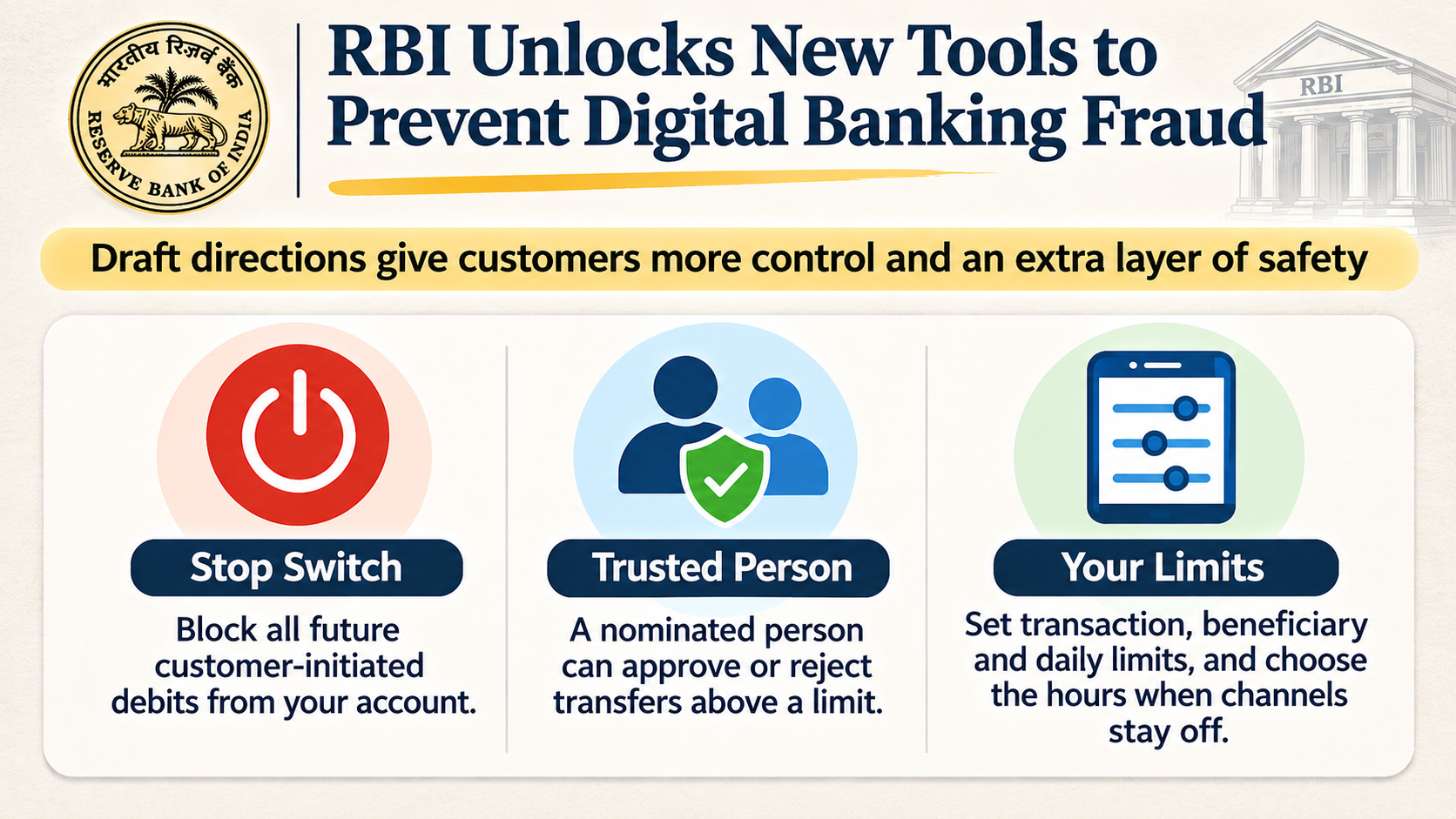
On Monday the RBI issued seven draft amendment directions covering different categories of banks. Customers could disable digital channels, set limits per transaction, per beneficiary and per day, and shut channels during chosen hours. A Stop Switch would disable all outward customer-initiated debits from an account. It would also bar new payment mandates and the registration of UPI on new third-party apps. Incoming credits, existing recurring mandates and bank-initiated recoveries such as loan instalments would be untouched. A voluntary Trusted Person Mechanism would require a second approver for transfers above a threshold the customer sets. Comments are invited until December 14, and the RBI proposes implementation from July 1, 2027.
Much of the architecture is right. Digital payment channels would be disabled by default at onboarding, and a newly enabled channel would carry a ceiling on transfers for its first 24 hours. A bank that fails to provide the controls or the Trusted Person Mechanism would be classed as negligent under the liability framework. A trusted person who stays silent for an hour counts as a rejection, which is the correct default. The draft builds on the June 24 directions on customer liability, which take effect on January 1, 2027.
Now the defects. The first is scope. The Trusted Person Mechanism does not apply to UPI payments, merchant payments or recurring payments. The RBI may have reasoned that UPI already operates within transaction limits, since the standard ceiling for person-to-person payments is Rs 1 lakh, which banks may lower. That reasoning is incomplete. The RBI's own discussion paper says nearly 92 per cent of the value of frauds reported on the National Cyber Crime Reporting Portal lies above Rs 50,000. The paper does not clarify whether this refers to individual transactions or the aggregate amount lost in each complaint. Either interpretation, however, points to the concentration of fraud losses in higher-value cases. The mechanism does cover the other rails, where larger sums move. The band between Rs 50,000 and the UPI ceiling is left bare. A fraud of Rs 90,000 carried out by UPI would never reach the second approver. The April paper exempted merchant payments made by any mode, UPI included. The November draft exempts the entire UPI channel, and the text offers no reason.
The second weakness lies in the trigger. The mechanism acts on a single transaction crossing the customer's threshold, so a fraudster can split a transfer into several payments, each below it. A customer who sets the threshold at Rs 50,000 gets no second approval on three payments of Rs 40,000. The draft lets customers cap their daily outflow, but a cap blocks payments. It does not put them in front of another person.
The third defect is opt-in design. Defaults protect new customers, since channels would be disabled at onboarding, but the existing customer base must find, understand and activate the Stop Switch, the limits and the trusted person on its own. Banks must make the controls available to everyone and run ongoing outreach, but a facility that is available is not a facility that is switched on. The contrast with the RBI's own discussion paper is significant. In April it floated making the trusted-person check mandatory for citizens aged 70 and above and for persons with disabilities, for transactions above Rs 50,000, and optional for everyone else. The November draft makes it voluntary for all, leaving its adoption to the very customers it is meant to protect. It cites public feedback on the paper but does not say what changed the RBI's mind. The draft does recognise vulnerability, with extra checks such as a branch visit or a tele-verification call, but only when an enrolled customer tries to change or leave the mechanism. The vulnerable are protected on exit and left unprotected at entry.
The fourth defect is the nature of modern fraud. According to the RBI's discussion paper, reported digital payment frauds on the National Cyber Crime Reporting Portal rose from 2.6 lakh in 2021 to 28 lakh in 2025, and the value involved from Rs 551 crore to Rs 22,931 crore. Much of that growth is social engineering, where the victim authorises the payment under pressure. In a "digital arrest" call the victim is told that disconnecting means arrest. A Stop Switch assumes a victim who wants to stop. A trusted person is less likely to face the same coercion or manufactured urgency as the account holder. That is precisely why a second approval can be effective. But a coached victim will also be told to raise the limit. The draft prescribes a 24-hour cooling period for changing the trusted person, the Trusted Person Mechanism's threshold or the channels covered, and for opting out. It lets banks impose a cooling period before a customer re-enables a channel or switches off the Stop Switch. But it prescribes no equivalent mandatory cooling period before a customer raises an ordinary transaction limit, beyond the first 24 hours of a new channel. That is a significant omission.
Behind these details lies a choice of philosophy. One approach gives customers tools and makes them responsible for switching them on. The other designs the system so that vulnerable customers are protected even when they do nothing. The draft leans towards the first, with default-off channels for new customers as the notable exception. The case for the second is stronger, because the customers most exposed to fraud are the ones least able to act.
So what should the RBI do before finalising? It should explain the exclusion of UPI and consider bringing person-to-person UPI payments within the mechanism when either an individual transaction or cumulative daily outflow crosses the customer's threshold. It should revisit the April idea that the check be mandatory for those aged 70 and above and for persons with disabilities. It should require a cooling period before any protective limit is raised. And it should turn the outreach duty into a measurable one, with banks reporting how many customers have actually activated these tools.
The Reserve Bank has recognised that prevention beats recovery, since recovering money after a scam is slow and rarely succeeds. That recognition is the right foundation, but the draft rests on a paradox. A customer who knows these mechanisms exist, and is technically capable of setting limits, nominating a trusted person and finding the Stop Switch, is also the customer far less likely to be taken in by a fraudster. The people these safeguards are meant for are the ones who will never initiate them, because they are unaware that the tools exist or lack the skill to switch them on. A protection that reaches only the already vigilant is a convenience for the safe, not a shield for the exposed. The final directions must ensure the customer who never touches a setting is still protected. Until they do, the shield will exist only for those who did not need it.