

Bengal Won the Case. Karnataka Built the Policy.
 Editor-in-Chief of indiacommentary.com. Current Affairs analyst and political commentator. Author of Cyber Scams in India, Digital Arrest, The Money Trap and The Human Hack
View all posts by this Author
Editor-in-Chief of indiacommentary.com. Current Affairs analyst and political commentator. Author of Cyber Scams in India, Digital Arrest, The Money Trap and The Human Hack
View all posts by this Author
By Sunil Garodia
First publised on 2026-08-03 03:47:57
About the Author
Editor-in-Chief of indiacommentary.com. Current Affairs analyst and political commentator. Author of Cyber Scams in India, Digital Arrest, The Money Trap and The Human Hack
View all posts by this Author
Karnataka's Chief Minister D K Shivakumar has announced a policy that highlights something Bengal has already established in court. His "Freedom from Waste" campaign, launched near Hebbal Junction, gives beneficiaries of government-allotted plots five years to construct a house, failing which the state resumes the land after refunding the amount paid with interest. His reasoning was blunt rather than bureaucratic: allottees who have sat on undeveloped land for twenty, thirty, even forty years have converted what was meant to be a housing solution into a civic liability, since vacant plots without a boundary wall or a caretaker inevitably become the neighbourhood's unofficial dumping ground, breeding ground for mosquitoes and stray dogs, and occasionally a site for activities the allottee would rather not be associated with. It is a clean, prospective rule, applied automatically to every future allottee. A grant conditioned on public purpose lapses when the purpose is abandoned. Bengal's own version of this fight took eight years of dormancy and three more of litigation, and produced no rule at all, only a verdict in one case.
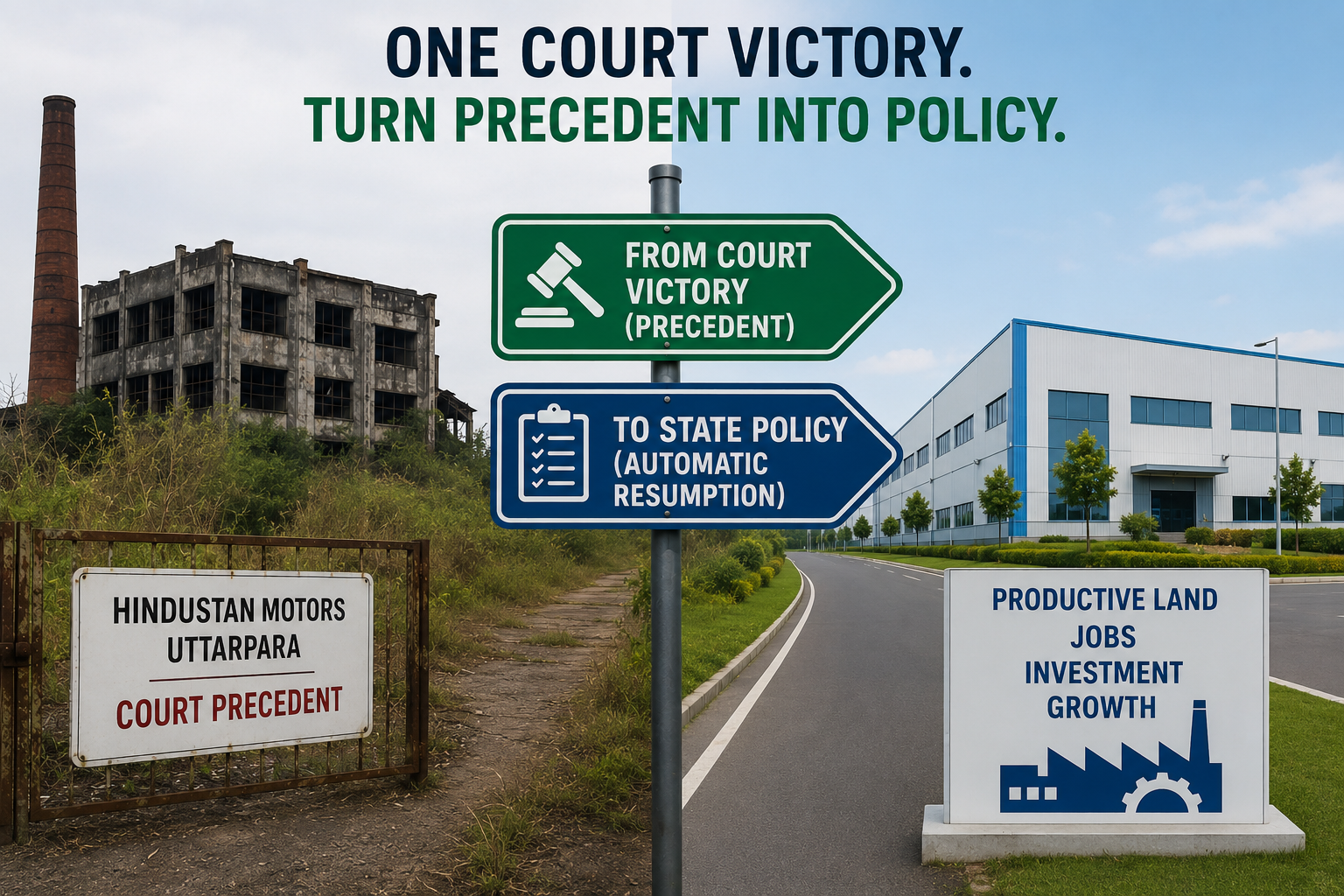
Hindustan Motors stopped making the Ambassador at its Uttarpara plant in May 2014. The land, 395 acres of it, sat fenced and largely unused while the company drew up revival plans that never materialised. The state government moved to reclaim it in November 2022. Hindustan Motors resisted, and the matter went to the Calcutta High Court, which upheld the resumption in May 2025, and then to the Supreme Court, which dismissed the company's final appeal on July 16, 2025. The land is now earmarked for a Titagarh Rail coach manufacturing facility. What Karnataka is proposing as a general policy, Bengal has already secured as a specific precedent, contested at every stage and upheld by the country's highest court. The two are not the same achievement. Karnataka's rule is prospective, general and automatic. Bengal's remains a judicial precedent rather than an administrative rule.
That precedent should have made the state's next move obvious. It has not, or not yet. Suvendu Adhikari's administration, sworn in this May after ending the Trinamool Congress's fifteen-year hold on the state, has ordered the Land and Revenue Department to survey unused land held by closed industrial units, and is preparing a new industrial policy for release around August 15 that would prioritise reusing such idle parcels for manufacturing and MSME clusters over releasing them for real estate. The contrast with the previous government's own land-use record is real but narrower than a clean reversal, and it sits uneasily with the Hindustan Motors case itself. The Mamata Banerjee cabinet, in September last year, cleared a policy allowing land that industries had been allotted decades earlier, often on ninety-nine-year leases, specifically to build residential colonies for their employees, and which had since fallen into disuse, to be converted into housing and commercial real estate, with a fee structure to be finalised by the government. That policy was confined to defunct employee-housing land, not production land itself. But the same government that passed it also spent three years in court reclaiming Hindustan Motors' production land for industrial reuse, not real estate. The previous administration's record on idle industrial land was mixed, not uniformly the disposal-to-real-estate instinct the new government presents itself as correcting. Its own biggest success on this front ran the other way.
The state's principal difficulty was not legal authority but the absence of a standard administrative mechanism. Hindustan Motors itself shows that authority still had to be tested and confirmed through litigation; it was not simply available for the asking. What the case established, after the Calcutta High Court and then the Supreme Court both affirmed it, is that a state can, at least where the governing lease and statutory framework permit, resume industrial land that has remained unused for decades. But establishing that took a lawsuit run against a company with the resources to contest it for three years, at the end of which the state got back one factory's land. A state that wants its idle industrial land back cannot litigate its way through every closed unit in Howrah, Hooghly, Durgapur and parts of North 24 Parganas one Supreme Court appeal at a time. What Karnataka's scheme does, and what Bengal still lacks, is move resumption from litigation to contract: a defined trigger written into the original allotment terms, so the state does not need eight years of dormancy and three years of appeals to establish what its own terms already implied. Most industrial allotment agreements already contain clauses permitting cancellation for non-implementation. What is missing is not the clause but a published, standard timeline that applies automatically instead of waiting to be invoked case by case in court.
The new government's response so far does not close this gap. Its ordered survey is a reasonable first step, and its stated preference for industrial reuse over real estate borrows the right instinct. But the mechanism reportedly under discussion for the August 15 policy is a "direct land purchase" model, buying land from private owners rather than resuming land the state has already allotted and the allottee failed to use. That is a tool for acquiring new industrial land, not for enforcing the terms of old allotments. It leaves the state exactly where the Hindustan Motors case found it: capable of winning back idle allotted land, but only by fighting for it one plot at a time, in each case for years, against whichever company happens to have the resources to resist.
The harder and more consequential extension, as with Karnataka, is to industrial land that was never state-allotted at all, where the plant is privately owned and shut but the land remains fenced off from any productive use. That is a different and harder problem, because the land is private property rather than a conditional grant. Any move toward compulsory acquisition there would have to survive the compensation standards under the Right to Fair Compensation Act, 2013, and the scrutiny an aggrieved owner would inevitably bring to court, much as Hindustan Motors did. Compensation under the 2013 Act would make such acquisitions expensive. But cost is not the same as impossibility, and the Hindustan Motors verdict has already shown courts are willing to weigh decades of non-utilisation against an owner's continued claim to idle land.
Karnataka has institutionalised, as a general rule, something Bengal has so far only demonstrated once, at considerable cost, under judicial compulsion. The Hindustan Motors litigation substantially clarified the state's authority in at least one important class of cases. What Bengal still lacks is an administrative process that avoids repeating that litigation plot by plot. A published resumption clause, five years and a refund with interest, applied automatically rather than fought out case by case, would let Bengal do routinely what it has so far only done once, expensively, against one of India's most storied manufacturers. Before searching for new industrial land through direct purchase, the state should first turn the Hindustan Motors precedent into a rule it does not have to relitigate every time.
The lead image is AI-generated