

TMC Rebels' Merger with NCPI May Trigger a Legal Battle Beyond West Bengal
 Editor-in-Chief of indiacommentary.com. Current Affairs analyst and political commentator. Author of Cyber Scams in India, Digital Arrest, The Money Trap and The Human Hack
View all posts by this Author
Editor-in-Chief of indiacommentary.com. Current Affairs analyst and political commentator. Author of Cyber Scams in India, Digital Arrest, The Money Trap and The Human Hack
View all posts by this Author
By Sunil Garodia
First publised on 2026-06-15 08:07:42
About the Author
Editor-in-Chief of indiacommentary.com. Current Affairs analyst and political commentator. Author of Cyber Scams in India, Digital Arrest, The Money Trap and The Human Hack
View all posts by this Author
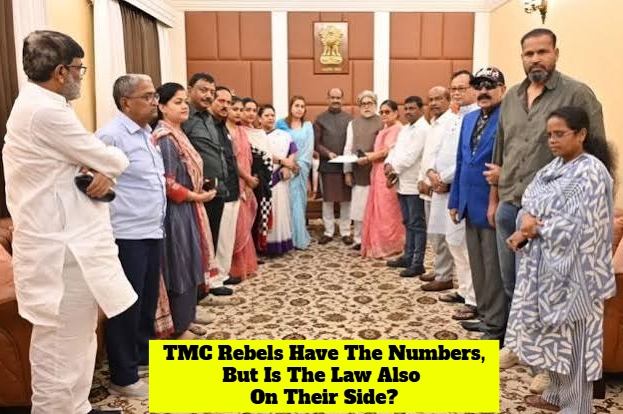
The decision of 20 rebel Trinamool Congress MPs to merge with the relatively unknown Nationalist Citizens Party of India (NCPI) has not only dealt a blow to the party's strength in Parliament but has also opened up a constitutional and legal debate whose implications could extend well beyond the immediate political fallout. While the rebels claim that they are protected by the anti-defection law because they constitute more than two-thirds of the TMC's Lok Sabha strength, the party leadership has challenged the very basis of that claim by arguing that a legislative wing cannot take decisions that belong exclusively to the organisational structure of a political party.
The political significance of the development is obvious. The rebellion has weakened the Trinamool Congress in the Lok Sabha and has simultaneously improved the numerical position of the BJP-led NDA. It has also exposed internal fissures within a party that has long projected itself as a tightly controlled political organisation centred around Mamata Banerjee's leadership. Yet the larger issue is not political arithmetic but the interpretation of the anti-defection law. The rebels have sought to take shelter under Paragraph 4 of the Tenth Schedule of the Constitution, which provides protection against disqualification in the event of a merger supported by at least two-thirds of the members of a legislative party. Their argument is that since they comfortably cross that threshold, their merger with the NCPI cannot be treated as defection.
The Trinamool Congress, however, has chosen to attack the argument at its foundation. The party's position is that the MPs who have rebelled may constitute a substantial portion of the parliamentary party, but they do not constitute the Trinamool Congress itself. According to the party, the authority to decide whether a political party should merge with another organisation rests with the bodies empowered under the party constitution and not with elected legislators. In simple terms, the TMC is arguing that while MPs represent the party in Parliament, they do not own the party and cannot take decisions that affect the existence or identity of the organisation.
This distinction between a political party and its legislative wing has acquired considerable importance in recent years, particularly after the political upheaval witnessed in Maharashtra during the Shiv Sena split. In examining that dispute, the Supreme Court emphasised the importance of the organisational structure of political parties and rejected the proposition that legislators alone could determine the identity of a political party merely by virtue of their numerical strength. Although the facts of the Maharashtra case were different, the principles discussed by the Court are likely to be relied upon heavily by the Trinamool Congress in any legal proceedings arising out of the present controversy.
The language of Paragraph 4 itself may become the focus of intense scrutiny. The provision refers to the merger of the "original political party" with another political party. This raises an important question. Has the Trinamool Congress merged with the NCPI, or have a group of TMC MPs merged themselves into another party while the original organisation continues to exist independently? The distinction may appear technical, but it could prove decisive. The Trinamool Congress remains intact as a registered political party. Its leadership remains unchanged, its organisational structure continues to function and there has been no decision by its authorised bodies approving any merger. If these facts are accepted, the rebels may find it difficult to argue that the original political party itself has merged with another organisation.
At the same time, the rebels are unlikely to concede the point easily. Their likely contention will be that the anti-defection law was designed to distinguish between individual defections and large-scale political realignments. Parliament deliberately fixed a high threshold of two-thirds to ensure that substantial sections of a legislative party are not automatically disqualified when they decide to move together. According to this interpretation, once the numerical requirement has been satisfied, legislators should be entitled to the protection provided under the merger clause. The rebels may also argue that elected representatives derive their legitimacy directly from the people and that the law cannot completely ignore the wishes of an overwhelming majority within a legislative party.
The difficulty with that argument is that it could have consequences extending far beyond the present dispute. If legislators alone are permitted to decide the fate of political parties, the authority of party constitutions and organisational structures may be severely diluted. Any sufficiently large group of MPs or MLAs could potentially bypass the leadership and claim the right to merge with another political formation. Such an interpretation would fundamentally alter the balance between party organisations and their elected representatives. It is precisely this possibility that the Trinamool Congress is seeking to prevent by insisting that merger decisions belong to the organisational wing and not the legislative wing of a political party.
The immediate decision will rest with Lok Sabha Speaker Om Birla, before whom rival claims are expected to be pressed vigorously. However, given the constitutional questions involved and the political stakes for both sides, it is difficult to imagine that the matter will end with the Speaker's ruling. The issue is almost certain to find its way to the courts, where a more definitive interpretation of the merger provisions of the Tenth Schedule may emerge. Whatever the eventual outcome, the dispute has already highlighted a grey area in India's anti-defection framework that has never been conclusively settled.
At present, the rebels can claim an important political success. They have embarrassed the Trinamool Congress, altered parliamentary equations and forced the party leadership onto the defensive. Whether they have achieved a corresponding legal success is a different matter altogether. Much will depend on how the Speaker and, eventually, the courts interpret the relationship between a political party and its legislative wing. The rebels undoubtedly have the numbers required to make a political statement. Whether those numbers are sufficient to satisfy the constitutional requirements governing mergers is a question that remains unanswered and one that could shape the future of anti-defection jurisprudence in India.