


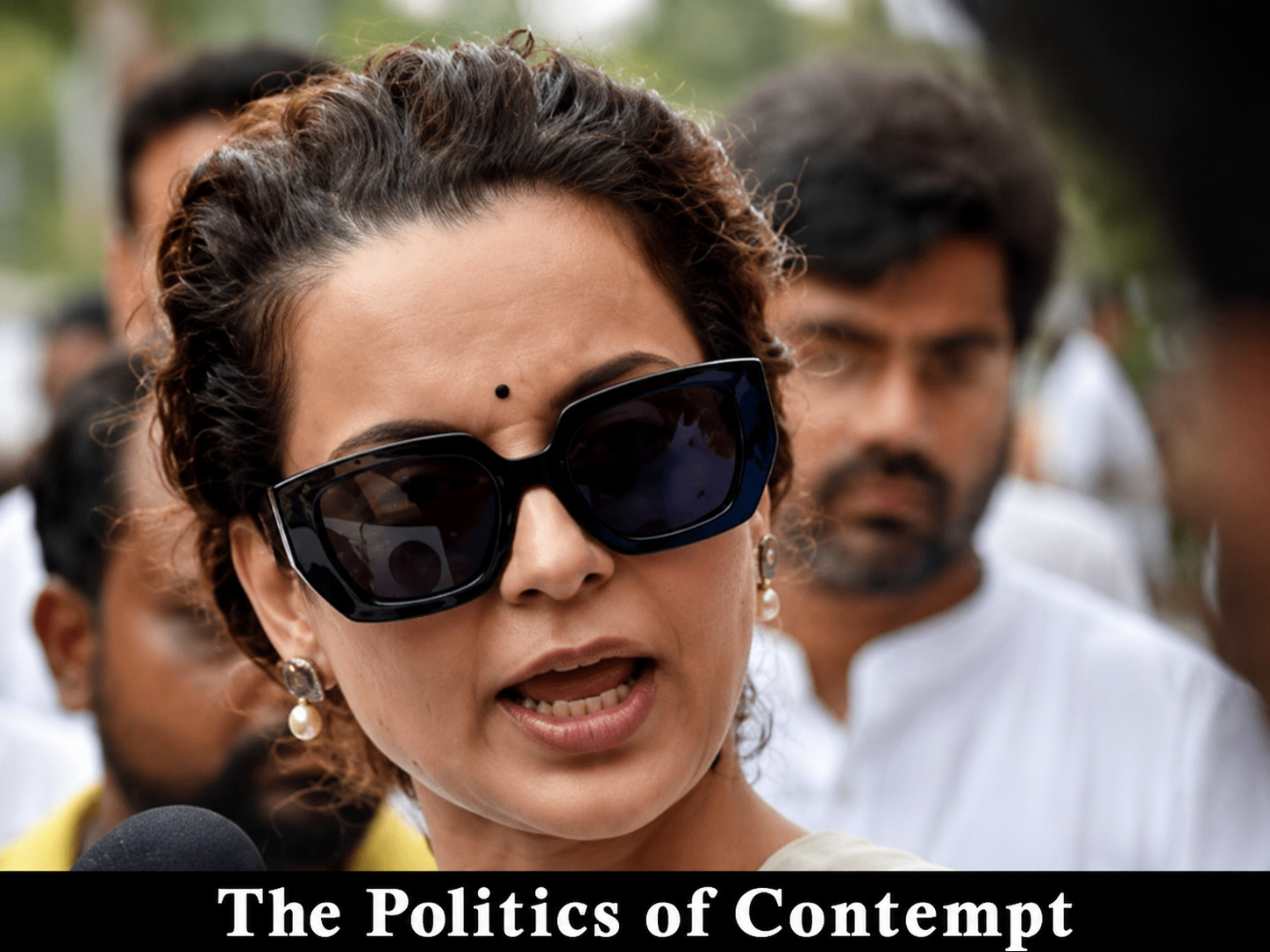
Kangana Ranaut's War on 'Generation Gutter'
 Editor-in-Chief of indiacommentary.com. Current Affairs analyst and political commentator. Author of Cyber Scams in India, Digital Arrest, The Money Trap and The Human Hack
View all posts by this Author
Editor-in-Chief of indiacommentary.com. Current Affairs analyst and political commentator. Author of Cyber Scams in India, Digital Arrest, The Money Trap and The Human Hack
View all posts by this Author
By Sunil Garodia
First publised on 2026-07-29 14:59:57
About the Author
Editor-in-Chief of indiacommentary.com. Current Affairs analyst and political commentator. Author of Cyber Scams in India, Digital Arrest, The Money Trap and The Human Hack
View all posts by this Author
There is a particular kind of political courage that consists entirely of insulting people who cannot vote you out, and Kangana Ranaut has just given a masterclass in it. This week, as the Cockroach Janta Party's protests over the NEET paper leak spread from Jantar Mantar to cities across the country, the Mandi MP took to Instagram to diagnose the entire generation participating in them. Her verdict: "gutter." Her supporting evidence: reels.
To recap what she actually said, because the words matter more than any paraphrase could: the protesters' videos were, in her telling, "puke-inducing," their language "jarring and crass," and she wondered aloud "who is birthing and raising them." She reserved a separate, sharper barb for what she called "so-called westernised Indian women" among the protesters, accusing them of flaunting "drugs, drinks" and living off their parents while demanding independence they had not earned. She named the whole cohort "Generation Gutter" and added, for good measure, that they were too "ugly and corrupt" even to be homemakers.
One need not agree with a single demand made by the protesters to recognise that elected representatives are expected to answer criticism with argument, not contempt. The question an elected member of Parliament ought to be able to answer is why a policy grievance about a leaked entrance exam warrants a character assassination of an entire demographic, delivered in the language of a WhatsApp forward rather than a public representative. It did not go unanswered for long. The CJP itself hit back, arguing that public representatives owe the discourse dignity rather than personal invective. Congress's Bhai Jagtap asked, not unreasonably, how a woman could watch young protesters being manhandled and respond with contempt rather than concern. AIMIM's Waris Pathan went further, suggesting Ranaut might not know what NEET stands for, and demanded an apology to the generation she had just written off.
None of this is new territory for her, and that is the point. This is the same politician who called the farm-law protests a "Bangladesh-type situation" of rapes and hanging bodies that existed only in her account, and who declared India's 1947 independence "bheek," with real freedom arriving only in 2014, a claim rejected by historians across the spectrum and criticised even within the BJP. None of these controversies arose from difficult policy choices; each arose because Ranaut chose maximal provocation where measured argument would have sufficed. The arc is always identical: an inflammatory claim built on no discernible evidence, a wave of backlash, a half-hearted retreat, and then, months later, a fresh controversy that makes the last one look quaint. This is not a politician occasionally losing her composure under pressure. It is the operating procedure of someone who has concluded that manufactured outrage is a more reliable currency than argument, recycling contempt for farmers into contempt for students into contempt for an entire generation.
What makes this instalment different is the audience she has chosen to alienate. Farmers and opposition politicians were never going to defend her. But "Generation Gutter" does not spare the young voters, including young women, whom the BJP has spent a decade cultivating as a demographic dividend. Calling them incapable of being homemakers while accusing them of promiscuity is not a swipe at an ideological opponent; it is a swipe at exactly the constituency a ruling party needs enthusiastic, not embarrassed. It is telling that even social media users sympathetic to her past positions have begun asking, pointedly, whether she has forgotten the excesses of her own Bollywood years before lecturing a generation on ugliness. When your own camp starts reaching for that argument, the insult has stopped being provocative and started being merely tone-deaf.
The BJP has often survived controversies created by outspoken allies. It is less clear whether it can afford one that tells an entire generation, many of them first-time voters, that they are "gutter." Elections are won by persuading young voters they belong in the future. They are rarely won by informing them they are the problem.