Rahul Gandhi Has A 30-Second Cure for Traders in Delhi
 Editor-in-Chief of indiacommentary.com. Current Affairs analyst and political commentator. Author of Cyber Scams in India, Digital Arrest, The Money Trap and The Human Hack
View all posts by this Author
By Sunil Garodia
First publised on 2026-10-26 15:31:02
About the Author
Editor-in-Chief of indiacommentary.com. Current Affairs analyst and political commentator. Author of Cyber Scams in India, Digital Arrest, The Money Trap and The Human Hack
View all posts by this Author
He says he is listening. They asked him to postpone his rally. His response: ask Modi to sack the CEC.
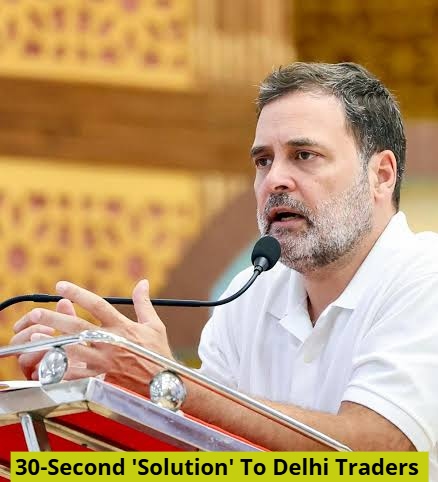
Rahul Gandhi has offered Delhi's traders a remarkable bargain. They fear that the Congress-led INDIA bloc's November 1 rally at Ramlila Maidan will disrupt business during the festive shopping season, and the Chamber of Trade and Industry has asked him to postpone it until after November 10. Gandhi's response, posted on X on October 26, was to tell the traders to ask Narendra Modi to sack Chief Election Commissioner Gyanesh Kumar. The protests, he promised, would stop in 30 seconds.
Thirty seconds is an ambitious deadline for anything in Indian politics, and more so for a constitutional dispute.
To be fair, Gandhi may be speaking in political shorthand. He may mean that the government should act against Kumar, not that it should dismiss him by order. But Modi cannot unilaterally remove the CEC. Under Article 324(5), Kumar can be removed only in the manner and on the grounds applicable to a Supreme Court judge: proved misbehaviour or incapacity, established through a parliamentary process and backed by special majorities in both Houses. A voluntary resignation is Kumar's decision, not the Prime Minister's.
More importantly, the traders did not ask Gandhi to settle the dispute over the Election Commission. They asked him to reschedule a rally organised by his own alliance. He can agree, refuse or offer a compromise, and none of these requires a call to the Prime Minister.
Gandhi opened his message with the words "We love you and hear you." The traders have a practical problem involving customers, traffic and festive sales. What they received in return was a political demand about the CEC.
This is familiar territory. In 2013, he publicly denounced an ordinance approved by the Manmohan Singh Cabinet as "complete nonsense" that should be torn up and thrown away. He did not literally tear the document, as the popular version of the episode suggests, but his intervention embarrassed the Prime Minister, and the government withdrew the ordinance. Gandhi may well have been right on the merits. The two episodes are not identical, but the pattern is similar: the declaration comes first, and the institutional route is worked out afterwards, if at all.
The same habit shows up now. Gandhi accuses Modi of weakening institutions and concentrating power, yet his remedy for the CEC controversy assumes the Prime Minister can deliver the outcome on demand. The Constitution, inconveniently, does not work like a customer-service counter.
There is a perfectly respectable way to answer the traders. Gandhi could explain why the rally must take place on November 1, agree to a later date, or work with the police to limit the disruption.
When people ask you to move your rally, the first question is whether you can move your rally. The dispute over the CEC can be pursued separately, through the appropriate constitutional and political channels.
Thirty seconds may be enough to deliver a punchline. It is not always enough to produce a solution.