

The Gaumutra Gambit: Where Priyanka Vadra Went Wrong
 Editor-in-Chief of indiacommentary.com. Current Affairs analyst and political commentator. Author of Cyber Scams in India, Digital Arrest, The Money Trap and The Human Hack
View all posts by this Author
Editor-in-Chief of indiacommentary.com. Current Affairs analyst and political commentator. Author of Cyber Scams in India, Digital Arrest, The Money Trap and The Human Hack
View all posts by this Author
By Sunil Garodia
First publised on 2026-07-30 15:32:52
About the Author
Editor-in-Chief of indiacommentary.com. Current Affairs analyst and political commentator. Author of Cyber Scams in India, Digital Arrest, The Money Trap and The Human Hack
View all posts by this Author
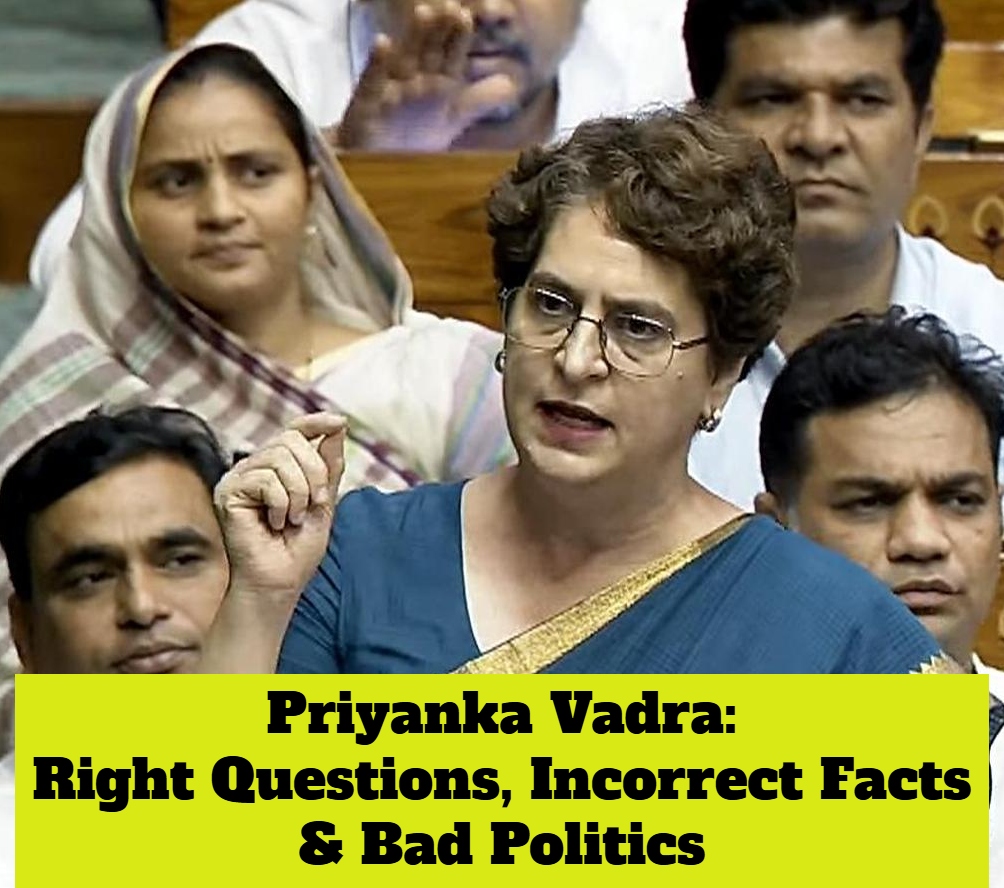
Priyanka Vadra stood up in the Lok Sabha this week to raise questions that deserved to be asked. Why, after the Radhakrishnan Committee's exhaustive report on examination reform, did the government feel the need to constitute yet another task force under Nandan Nilekani? Which recommendations remain unimplemented, and why? Those are legitimate questions for Parliament to put to the government. Instead, the debate disappeared beneath two avoidable soundbites. Vadra claimed that not a single recommendation of the Radhakrishnan Committee had been implemented, and described one of the task force's members, IIT Madras Director V. Kamakoti, as a "gau mutra expert."
The available record does not support that claim.A High-Powered Steering Committee under K. Radhakrishnan was constituted soon after the report's submission to oversee implementation. Security protocols for JEE (Main) were tightened, the CUET subject structure was rationalised, and a substantial number of the committee's recommendations were either implemented or put into execution. That does not mean the reforms were complete, or that they succeeded in preventing subsequent failures. It does mean that criticism should have focused on what remained undone rather than suggesting nothing had been done at all.
The second remark has since drawn a rebuke from 215 vice-chancellors, former vice-chancellors and academicians, who wrote an open letter arguing that whether intended as sarcasm or as political rhetoric, the label reduces a scientist with over 150 published papers and more than fifty R&D projects to an ideological caricature. Their letter makes a point that ought to be uncontroversial: the Lok Sabha is supposed to be a forum where arguments are tested against arguments, not where individuals are dismissed through caricature. That a professor's real or presumed ideological associations should become shorthand for evaluating his scholarship is precisely the kind of reasoning that democratic debate is meant to resist.
None of this excuses the government benches from their own contribution to the theatre. BJP MP Anurag Thakur's response, which suggested Vadra should "join the RSS" to "learn some values," was every bit as much an argument by association as the remark it condemned. If Kamakoti's presumed ideological leanings do not diminish his scientific credentials, and they plainly do not, then invoking those same associations approvingly as a rebuke to Vadra accepts the very premise her critics say she was wrong to introduce: that a person's political address matters more than the quality of his work. Both sides, in other words, agreed on the terms of the fight even while pretending to disagree on the outcome.
What makes this episode worth dwelling on is that it is neither new nor confined to one party. Congress leaders have questioned university appointments by suggesting ideological loyalty has trumped merit, prompting public letters from academicians defending the appointees. The BJP, in turn, has rallied academics against what it calls a "disruptive far-left agenda" on university campuses. Across these episodes, the pattern is remarkably consistent. In a political culture where ideological labels are often more electorally useful than evidence, it becomes cheaper to identify a person's tribe than to engage with his argument.
That is what makes the Kamakoti episode instructive beyond its immediate controversy. Parliament had before it an opportunity to examine why, despite significant progress on the Radhakrishnan Committee's recommendations, important gaps evidently remained, because the government itself chose to constitute another high-level task force.It could have debated which reforms had succeeded, which had stalled, and whether the government's priorities had been misplaced. Instead, a debate about institutional reform became a debate about an individual's perceived ideological identity.
If the intended target of Vadra's intervention was the government's handling of examination reform, the intervention achieved the opposite of its purpose. By combining an inaccurate claim about implementation with a personal label, it offered the government's defenders a far easier contest. They no longer had to answer difficult questions about unfinished reforms or the necessity of a new committee. They only had to defend a scientist against an insult, and they accepted that invitation gladly.
There is a recurring design flaw in Indian political rhetoric that this episode illustrates with unusual clarity. A legislator who wants to be taken seriously on a matter of public policy cannot afford to replace precision with provocation. Every time a prominent parliamentarian, of any party, reaches for a label rather than a rebuttal, supporters may celebrate the flourish, but the substantive argument quietly slips away. The discussion ceases to be about evidence and becomes a contest over identities. That is not a victory for either side. It is a failure of democratic argument, dressed up as political success.
The open letter's most valuable contribution is not its defence of Kamakoti's academic record, creditable though that record is. It is its reminder that scientists and scholars should be able to participate in public life without expecting disagreement to take the form of ideological labelling rather than intellectual engagement. That principle should not require 215 signatures to defend. It should be the minimum standard of a functioning legislature. A democracy cannot deliberate if every disagreement begins by deciding who a person is instead of examining what they have argued.