

India Acts To Keep Black Mass at Home
 Linus tackles things head-on. He takes sides in his analysis and it fits excellently with our editorial policy. No 'maybe's' and 'allegedly' for him, only things in black and white.
View all posts by this Author
By Linus Garg
First publised on 2026-11-12 05:41:36
About the Author
Linus tackles things head-on. He takes sides in his analysis and it fits excellently with our editorial policy. No 'maybe's' and 'allegedly' for him, only things in black and white.
View all posts by this Author
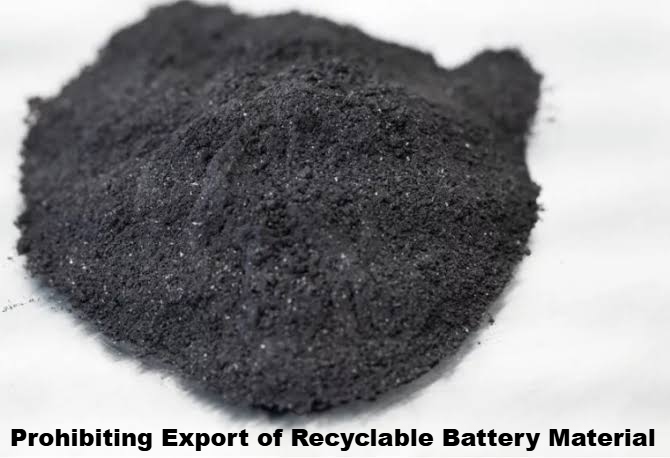
The Directorate General of Foreign Trade has moved the export of lithium-ion battery black mass from "Free" to "Prohibited," with immediate effect. It is a short notification with large consequences, and the government deserves credit for acting before the damage became irreversible.
Black mass is the dark powder left when end-of-life lithium-ion batteries are shredded. It looks like waste. It is in fact a concentrated store of lithium, cobalt, nickel, manganese and graphite, the materials on which India's electric-vehicle ambitions, grid storage plans and cell-manufacturing incentives all depend. India has almost no commercial reserves of cobalt or nickel and only nascent lithium prospects. Every tonne of recyclable battery material is therefore one of the few domestic "mines" the country has. Shipping it abroad as an unprocessed commodity amounts to exporting our future raw material at a discount.
A leaky regime
The old arrangement was weaker than it looked. Black mass is classified as hazardous waste, and exporting it already required permission from the environment ministry and a licence from the DGFT. Yet the trade persisted. Industry reports have described attempts to move black mass out under altered HS codes, with cargo allegedly bound for China via a bill-of-lading switch at Singapore. Those are allegations, but they point to a real problem. A licensing system that can be dodged by relabelling a consignment is not protecting a strategic resource.
Underneath lies a simple distortion. High export prices have lured Indian recyclers, creating a distorted market. The price of black mass is driven largely by its cobalt content. A recycler who can sell the powder abroad for a better price has little reason to feed it to a domestic refinery. Left alone, that logic turns India into a feedstock supplier for other countries' battery industries and then makes us buy back the refined chemicals at a premium. A prohibition changes the incentive.
We are not alone
The government has not acted in isolation. On 6 August 2026 the US Commerce Departmentâs Bureau of Industry and Security issued a temporary final rule barring black mass exports without a licence. Sellers there must allocate all their monthly sales to US buyers. China has built its own system of standards and import management around recycled black mass. The world's major economies have concluded that recovered battery metals are strategic assets. A country that treats them as ordinary scrap while its rivals lock them down will find itself at the back of the queue.
The honest caveats
The prohibition is necessary, but it is not sufficient, and the industry has raised fair concerns. Some stakeholders have argued for a phased, consultative rollout, since several shredding-stage (R2) recyclers currently depend on exports. Others note that the ban does not touch refined metals and salts. There is also the harder question of whether India can absorb what it now keeps. Industry voices have pointed out that without a domestic cathode active material ecosystem, black mass producers can sustain themselves only through exports.
These are arguments for completing the policy, not for withholding it. Domestic refining capacity is already arriving. One facility in Karnal reports 7,600 tonnes a year of black mass refining capacity. The government's task now is to make sure that capacity scales faster than the stockpiles of unprocessed powder grow. That means the following:
1. Speed up refiner approvals and pollution clearances, so that R2 recyclers have somewhere to sell.
2. Publish a clear black mass standard and a stable HS classification, which would close the mislabelling loophole.
3. Link the ban to demand: procurement and incentive schemes for domestic cell makers should reward the use of recycled content.
4. Keep customs enforcement vigilant, because a ban is only as good as its inspection.
5. Review the policy periodically, and extend it to intermediate refined products if value is still leaking out.
The strategic logic is straightforward. India is spending enormous public money to build a battery and EV supply chain through production-linked incentives, the critical minerals mission and extended producer responsibility under the Battery Waste Management Rules. It would be self-defeating to subsidise the factories and then export the recovered raw material that could feed them. Every tonne of black mass retained is a tonne of cobalt and nickel we need not import, and a tonne of skilled refining work done in India rather than elsewhere.
There will be short-term friction. Some recyclers will lose a lucrative outlet, and prices for black mass will adjust. But a transition cost borne by a few firms is a small price for resource security that benefits the entire economy. The decision is the right one, taken at the right time. Now the government must build quickly on the ground it has secured.