

Turning Back the Clock: UP Bets on Newspapers in Schools
 Editor-in-Chief of indiacommentary.com. Current Affairs analyst and political commentator. Author of Cyber Scams in India, Digital Arrest, The Money Trap and The Human Hack
View all posts by this Author
Editor-in-Chief of indiacommentary.com. Current Affairs analyst and political commentator. Author of Cyber Scams in India, Digital Arrest, The Money Trap and The Human Hack
View all posts by this Author
By Sunil Garodia
First publised on 2025-12-29 12:18:19
About the Author
Editor-in-Chief of indiacommentary.com. Current Affairs analyst and political commentator. Author of Cyber Scams in India, Digital Arrest, The Money Trap and The Human Hack
View all posts by this Author
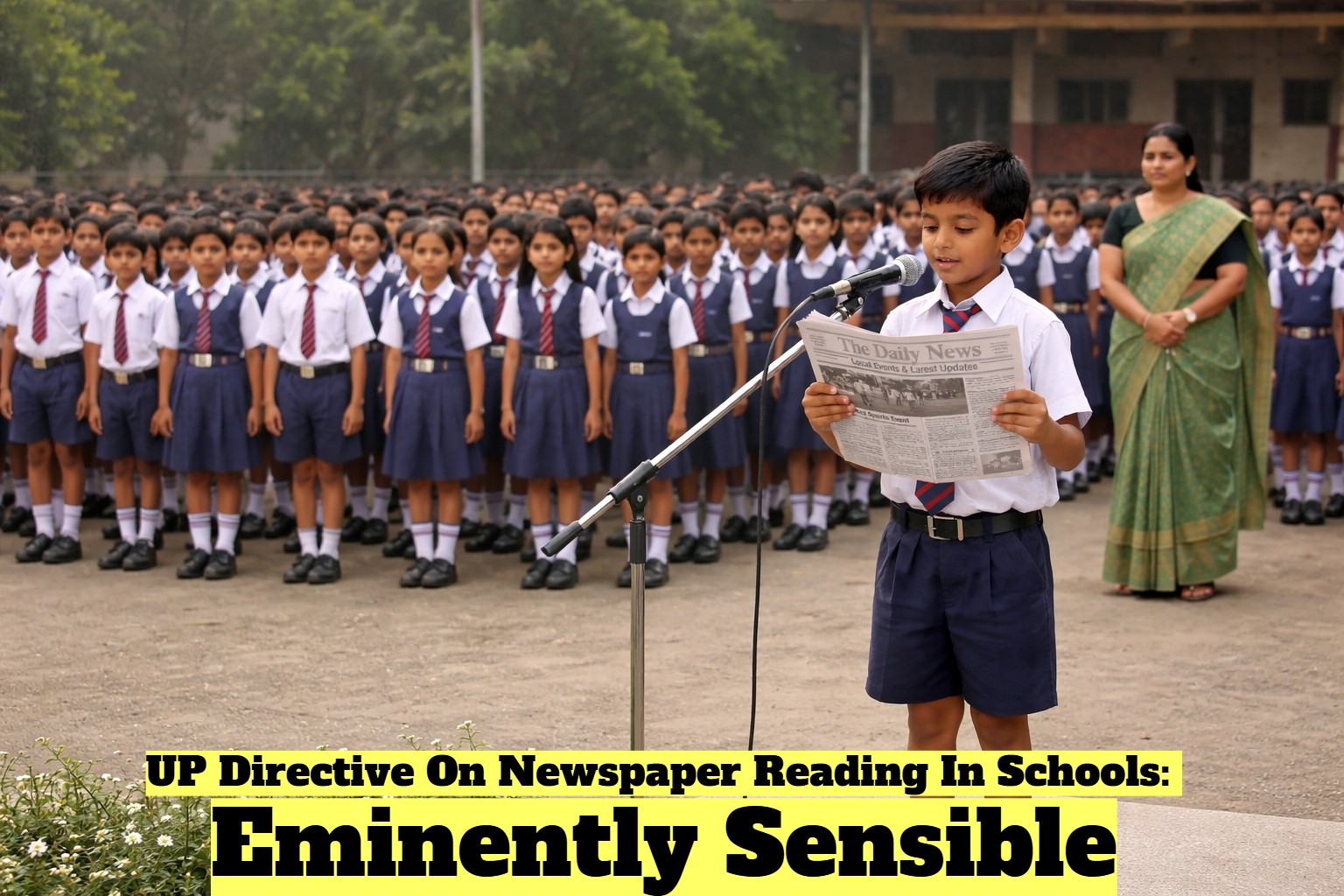
In a time when children scroll instinctively but struggle to sit with a page, the Uttar Pradesh government has chosen an unexpectedly simple intervention. On December 23, a directive made newspaper reading a compulsory daily activity in all primary and secondary schools across the state, cutting against the grain of most contemporary education reforms.
The instruction is precise and leaves little room for ambiguity. Ten minutes during morning assembly are now reserved for reading newspapers. Students will take turns reading editorials and major developments from national, international, and sports pages. Schools are required to provide both Hindi and English newspapers in their libraries, and each day five unfamiliar words from the paper will be selected, explained, and displayed on notice boards to build vocabulary.
The measure may appear modest at first glance, but it is responding to a problem that has been building quietly for years. Children today are growing up in a world of constant screens, and the consequences are becoming harder to ignore.
Studies conducted in India and abroad suggest the problem is already widespread. A 2022 paper published in the Indian Journal of Pediatrics found that 53.7% of Indian children had screen exposure beyond recommended limits, with an average daily screen time of around 1.6 hours. The same research reported that over 95% of infants under one year were exposed to screens, despite medical guidelines advising against it.
Among older children and adolescents, screen use has become even more embedded in daily routines. A study published in BMC Public Health noted that more than three-quarters of Indian adolescents watched television during meals, indicating that screen consumption is no longer a discrete activity but a constant background presence.
What is happening in India is happening on a bigger scale in more advanced economies. According to data from Common Sense Media, teenagers in the United States spend an average of 8 hours and 39 minutes per day on entertainment screen use alone. Medical and developmental research published in journals such as JAMA Pediatrics has linked excessive screen exposure in childhood to delayed language development, reduced attention span, sleep disruption, and weaker social skills.
Against that backdrop, asking children to read a newspaper every morning looks less like a nostalgic gesture and more like a deliberate intervention. It is an attempt to reintroduce habits that screens have steadily displaced.
What makes this initiative especially interesting is where it is happening. While newspapers are shrinking across much of the world, India remains an exception. From just a few hundred dailies after Independence, the country now has over 1.4 lakh registered newspapers and periodicals, making it one of the largest print markets globally.
Surveys continue to show that a significant share of Indians aged 12 and above still read newspapers regularly. Hindi dailies such as Dainik Jagran and Dainik Bhaskar reach tens of millions of readers each day. Print, at least for now, still holds ground in a way it no longer does elsewhere.
Even so, the warning signs are clear. Younger readers are steadily drifting away from print toward digital platforms. Research points to a noticeable decline in newspaper use among younger age groups, with online sources becoming their default. That is precisely the audience this policy is trying to reach before the habit disappears entirely.
The case for newspapers in classrooms is not about sentimentality. It is about what this form of reading trains the mind to do, and what is lost when it disappears.
Newspapers expose children to language they rarely encounter elsewhere. Vocabulary, sentence structures, and writing styles vary widely across reports, editorials, features, and sports coverage. Over time, this steady exposure strengthens reading, comprehension, and expression in ways textbooks often struggle to replicate.
They also teach judgment. In a media environment flooded with misinformation, learning to distinguish fact from opinion matters. Reading newspapers helps students notice sourcing, recognise bias, and understand how arguments are constructed rather than simply consumed.
Equally important is the demand newspapers place on attention. Articles cannot be absorbed in seconds. They require readers to follow a thread, retain context, and sit with complexity. That kind of sustained focus is becoming increasingly rare, and increasingly valuable.
There is also a civic dimension to this exercise. Democracies depend on informed citizens, and newspapers remain one of the few formats that explain policy debates and social issues with depth rather than outrage. Reading the news regularly is not just about knowing what happened, but about understanding how decisions are made and why they matter.
The newspaper mandate does not stand alone. It is part of a broader attempt to rebuild reading habits within schools. Under the "No Bouquet, Only Book" campaign, books are given instead of trophies at school functions. Students are expected to borrow at least one non-syllabus book each week from their libraries, and frequent readers are formally recognised.
Taken together, these measures point to a quiet shift in priorities. There is less emphasis on novelty and spectacle, and more emphasis on routine and habit.
Implementation, however, will be the real test. Ensuring consistent access to newspapers in remote and rural schools will not be easy. Teachers will need guidance to turn reading into discussion rather than routine. There is also the familiar risk that the exercise becomes symbolic, completed in form rather than in spirit.
Some critics argue that teaching children to read print newspapers is outdated in an age when news breaks online within seconds. That argument misunderstands the goal. Children already know how to access information quickly. What they increasingly lack is the ability to slow down, read carefully, and make sense of what they are consuming.
Scrolling delivers updates, but reading builds understanding. The difference is subtle, but it matters.
Other countries with strong education outcomes have not abandoned newspapers. In Finland, often cited for its education system, newspapers are used across subjects. Students analyse articles, debate editorial positions, and use reporting as a starting point for research. Strong reading comprehension follows naturally from this approach.
Uttar Pradeshâs strategy is simpler and more basic. Build the habit first, and let the skills develop over time.
Ten minutes of newspaper reading a day will not transform education overnight. But it can restore something that constant connectivity has steadily eroded: patience, focus, and the ability to engage with complex ideas without distraction.
Newspapers are slow by design. They expose readers to viewpoints outside algorithmic bubbles and operate within systems of editorial accountability that much online content lacks. Those qualities matter more now than they did before.
Whether this initiative succeeds will depend entirely on how seriously it is implemented. But the instinct behind it is hard to dismiss. At a moment when most educational reforms chase the newest technology, it is refreshing to see one that looks backward with intention.
Some practices endure because they work. Regular, focused reading is one of them.
Note: The lead picture is AI-generated