

VIP Culture, Once Again, Shows India Its Place
 Editor-in-Chief of indiacommentary.com. Current Affairs analyst and political commentator. Author of Cyber Scams in India, Digital Arrest, The Money Trap and The Human Hack
View all posts by this Author
Editor-in-Chief of indiacommentary.com. Current Affairs analyst and political commentator. Author of Cyber Scams in India, Digital Arrest, The Money Trap and The Human Hack
View all posts by this Author
By Sunil Garodia
First publised on 2025-12-15 15:44:16
About the Author
Editor-in-Chief of indiacommentary.com. Current Affairs analyst and political commentator. Author of Cyber Scams in India, Digital Arrest, The Money Trap and The Human Hack
View all posts by this Author
If anyone still needed proof that VIP culture is corroding public life in India, Lionel Messi's visit to Kolkata provided it in brutal clarity.
Thousands of fans paid hefty sums to attend the event at Salt Lake Stadium as part of Messi's G.O.A.T. India Tour. Many travelled long distances, took time off work, and stood for hours in packed galleries, hoping for a glimpse of one of football's greatest players. What they got instead was a lesson in how little the paying public matters when power walks in.
Messi did appear. But he was quickly ring-fenced by a dense cluster of politicians, government functionaries, celebrities, and assorted VIPs who crowded around him as if access itself were the prize. Ordinary ticket-holders were left straining to see past a human wall of entitlement, lifting phones above their heads, standing on tiptoe, trying desperately to justify the money they had spent.
The videos that flooded social media captured the moment perfectly. Smiling ministers posing for photographs. Entourages blocking sightlines. Fans behind them visibly angry and helpless. The contrast was obscene. This was not an event organised for football lovers. It was a photo-op for the powerful.
What made it worse was the sheer absurdity of it. Many of these VIPs had no visible connection to football at all. Their interest began and ended with the selfie. Never mind that ordinary citizens had shelled out thousands of rupees, navigated traffic and crowds, and rearranged their lives for this one evening. Their experience was clearly secondary.
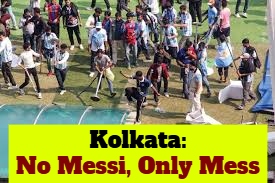
Predictably, frustration boiled over. Booing followed. Objects were thrown. Parts of the stadium were vandalised. Authorities were quick to condemn the crowd's behaviour, far quicker than they were to acknowledge what had caused it. Fans didn't arrive angry. They became angry after being treated as extras in a spectacle they had paid for.
The aftermath followed a familiar script. The event organiser was arrested. Chief Minister Mamata Banerjee issued a public apology. A government-appointed inquiry was announced to look into mismanagement and lapses. And then, almost as quickly, the system moved on.
What was missing was accountability at the level where it actually mattered. Not one VIP who elbowed their way into the spotlight apologised. No politician acknowledged that their presence may have worsened the chaos. The message was clear: consequences are for organisers, not for the powerful who hijack public events with impunity.
This episode was not an aberration. It is part of a pattern Indians know too well. Cricket matches, concerts, cultural programmes - everywhere, the same hierarchy asserts itself. VIP passes multiply. Rules bend. Organisers comply. And the paying public adjusts or suffers.
VIP culture has seeped into every corner of public life - airport queues, hospital wards, school admissions, train compartments. It thrives on the unspoken assumption that some people matter more than others, even in spaces that are supposedly public.
Messi's visit should have been remembered as a celebration of football in a city that loves the game. Instead, in Kolkata, it became a reminder of something else entirely: that in India, status often trumps fairness, and the common citizen is still expected to stand quietly behind the rope.
And that, more than the chaos or the damaged seats, is the real disgrace.