
A Bench Is Not A Blacklist
 Editor-in-Chief of indiacommentary.com. Current Affairs analyst and political commentator. Author of Cyber Scams in India, Digital Arrest, The Money Trap and The Human Hack
View all posts by this Author
By Sunil Garodia
First publised on 2026-11-22 00:49:19
About the Author
Editor-in-Chief of indiacommentary.com. Current Affairs analyst and political commentator. Author of Cyber Scams in India, Digital Arrest, The Money Trap and The Human Hack
View all posts by this Author
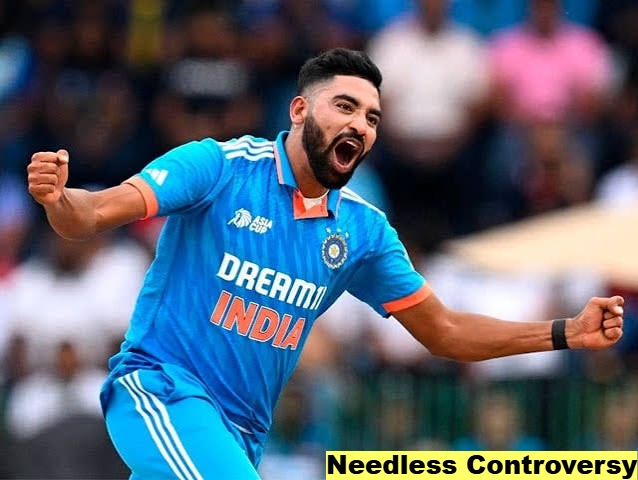
The charge that Mohammed Siraj was left out of the Wellington Test because he is a Muslim has not been supported by any evidence. It rests entirely on his name. An accusation of religious discrimination against a team management is a charge of intent, which must be proved and cannot be assumed.
The facts come first. On November 19 India chose four fast bowlers, Jasprit Bumrah, Akash Deep, Anshul Kamboj and Prasidh Krishna, with Washington Sundar as the spinning all-rounder. Siraj, Gurnoor Brar and Ravindra Jadeja were left out. Captain Shubman Gill said at the toss that the decision was very difficult and acknowledged how well Siraj and Brar had done in the ODI series. Batting coach Sitanshu Kotak said there was nothing wrong with Siraj, that no fitness issue existed, and that the XI was picked for five days on a grassy pitch and not for the first morning alone.
The next day Congress MP Imran Masood said, "His name is Siraj, isn't that reason enough?" His own party colleague Hussain Dalwai publicly disagreed. Dalwai said such things happen in cricket and that viewing every matter through that lens is wrong. The BJP then joined in. Kiren Rijiju said opportunities in India go by merit, and Pradeep Bhandari called the Congress communal. Within a day a bowling combination had become a party contest, which is exactly the harm such remarks do.
Apply the test of logic. If faith decided this XI, it would have to explain Jadeja, a senior all-rounder with a long Test record, who was also dropped. It would have to explain Brar, praised by his own captain. It would also have to explain why this management picked Siraj for 11 Tests in the current World Test Championship cycle, in which he has taken 43 wickets, making him India's leading wicket-taker so far. A management bent on keeping a Muslim bowler out does not behave in that way.
The examples offered by the accusers do not help them. Mohammed Shami played 64 Tests for India over 13 years and took 229 wickets. He ended that career on November 6 by his own announcement, and he thanked the BCCI and the Cricket Association of Bengal as he left. Sarfaraz Khan made his debut in February 2024 with 62 off 66 balls, played six Tests, and scored a hundred against New Zealand. He has not played since November 2024. His absence from subsequent Test selections has to be assessed against the competition for batting places and the selectors' assessment of form and team balance. Being out of the team, without evidence of discriminatory treatment, does not establish that faith is the reason.
Indian cricket is full of players who were good enough and never capped. Padmakar Shivalkar took 589 first-class wickets for Bombay at 19.69 between 1961-62 and 1987-88, with 42 five-wicket hauls. He never played a Test because Bishan Singh Bedi was the left-arm spinner India picked, and because the famous spin quartet left no vacancy. Rajinder Goel took 750 first-class wickets, 637 of them in the Ranji Trophy, a record that still stands. Sunil Gavaskar recalled that Goel bought new boots and kit for a Test where he ended up twelfth man, and that Bedi returned from suspension for the next one. Goel was never bitter about it, and in his tribute after Goel died in 2020, Bedi said he envied Goel's contentment. Their careers remain reminders that exceptional domestic achievement does not guarantee international selection.
The modern list is as long. Amol Muzumdar scored 11,167 first-class runs with 30 hundreds at an average of 48.13, including 260 on debut, and never played for India because Tendulkar, Dravid, Ganguly and Laxman held the middle order. Jalaj Saxena has approximately 7,060 first-class runs and 484 wickets, and last October two former selectors, Salil Ankola and Chetan Sharma, joked on air about his absence from the national side. Sitanshu Kotak scored 8,061 runs with 15 hundreds across more than two decades for Saurashtra and was never capped. He is the man now explaining the Wellington XI, and few people know better what it is to be good enough and still left out.
The closest parallel is the old charge of regionalism. For decades Bombay supplied the core of the national side. It was said that making the Indian team was easier than making the Bombay XI, and the 1971 tour party that won in the West Indies carried five Bombay players. Other zones complained that Bombay cornered places. By 1996 the complaint had turned around, when a tour party for South Africa carried just one Bombay player. In 2016 India played England without a Bombay player for the first time in 73 years, and Gavaskar himself has accused national selectors of bias against Mumbai players. These charges cannot all be true. They show what an aggrieved camp does after a selection that goes against it: it reaches for a motive when it should examine the merit.
Selection politics is real. Cricinfo's history records the selectors of 1958-59 quarrelling along regional lines. That is exactly why an allegation of bias must come with facts. Where bias exists, a pattern can be shown, such as equally placed players treated differently, or a rule that fell on one group alone. Nobody has produced such a pattern in this case.
None of this puts the decision beyond criticism. Gavaskar, Ravi Shastri, R Ashwin and Aakash Chopra have all questioned it on cricketing grounds, and they are entitled to do so. New Zealand recovered on the opening day through Henry Nicholls and Glenn Phillips, and the management will be judged on the result of the series. A selection can be wrong without being biased, and a fine bowler can miss out on a given morning for reasons of conditions, balance and workload. The proper reply to that is the one cricket has always offered, which is argument over form and combination.
The accusation also does harm. It tells Akash Deep, Kamboj and Prasidh that their places were won by a name and not by the ball. It turns Siraj, who has taken five-wicket hauls in three of the four SENA countries, into a symbol in an argument that is not about bowling. It also hands politicians of both camps a platform they did not earn.
Siraj has not been sent home. He is with the squad. He bowled 35 overs for India A at Hagley Oval on November 2, the ground where the second Test begins on November 27. He will play when the management decides that the conditions and the combination need him, as every member of a touring squad does. The Indian bench is long and deep, and it holds players of every faith and region. It is a queue and not a blacklist. The management should be judged by the scoreboard, and it should not be tried for a crime that nobody has shown it committed.