

A Celebration That Should Make Us Uncomfortable
 Editor-in-Chief of indiacommentary.com. Current Affairs analyst and political commentator. Author of Cyber Scams in India, Digital Arrest, The Money Trap and The Human Hack
View all posts by this Author
Editor-in-Chief of indiacommentary.com. Current Affairs analyst and political commentator. Author of Cyber Scams in India, Digital Arrest, The Money Trap and The Human Hack
View all posts by this Author
By Sunil Garodia
First publised on 2026-04-06 05:59:34
About the Author
Editor-in-Chief of indiacommentary.com. Current Affairs analyst and political commentator. Author of Cyber Scams in India, Digital Arrest, The Money Trap and The Human Hack
View all posts by this Author
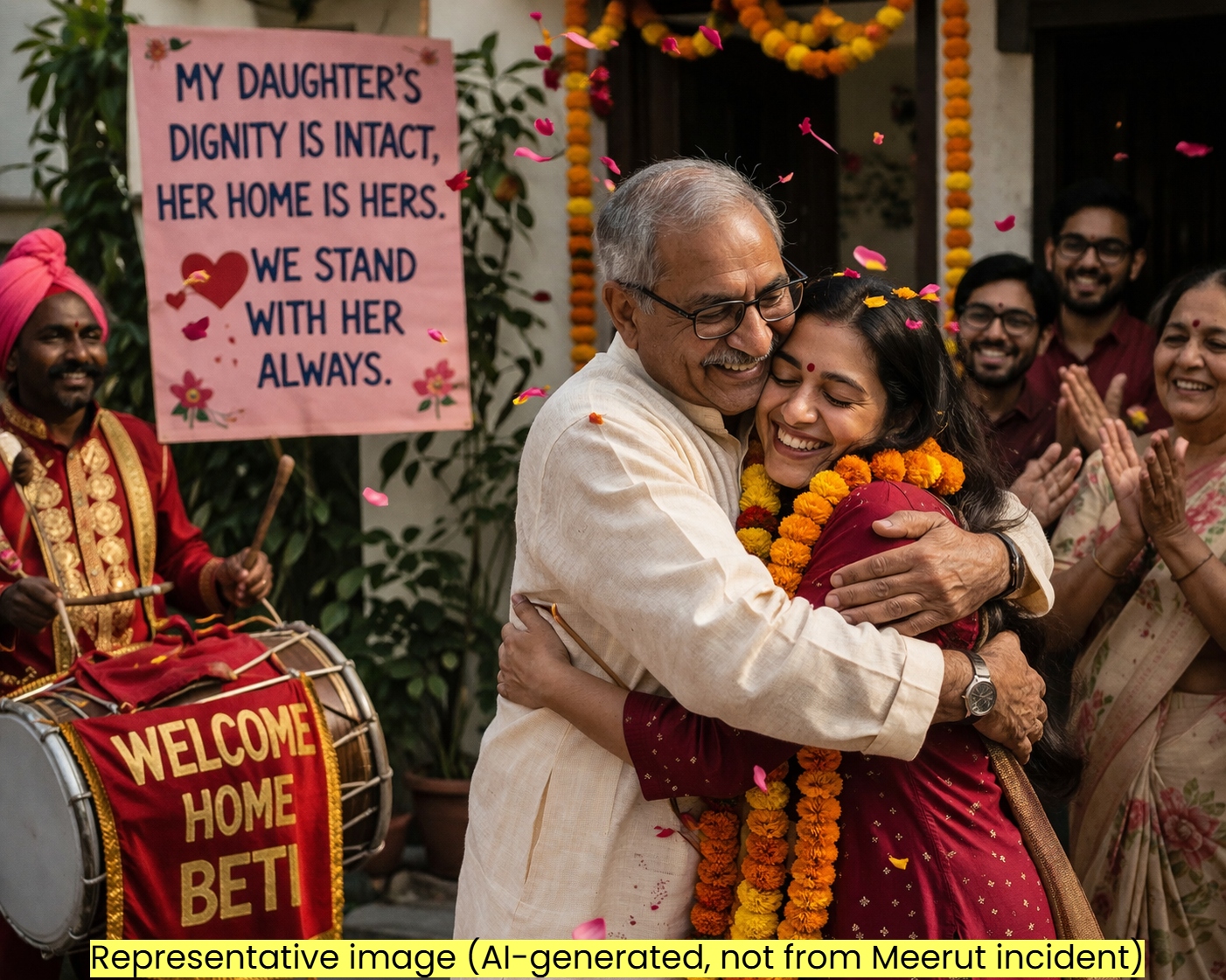
The image from Meerut is striking not because it is dramatic, but because it is so rare. A retired judge chose to welcome his divorced daughter home with drums, garlands and sweets, and did so publicly, without hesitation or apology. In a country where such moments are usually buried under silence, this act stands out as a direct challenge to a deeply entrenched social instinct - the instinct to treat a woman's return after marriage as a matter of embarrassment rather than dignity.
It is worth stating plainly that this discomfort is not accidental. It is cultivated over generations. We have built a social framework in which a daughter's marriage is seen as a final settlement of responsibility, and her return as a disruption of that order. The language may be polite, but the sentiment is unmistakable. Families begin to worry about perception before they think about the person standing in front of them. The question is not what she has endured, but what others will say. This is our gravest mistake.
Instead of recognising the complexity of a broken marriage, we collapse it into a simplistic judgement. The woman is expected to explain herself, to justify why she could not "adjust," as though endurance were the only acceptable measure of character. This expectation is not neutral; it is loaded with the assumption that the burden of preserving a marriage rests disproportionately on her. When that marriage ends, the conclusion is drawn almost reflexively that she has fallen short in some way. But why do we not change our thinking? Doesn't it take two to tango?
What follows is often a quieter, more insidious form of exclusion. The parental home, which should function as a place of stability, becomes a space of negotiation. Her presence is accommodated, but not always embraced. Decisions about her life are discussed in terms of practicality and reputation. Whispered conversations between elders point to the fact that she might have done something gravely wrong. The urgency to restore normalcy often translates into pressure - sometimes subtle, sometimes explicit - to move on quickly, to remarry, to minimise disruption. The underlying concern is less about her autonomy and more about closing an uncomfortable chapter. After all, "pati is parmeshwar", and in that framework, she is seen as having 'failed' him.
This approach does not reflect strength or tradition; it reflects a lack of moral clarity. It allows society to avoid confronting the fact that marriages can fail for reasons that have nothing to do with a woman's willingness to endure. It avoids acknowledging that in many cases, leaving is not a failure but a necessary assertion of self-respect. By refusing to engage with these realities, families end up reinforcing the very stigma they claim to regret.
The contrast with how men are treated in similar circumstances is telling. A man who exits a marriage is rarely subjected to the same level of scrutiny. His social standing remains largely intact, his choices are not dissected with the same intensity, and his future is not framed as a problem to be resolved. This asymmetry is not incidental; it is built into the way we assign responsibility and blame.
Against this backdrop, the judge's decision carries weight. By choosing to celebrate his daughter's return, he has rejected the premise that her status has diminished. He has made it clear that her place in the family is not conditional on marital success. More importantly, he has demonstrated that acceptance need not be quiet or reluctant; it can be visible, deliberate and unambiguous.
What makes this significant is not just the gesture itself, but the contrast it creates. It exposes how far most families are from offering the same level of clarity and support. It highlights the gap between what we claim to value - family, dignity, unconditional support - and how we actually behave when those values are tested.
If this incident feels unusual, it is because the baseline remains unchanged. Too many families still measure a daughter's worth through the lens of marriage. Too many still prioritise social comfort over personal dignity. And too many continue to treat a woman's return not as a moment that calls for support, but as a situation that must be managed.
The lesson from Meerut is not complicated; it is simply inconvenient. It demands that families choose their daughters over social approval, replace judgement with understanding, and accept that dignity does not diminish with the end of a marriage. Until that becomes routine rather than exceptional, such stories will continue to stand out - not because they are extraordinary, but because they remain rare. How many of us would do the same - even without the band-baaja, at least with open arms?