

A Movement the Government Bet Would Fizzle
 Editor-in-Chief of indiacommentary.com. Current Affairs analyst and political commentator. Author of Cyber Scams in India, Digital Arrest, The Money Trap and The Human Hack
View all posts by this Author
Editor-in-Chief of indiacommentary.com. Current Affairs analyst and political commentator. Author of Cyber Scams in India, Digital Arrest, The Money Trap and The Human Hack
View all posts by this Author
By Sunil Garodia
First publised on 2026-07-24 04:59:12
About the Author
Editor-in-Chief of indiacommentary.com. Current Affairs analyst and political commentator. Author of Cyber Scams in India, Digital Arrest, The Money Trap and The Human Hack
View all posts by this Author
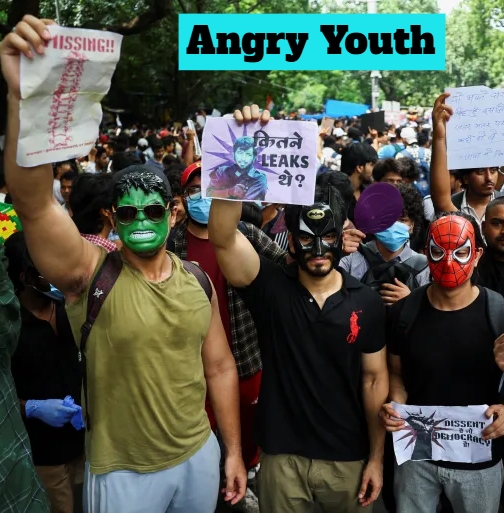
Every movement that unsettles a government begins as something it initially dismisses. In May, a satirical youth campaign calling itself the Cockroach Janta Party surfaced online, its name lifted from a slight aimed at India's unemployed. It read, at first, like the kind of internet joke that dies within a news cycle. By June 6 it had a physical address: Jantar Mantar, alongside the Students Federation of India, the All India Students Association and the All India Students Federation, demanding the resignation of Union Education Minister Dharmendra Pradhan over the NEET-UG paper leak and the CBSE's On-Screen Marking irregularities. The government appeared to calculate, reasonably enough from the playbook of the last decade, that online movements without a heavyweight moral or political sponsor tend to dissolve into hashtags. This one did not follow the script.
The reason it did not is a name familiar to anyone who has watched Ladakh's statehood movement: Sonam Wangchuk. On June 28 the engineer-activist joined the Jantar Mantar sit-in on an indefinite hunger strike, and a campus grievance about examination fairness acquired the one ingredient governments in India have historically found hardest to ignore, a fast with a face the country already trusts. Eighteen days in, still no minister had come to the tent to talk. On July 18, twenty days into the strike, Delhi Police removed Wangchuk to a government hospital against his will. The Delhi High Court subsequently permitted his transfer to a private facility. A protest the administration had hoped to outlast instead had its central figure hospitalised by the state, which is not the kind of image a government wanting the story to end quietly should want circulating.
By July 20 the sit-in had become a march toward Parliament, met with lathis and tear gas. Two days later, on the night of July 22, clashes broke out at Sansad Marg; police said demonstrators threw stones and bottles, injuring several officers, and responded with tear gas of their own. Mobile internet was suspended around Jantar Mantar. Sixteen Delhi Metro stations, including ones serving the Supreme Court and the Prime Minister's residence, were shut for a second consecutive day "until further instructions." A damaged car appeared outside the protest site in circumstances neither side has adequately explained, each accusing the other of staging it for the cameras.
What should embarrass the government more than any of this is what it reveals about its own theory of the protest. The assumption, evidently, was that a leaderless online movement would run out of energy once the news cycle moved on, the way most such movements do. That assumption required ignoring two things simultaneously: that Wangchuk was never leaderless, and that the students' grievance, a compromised entrance examination millions of families had staked years of saving and sacrifice on, was never going to read as frivolous to anyone outside official messaging. By July 23, the movement had drawn Rahul Gandhi's charge that the Prime Minister had done more damage to the youth's future than anyone he was warning against, Mallikarjun Kharge's renewed call for Pradhan's resignation in the Rajya Sabha, and, tellingly, public expressions of support from Salman Khan and Alia Bhatt. A protest that reaches Bollywood without being invited there is not a protest running out of road.
It is not only the executive that chose not to look closely. On July 22, when a petitioner sought urgent hearing of a plea alleging police brutality against the students, offering video evidence of the force used, the Chief Justice of India, Surya Kant, declined even to schedule it. The bench said it had no interest in watching the videos and told the petitioner not to waste its time. Whatever the eventual merits of that plea, the timing could not have been worse for an institution whose own bar association, days later, would condemn the force used on students as excessive and call for an independent inquiry. A court that declines to examine contemporaneous evidence inevitably invites questions about whether sufficient judicial scrutiny is being exercised. The institution expected to scrutinise executive action, in this instance, declined an immediate examination of the material placed before it.
The government's actual response, once it arrived, was a fast-track court announcement from the Prime Minister and a statement from BJP chief JP Nadda that any debate on the alleged irregularities should happen only inside Parliament, a chamber that spent July 23 being repeatedly adjourned amid the Opposition's protest over Monday's police action. Whatever the political interpretation, the sequence is difficult to ignore: fast-track courts were announced only after a hunger strike, two rounds of tear gas, a hospitalisation, an internet shutdown and a judicial refusal to even watch the evidence had made the matter impossible to keep off the front page.
None of this means every allegation runs one way. The police have named individuals they say attacked officers, and if that is true, the law should follow them precisely as the students have asked the law to follow Pradhan. Nor does sympathy for the protest excuse what several television reporters say happened to them at the same site: journalists who reported being heckled with "Godi media" chants during the protests, and, on July 20, at least two Times Now staffers who alleged they were physically assaulted while covering the march. A movement demanding accountability from the state does not get a pass on accountability to the press. But a government confident it had nothing to fear from its own examination system would have opened a conversation in May, not fast-tracked a court in July after the story had already cost it a month of headlines, a suspended metro network and a fasting activist in a hospital ward.
But governments are not the only ones facing a test. The movement itself now risks measuring success too narrowly. Holding the Education Minister politically accountable is one demand; rebuilding the institutions that allowed repeated examination controversies is another. Governments change ministers far more easily than they reform systems. If this summer ends only with a resignation but without fundamental changes to how national examinations are conducted, secured and audited, the students may win a political battle while losing the larger fight they set out to wage.
The lesson of Jantar Mantar this summer is that governments which mistake patience for exhaustion often discover that movements ignored in May become crises by July.