

Ash & Accountability
 The India Commentary view
View all posts by this Author
The India Commentary view
View all posts by this Author
By Our Editorial Team
First publised on 2026-06-04 10:47:11
About the Author
The India Commentary view
View all posts by this Author
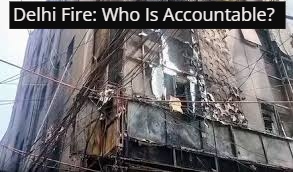
Twenty-one people are dead. Seventeen were foreign nationals - patients' attendants from Liberia, Nigeria, Mozambique, Bangladesh, and Central Asia, who had come to Delhi so a family member could receive treatment at a nearby hospital. They did not die because of a freak accident. They died because a basement kitchen operated inside a building that had no business hosting overnight guests, in a lane too narrow for a fire tender to enter in time, in a city whose authorities have long chosen to look the other way.
This fire is the latest entry in a ledger that never closes. Nine dead in Palam, Delhi, in March. Twelve dead at a Cuttack medical college and hospital, also in March. Fourteen dead at a Kolkata hotel in April. Seventeen dead in a Hyderabad building in May. Twenty-five dead at a Goa nightclub in December 2025. The specific causes vary. The structural cause does not: buildings that should not exist in their present form, hosting activities they are not permitted to host, inspected by officials who either cannot or will not act.
The Malviya Nagar area is a textbook case of what urban informality looks like when governance abdicates. The proximity of Max Hospital and other facilities in Saket has made the neighbourhood a magnet for out-of-town patients. Demand creates supply. Unlicensed B&Bs and basement restaurants have proliferated. Buildings stand wall to wall. Lanes serve also as parking lots. The National Building Code exists, in such localities, purely on paper.
The owner, Lavkesh Bajaj, has been arrested. Good. But the arrest of the owner is the beginning of accountability, not its conclusion. The questions that follow are equally important. Did the Flourish Stay B&B hold a valid fire NOC? If it did, on what basis was it granted? If it did not, why was it allowed to operate? Who last inspected the building, and what did that inspection record? The 2024 Old Rajendra Nagar coaching centre probe found that violations had been noticed by officials and ignored. A magistrate ruled that such inaction is not negligence. It is culpable homicide. Bajajâs arrest must be followed by the arrest of the officials who enabled him.
The standard official response follows a reliable sequence. Condolences. Compensation. An arrest. A promise of audit. The audit, if it occurs, produces a list that is filed and forgotten. The next fire produces the same sequence. This is not a failure of policy. It is the policy. Urban local bodies, which are chronically underfunded and politically subordinate, have no incentive to seal a building whose owner has a politician's ear. The inspector who grants a NOC risks nothing. The calculus is not complicated.
The foreign nationals who died here came to India because they believed its medical institutions offered their families a chance at survival. The state owes them, and every Indian who dies in fires like these, something beyond condolences and a compensation cheque. It owes them enforcement. It owes them the honest acknowledgement that their deaths were preventable.
That acknowledgement will not come. Neither will the enforcement. And in six months, when the next fire kills the next set of people in the next overcrowded building in the next congested lane, another editorial will note, accurately, that nothing changed.