

Conversion Law Unlikely To Pass Judicial Scrutiny
 Editor-in-Chief of indiacommentary.com. Current Affairs analyst and political commentator. Author of Cyber Scams in India, Digital Arrest, The Money Trap and The Human Hack
View all posts by this Author
Editor-in-Chief of indiacommentary.com. Current Affairs analyst and political commentator. Author of Cyber Scams in India, Digital Arrest, The Money Trap and The Human Hack
View all posts by this Author
By Sunil Garodia
First publised on 2020-12-01 08:45:41
About the Author
Editor-in-Chief of indiacommentary.com. Current Affairs analyst and political commentator. Author of Cyber Scams in India, Digital Arrest, The Money Trap and The Human Hack
View all posts by this Author
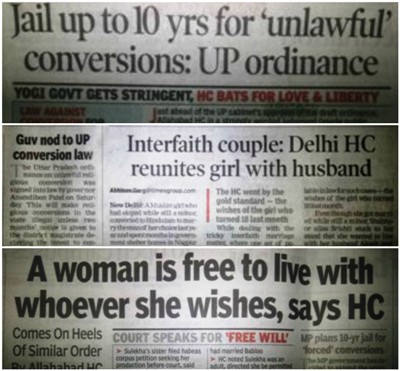
It seems that the judiciary and the executive and legislature are on a collision course where interfaith marriages are concerned. BJP ruled states are firm on clamping down on what they call love jehad, with UP already having enacted a law on the subject. Haryana and Karnataka have indicated their strong desire to follow suit. The UP ordinance that has already got the governor's nod prescribes a jail term of 1 to 5 years and a fine of Rs 15000 (in case of minors or SC/ST, it goes up to 3 to 10 years and a fine of Rs 25000). Mass conversions will attract a jail term of 3 to 10 years with a fine of Rs 50000. Under the Special Marriage Act, the couple has to give a notice of one month about their wish to marry. But the UP Prohibition of Unlawful Religious Conversion ordinance has prescribed that if anyone is converting to another religion before marriage, she or he will have to inform the District Magistrate 2 months in advance. Failure to do so would a prison term of 6 months to 3 years and a fine of Rs 10000.
This is a direct interference by the state in the matter of freedom of choice of individuals. Cupid has his own ways of striking. Love can happen between any two individuals, irrespective of caste, creed, age and religious, linguistic or regional affinities. Love jehad is a term that implies that Muslim males, as part of a deeper conspiracy, are targeting Hindu females for the sole reason of misleading them into love and marriage with the intention to convert them to Islam. If that were true, then obviously action taken by the government would have been justified. But is it actually true? Crime figures in UP or elsewhere do not support this contention. There has not been an avalanche of FIRs by parents about their daughters converting to Islam for marrying Muslims. Even in individual cases that have sought to be highlighted, almost always the girl has testified that she converted out of her free will to marry the boy as she loved him.
But will any such law stand judicial scrutiny? Even as the UP government approved the ordinance, the Allahabad High Court delivered a judgment that restrained the administration, the police and the parents of a girl from interfering in the married life of a couple where the Hindu girl had converted to marry the Muslim boy. The court said that "the right to choose a partner irrespective of caste, creed or religion is inherited under the right to life and personal liberty". The court further said that it did not see the couple as Hindu or Muslim but as two grown-up individuals. Any law that denies the freedom of choice and impinges upon rights is unlikely to pass legal muster. The UP government must first prove a conspiracy by the Muslim society to start a love jehad (although this is an obnoxious term) with facts and figures and should not rely on fake WhatsApp forwards that allege such a concerted act on part of the Muslim society. In the meantime, it should not create hurdles for any two persons willing to marry out of their own free will.