Delimitation: Congress Finds Itself Increasingly Isolated as Government Closes the Numbers Gap
 Editor-in-Chief of indiacommentary.com. Current Affairs analyst and political commentator. Author of Cyber Scams in India, Digital Arrest, The Money Trap and The Human Hack
View all posts by this Author
By Sunil Garodia
First publised on 2026-11-29 02:56:58
About the Author
Editor-in-Chief of indiacommentary.com. Current Affairs analyst and political commentator. Author of Cyber Scams in India, Digital Arrest, The Money Trap and The Human Hack
View all posts by this Author
The battle over delimitation has entered a new phase, and the political landscape has changed considerably since the Modi government suffered a setback in Parliament in April. What appeared then to be a united opposition capable of stopping the government's constitutional amendment has now developed into a deeply fractured political contest. With the DMK, BRS and YSR Congress Party signalling support for the revised legislation, and the NCP (Sharadchandra Pawar) faction also moving towards backing it, the Congress is finding it increasingly difficult to hold its opposition partners together.
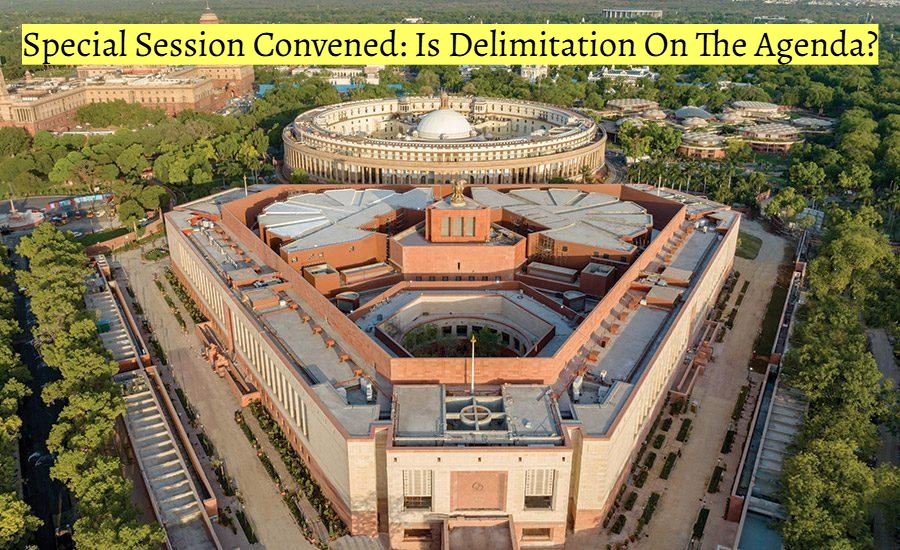
The special session of Parliament, beginning November 30, will therefore be a very different contest from the one witnessed in April.
The government's principal achievement has been to recognise that its earlier proposal had failed to address a fundamental concern of southern states: the possibility that population-based delimitation would reduce their relative representation in Parliament. The revised proposal attempts to neutralise that objection by providing for a uniform 50 per cent increase in Lok Sabha seats across all states and Union Territories, while protecting their relative share of representation until 2051.
The Lok Sabha's strength would consequently rise from 543 to 816 seats. The revised framework also seeks to facilitate implementation of the 33 per cent reservation for women in Parliament and state legislatures.
For the DMK, this has proved an important distinction. M K Stalin had previously opposed the government's proposal, arguing that Tamil Nadu's representation could suffer. The revised formula, according to DMK MP Kanimozhi Karunanidhi, protects the state's existing share. Tamil Nadu's Lok Sabha representation would increase from 39 to 59 seats.
The DMK has consequently announced its support for the revised Bills. The significance of this decision cannot be overstated. All 22 DMK MPs had voted against the original constitutional amendment in April. Their change of position substantially alters the parliamentary arithmetic.
The BRS has also announced support, with K T Rama Rao saying that the proposed safeguards protect Telangana's share of parliamentary representation. The YSR Congress Party has indicated support as well. The TDP, Jana Sena and JD(S) are already aligned with the government on the proposal.
The NCP (Sharadchandra Pawar) faction has also moved closer to the government's position. Supriya Sule has indicated that the revised proposal deserves consideration, citing national interest. The party's eight Lok Sabha MPs could prove important in a closely contested vote.
What makes the situation particularly uncomfortable for the Congress is that some of these parties are not merely outside its political camp. The DMK was an important constituent of the INDIA bloc until its political relationship with the Congress deteriorated following the latter's electoral realignment in Tamil Nadu.
The Congress is now left arguing that the revised legislation remains fundamentally flawed, notwithstanding the safeguards introduced for southern states.
Its objections are not without substance. The party maintains that the Women's Reservation Act, already passed unanimously in 2023, should be implemented within the existing strength of 543 Lok Sabha seats rather than being linked to a fresh delimitation exercise. It also questions the wisdom of pushing through a constitutional amendment in a compressed parliamentary session.
At a meeting of INDIA bloc leaders on November 28, Congress president Mallikarjun Kharge announced that the opposition would jointly resist the legislation. The bloc has demanded that women's reservation be implemented within the existing Lok Sabha strength and that the present distribution of seats among states be protected for another 25 years.
But a joint political declaration is not the same as a joint voting position. The DMK has already announced its support, while the NCP (Sharadchandra Pawar) faction has moved away from the Congress's position. The BRS, too, has publicly committed to supporting the revised proposal.
The government's numerical position is consequently much stronger than it was seven months ago.
In April, the Constitution (131st Amendment) Bill secured 298 votes in favour and 230 against in the Lok Sabha. It needed 352 votes, given the 528 members who participated, and fell short by 54.
The latest reported calculations suggest that the government could assemble approximately 354 votes in the Lok Sabha if its expected supporters, including the eight NCP (Sharadchandra Pawar) MPs, vote in its favour. This would still be six short of the 360 required if 540 members participate in the voting. The actual threshold, however, will depend on the number of members present and voting, subject to the additional constitutional requirement of a majority of the total membership.
The Rajya Sabha presents a separate challenge. One reported projection puts the government-supported tally at approximately 166, against 163 if all 244 members vote. This calculation depends on the support of regional parties, including the DMK and BRS. The two Houses must independently satisfy the constitutional requirements.
These figures explain both the government's renewed confidence and the caution that should accompany predictions of passage. The arithmetic has improved considerably, but the final outcome will depend on attendance, voting commitments and the positions taken by parties whose support has not been conclusively established.
There is also an important distinction between the constitutional amendment and the accompanying delimitation and Union Territories legislation. The constitutional amendment requires a special majority in each House. The ordinary legislative requirements applicable to the accompanying Bills are different, although their passage is necessary to implement the proposed package.
The November 30 session will therefore be more than another parliamentary confrontation between the government and the opposition. It will test whether the INDIA bloc can function as a coherent legislative alliance when its constituent parties have different regional interests.
The Congress has every right to question the government's legislative strategy and demand scrutiny of the proposed constitutional changes. But it cannot assume that every opposition party will subordinate its regional interests to a common political position.
The government's revised formula has provided several southern parties with a reason to reconsider their earlier opposition. Whether its safeguards adequately address every constitutional and federal concern is a separate question, one that Parliament must examine seriously.
For now, the political initiative has shifted towards the government. April demonstrated that the opposition could defeat the proposal when it stood together. November will establish whether that unity can survive when the interests of its constituents diverge.