

Dialogue Is Not a Substitute for Dismantling Terror
 Editor-in-Chief of indiacommentary.com. Current Affairs analyst and political commentator. Author of Cyber Scams in India, Digital Arrest, The Money Trap and The Human Hack
View all posts by this Author
Editor-in-Chief of indiacommentary.com. Current Affairs analyst and political commentator. Author of Cyber Scams in India, Digital Arrest, The Money Trap and The Human Hack
View all posts by this Author
By Sunil Garodia
First publised on 2026-07-03 15:01:46
About the Author
Editor-in-Chief of indiacommentary.com. Current Affairs analyst and political commentator. Author of Cyber Scams in India, Digital Arrest, The Money Trap and The Human Hack
View all posts by this Author
The latest appeal by several prominent personalities from both India and Pakistan urging the Prime Ministers of the two countries to resume dialogue has once again revived a familiar debate. The appeal speaks of peace, reconciliation and the shared aspirations of ordinary people. Few would disagree with those objectives. The real question, however, is whether dialogue by itself can produce lasting peace when the principal source of mistrust remains unaddressed.
Such appeals invariably resonate because dialogue is almost always preferable to confrontation. But the history of India-Pakistan relations suggests that dialogue alone has never been enough to prevent terrorism from repeatedly derailing the peace process. That is the uncomfortable reality that every fresh call for engagement must confront.
India's current policy of refusing comprehensive engagement until Pakistan takes credible and verifiable action against cross-border terrorism is often portrayed as inflexible. In reality, it is a policy shaped by decades of experience rather than ideology.
The appeal also comes against the backdrop of New Delhi making it clear that it sees little value in unofficial Track II initiatives in the absence of tangible action by Pakistan against cross-border terrorism. By distancing itself from such back-channel engagement, India has underlined that symbolic conversations, whether official or unofficial, cannot substitute for concrete measures against the infrastructure of terror.
For decades, India pursued precisely the course that advocates of renewed dialogue continue to recommend. There were summits, composite dialogues, confidence-building measures, expanding trade, sporting contacts, cultural exchanges and repeated diplomatic initiatives. Yet almost every serious attempt at improving relations was eventually overshadowed by a major terrorist attack. The attacks on Parliament, Mumbai, Pathankot, Uri, Pulwama and numerous other incidents repeatedly erased the trust that diplomacy had sought to build.
Successive Indian governments have maintained that many of these attacks were planned or supported by terrorist organisations operating from Pakistani territory. Several of these organisations have also been designated as terrorist entities by the United Nations, while international scrutiny over the years has focused on Pakistan's efforts to curb terror financing and dismantle extremist networks. India's insistence on verifiable action before resuming comprehensive dialogue is therefore rooted not merely in bilateral mistrust but in concerns that have received wider international recognition.
This history also exposes a recurring imbalance in the debate. Almost every deterioration in India-Pakistan relations is followed by renewed calls for New Delhi to restart dialogue. Far less attention is paid to the question of why dialogue broke down in the first place. The burden of restoring engagement is repeatedly placed on India, while comparatively little public pressure is directed at Pakistan to dismantle the terrorist infrastructure that destroyed trust and made meaningful negotiations impossible. Unless that imbalance is addressed, calls for talks risk treating the symptom while ignoring the underlying cause.
Supporters of unconditional dialogue rarely answer a fundamental question. If decades of negotiations, trade and cultural engagement failed to persuade Pakistan's establishment to abandon terrorism as an instrument of policy, why should another round of talks, without any corresponding change in Pakistan's conduct, produce a different outcome? Repeating an approach that has consistently failed is not a strategy. It is wishful thinking.
The problem has never been India's willingness to talk. The problem has been Pakistan's ability to engage diplomatically while terrorist organisations accused by India of targeting it continued to find space to operate from its territory. As long as those two realities coexist, dialogue risks becoming an exercise in optics rather than an instrument for resolving disputes.
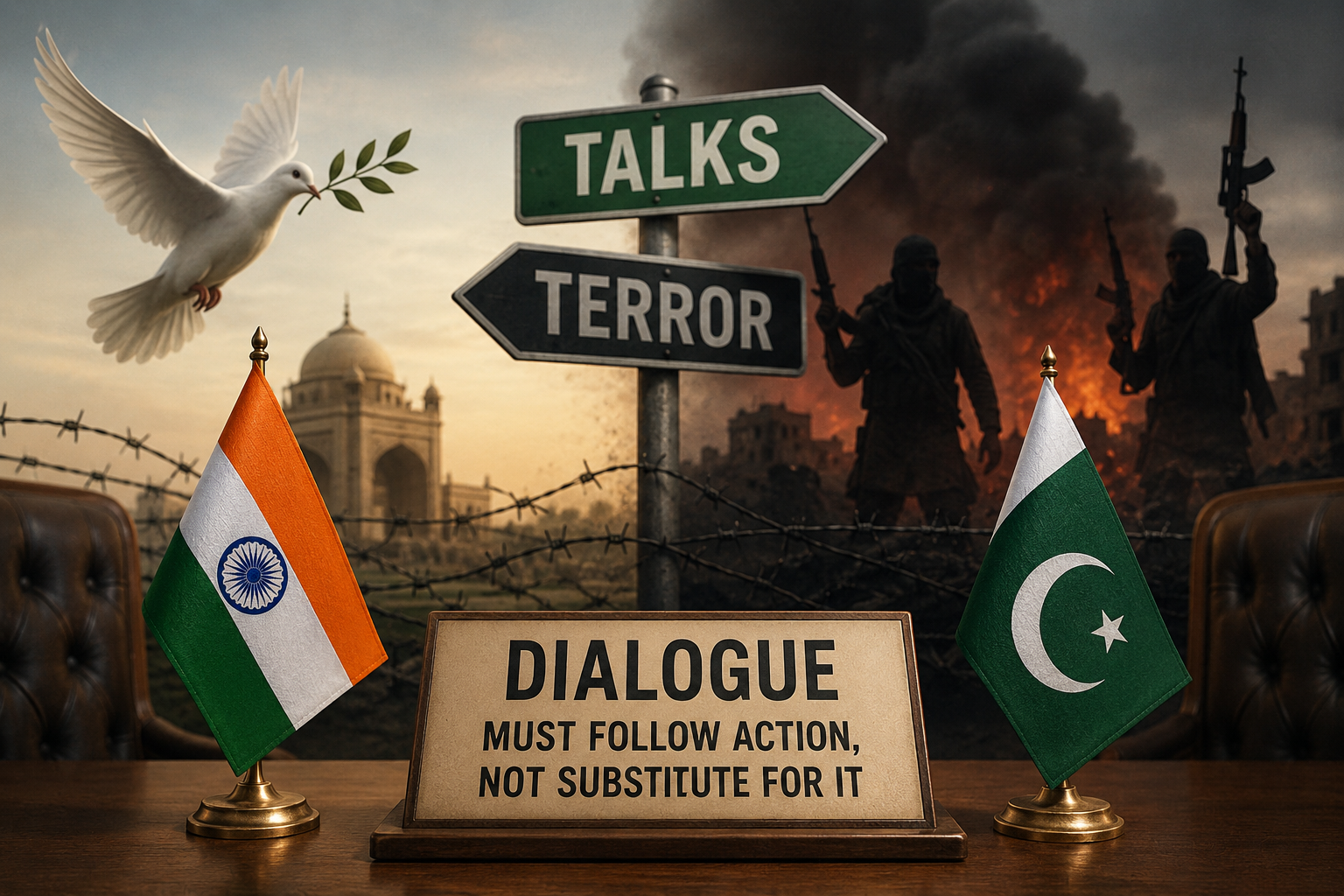
India's present policy does not reject dialogue as a matter of principle. It simply insists that dialogue should follow, not precede, credible and sustained action against terrorism. That distinction is often overlooked in the public debate.
If Pakistan genuinely seeks lasting peace, the broad roadmap is already evident. Terrorist organisations operating from its territory must be dismantled rather than merely renamed or temporarily restricted. Individuals wanted by India in terrorism-related cases should face due legal process. Terror financing must be eliminated through genuine compliance with international obligations. Above all, infiltration across the Line of Control must cease in a manner that is credible, verifiable and enduring.
None of these expectations is extraordinary. Every sovereign state has an obligation to ensure that its territory is not used for terrorism against another country. Asking Pakistan to fulfil that obligation is not an obstacle to peace. It is the foundation upon which any durable peace must rest.
Those who advocate an immediate return to negotiations argue that dialogue itself can reduce tensions and build confidence. That proposition would be more persuasive if history supported it. Instead, the experience of the past three decades suggests that diplomatic engagement repeatedly generated optimism, only for acts of terrorism to erase the goodwill that had been created. The lesson India has drawn from that experience is neither irrational nor vindictive. Trust cannot be rebuilt through declarations while violence continues to undermine every diplomatic initiative.
Every Indian would welcome a stable, cooperative and peaceful relationship with Pakistan. But peace cannot rest on sentiment alone. It must be built on security, accountability and mutual trust. Those conditions cannot exist while terrorist organisations continue to function and cross-border terrorism remains a recurring reality.
The obstacle to dialogue is not India's refusal to talk. It is Pakistan's failure to remove the conditions that make meaningful dialogue possible. The day Pakistan demonstrates through sustained and verifiable action that terrorism is no longer tolerated as an instrument of policy, India will have every reason to engage. Until then, calls for New Delhi to resume talks ask India to disregard the lessons that decades of painful experience have taught it.
The lead picture is AI-generated