

oppn parties Floods Will Happen If People Treat All Open Spaces As Dump Yards

News Snippets

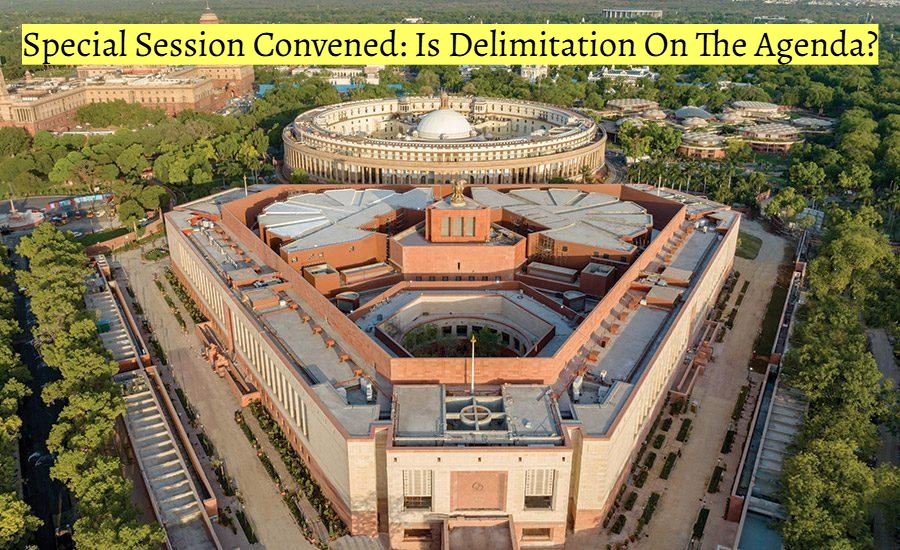
  • The Union government announced a four-day sitting of Parliament from November 30 to December 3, with the Lok Sabha scheduled to reconvene on November 30 and the Rajya Sabha on December 2. Parliamentary Affairs Minister Kiren Rijiju said the purpose was to transact essential government business, but speculation over possible legislation on delimitation has intensified
  • Opposition parties marked Constitution Day with demonstrations in several states, demanding accountability from Chief Election Commissioner Gyanesh Kumar and raising allegations of irregularities in electoral-roll revision. Congress president Mallikarjun Kharge led the Samvidhan Raksha campaign in Lucknow.
  • The Supreme Court ruled that the adjudicating authority under the Prevention of Money Laundering Act must include a judicial member when confirming property attachments, although its chairperson need not necessarily be a judicial member
  • The Supreme Court quashed the Bihar government's 2023 decision granting premature release to former MP Anand Mohan, convicted in the 1994 murder of IAS officer G Krishnaiah, and directed him to surrender within one month. The Court also struck down the prison-rule amendment that had enabled his release, holding the decision legally unsustainable
  • The Supreme Court directed the Food Safety and Standards Authority of India to prepare revised front-of-package nutrition-labelling regulations within 10 weeks, requiring separate warnings for products high in sugar, salt and saturated fat. The Court rejected the regulator's earlier proposed framework and directed it to recalculate nutrient thresholds
  • India's foodgrain production reached a record 378.54 million tonnes in 2025-26, an increase of 20.81 million tonnes over the previous year, according to the Agriculture Ministry's final estimates released on November 26. The government also estimated kharif foodgrain production for 2026-27 at 167.14 million tonnes
  • Tamil Nadu Governor R N Ravi urged Chief Minister C Joseph Vijay to intervene in filling vacant university vice-chancellor positions and address pending university convocations
  • Indian money markets are signalling the possibility of a 50-basis-point RBI interest-rate increase at the December 2-4 monetary policy meeting, although most economists continue to expect a 25-basis-point hike. October retail inflation rose to 6.09%, exceeding the RBI's upper tolerance limit of 6%. Rising Treasury bill yields and interest-rate swaps indicate concerns about the persistence of inflation
  • The Reserve Bank of India has authorised the National Stock Exchange to introduce futures contracts linked to corporate bond indices, following an earlier clearance from SEBI. The proposed instruments will allow investors to hedge corporate bond portfolios and take positions on movements in bond valuations and credit spreads
  • Indian equity markets closed higher for the second consecutive session, with the Sensex gaining 390.31 points (0.46%) to 84,328.59 and the Nifty 50 advancing 65.25 points (0.25%) to 25,884.50
  • Kerala produced one of the day's outstanding performances in the Syed Mushtaq Ali Trophy, scoring 268 for four against Himachal Pradesh before restricting their opponents to 201 for six to win by 67 runs. Mumbai also registered a commanding 86-run victory over Uttarakhand, while Vidarbha defeated Chhattisgarh by 34 runs
  • Defending champions Treesa Jolly and Gayatri Gopichand advanced to the quarter-finals of the Syed Modi International Super 300 badminton tournament in Lucknow with a 21-9, 21-8 victory over compatriots Shreya Balaji and Pranavi Natarajan. In women's singles, Tanvi Sharma, Unnati Hooda, Anmol Kharb and Tasnim Mir also entered the last eight, giving India a strong presence in the knockout stages
  • Indian athletes enjoyed a productive second day at the BIMSTEC Under-23 Athletics Championships in Bhubaneswar. Vaibhav won the men's discus gold with a throw of 51.97 metres, ahead of compatriot Bharatpreet Singh, who secured silver with 49.63 metres. Roshan Shaikh also won the men's 110-metre hurdles, while Tamil Nadu's Sadhana Ravi captured the women's triple-jump gold with a leap of 13.24 metres
  • Rising Stars: Sri Lanka crush India by 8 wickets in the semifinals as bowlers lose their way after the batters score a competitive 317
  • MEA says notice for discrepancy in place of birth was issued to Saurav Das of CJP and he was advised not to use passport for 7 days
Supreme Court rebukes Vijay government in Tamil Nadu, says it acted in contempt, orders lighting of lamp at Deepathoon and suspended the board of trustees of Tamil Nadu's Arulmigu Subramaniaswamy temple /////// Big victory for Mamata Banerjee - Calcutta HC removes Ritabrata Banerjee of rival faction as Leader of Opposition in the Bengal assembly, says the Speaker must think afresh and provide proper reasoned order
oppn parties
Floods Will Happen If People Treat All Open Spaces As Dump Yards

By Anukriti Roy
First publised on 2018-09-05 12:52:56

About the Author

Sunil Garodia Anukriti is a student who dabbles in writing when she finds time.
Humans are their own biggest enemies. The lead picture with this article shows a bridge in Kerala after the flood waters receded. Just see the things that were thrown from the bridge in the stream below, as if it was a large open drain. Things like plastic and plastic water bottles should not be thrown in drains leave alone a canal or a stream of water. They are non-biodegradable and clog the drains, leading to overflow of dirty water. Here we see that supposedly educated people had thrown all kinds of discarded items in the canal.

The fact is that most ordinary citizens have little or no concern for the environment. Yet, when faced with Nature’s fury, like in the torrential rains in Kerala and the subsequent floods, they are vociferous in blaming the administration for not taking measures to prevent floods. The administration can construct drains to ensure that water flows out. But if plastic and other assorted waste is dumped indiscriminately and regularly in these drains, the administration is rendered helpless. People do not have the civility to dump waste in designated bins.

Things are changing though, but very slowly. Children are now being seen as the medium to bring about this change. They are being taught in schools to dispose of waste properly, prevent water wastage and follow traffic and other civic rules. They in turn are impressing upon their parents and relatives to do likewise. But when a parent rushes his child to cross the road from a place other than the zebra crossing or scolds him if he or she does not throw a bottle out of a running car, the child can be too afraid to disobey. Hence, parents have to change themselves simultaneously. It is not enough to teach the children only. Schools must have periodic, and compulsory, classes for parents too.