

Getting Back Money Lost To Cyber Scammers
 Editor-in-Chief of indiacommentary.com. Current Affairs analyst and political commentator. Author of Cyber Scams in India, Digital Arrest, The Money Trap and The Human Hack
View all posts by this Author
Editor-in-Chief of indiacommentary.com. Current Affairs analyst and political commentator. Author of Cyber Scams in India, Digital Arrest, The Money Trap and The Human Hack
View all posts by this Author
By Sunil Garodia
First publised on 2026-07-15 10:51:58
About the Author
Editor-in-Chief of indiacommentary.com. Current Affairs analyst and political commentator. Author of Cyber Scams in India, Digital Arrest, The Money Trap and The Human Hack
View all posts by this Author
How to Get Your Frozen Cybercrime Money Back: A Simple Guide
If you have been a victim of cyber fraud, you already know the frustrating part. You file a complaint. The bank confirms the fraudster's account has been frozen. And then, silence. You don't know what to do next.
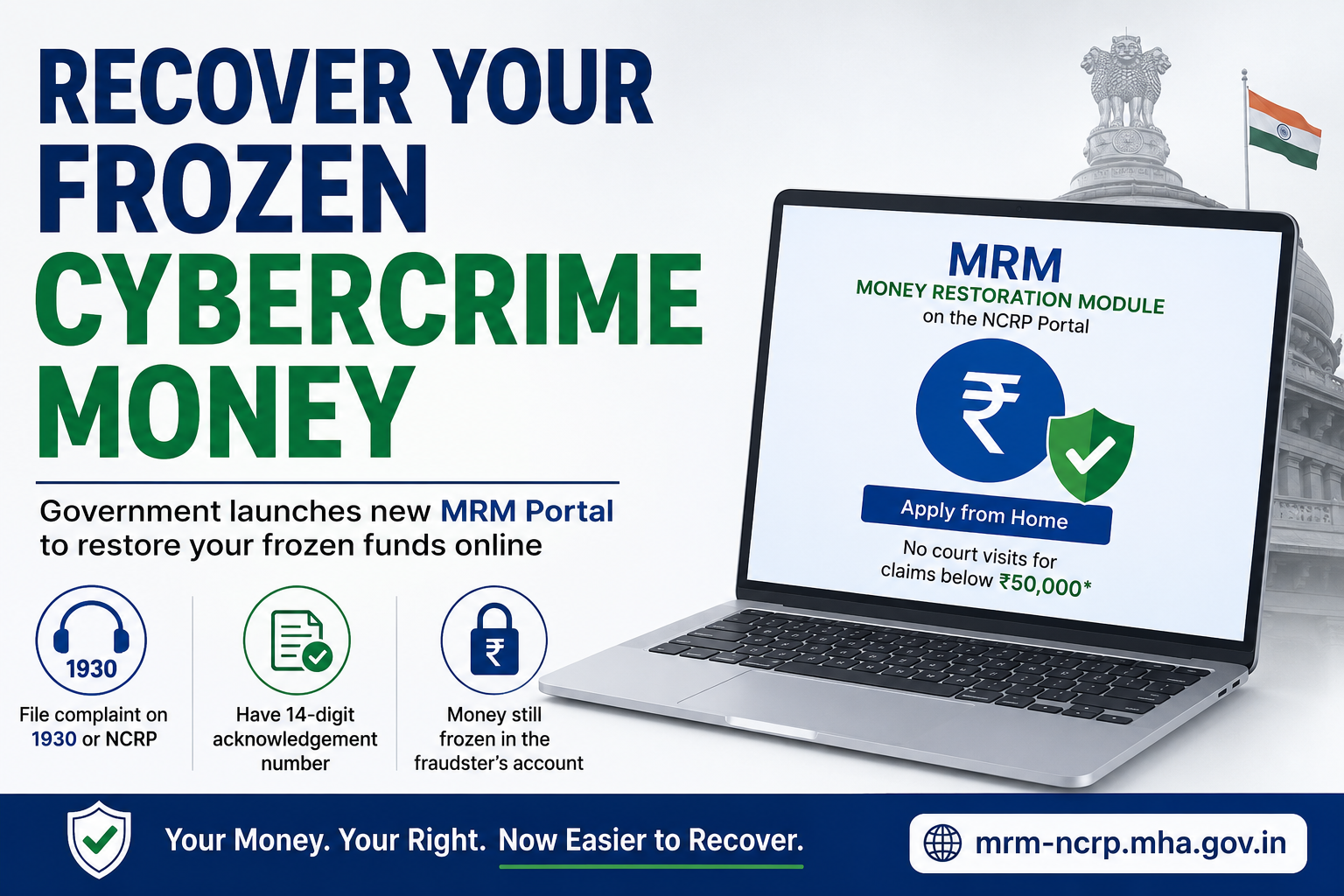
The Ministry of Home Affairs has now launched an online facility to fix exactly this problem. It is called the Money Restoration Module, or MRM, and it sits inside the National Cyber Crime Reporting Portal. The process looks complicated in the promotional graphics, but it is actually quite straightforward once explained step by step.
Who Can Use This Facility: The MRM only works if three things are true for you:
- You reported the fraud immediately, either through the 1930 helpline or on cybercrime.gov.in.
- You have the 14-digit acknowledgement number from that complaint.
- The stolen money is still sitting frozen in the fraudster's account. It has not been withdrawn.
If the fraudster has already withdrawn the money before it could be frozen, the MRM cannot help. It only restores money that is still there.
The Three Categories, Explained Simply: How much paperwork you need depends on how much money is frozen, and where.
Category 1: Less than Rs 50,000 frozen in one account. You need a police report and an indemnity bond. No FIR needed.
Category 2: More than Rs 50,000 total, but spread across accounts so no single account holds more than Rs 50,000. Same as above. A police report is enough. Still no FIR.
Category 3: More than Rs 50,000 frozen in a single account. Here an FIR is mandatory. Once the FIR is filed, everything else runs through the same MRM portal.
The key thing to understand is this: what triggers the FIR requirement is not your total loss. It is how much money sits in any one account. Lose Rs 80,000 split evenly across two accounts, and you may only need Category 2. Lose Rs 60,000 in a single account, and you need an FIR.
How to Apply: 5 Simple Steps
1. Visit mrm-ncrp.mha.gov.in and log in using the mobile number you registered with your original complaint. You will get an OTP.
2. Raise a refund request and enter your 14-digit complaint acknowledgement number.
3. Wait while the portal verifies the frozen amount against your complaint.
4. Upload your documents: your PAN card and your bank account details, including the IFSC code, where you want the refund credited.
5. Submit the request. You will get a 14-digit request ID starting with "MR." Save it. This is how you track your case.
What Happens Next: Submitting the form online is not the last step. It sets the legal process in motion.
The local police station uploads the required document on the portal, either a police report and indemnity bond, or the FIR paperwork if you're in Category 3. This document is formally called an Indemnity Bond or Notice under Section 106(3) of the Bharatiya Nagarik Suraksha Sanhita. In simple terms, this is the legal order that lets the bank release money it is holding as part of an investigation, once the police confirm it belongs to you.
Once the bank receives this document through the portal, it transfers the money directly into your account. No further visits to the bank or the police station are needed.
A Word of Caution
Since this process involves sharing your PAN and bank details, be careful. Fraudsters love to imitate government refund schemes.
- The only genuine site is mrm-ncrp.mha.gov.in.
- The only legitimate starting point is a complaint filed through cybercrime.gov.in or the 1930 helpline.
- The MRM never calls you first. You initiate the request yourself, only after you already have a valid acknowledgement number.
If anyone calls, texts, or messages you claiming they can speed up your refund, asking for money upfront, an OTP, or remote access to your phone or computer, that is a new scam built on top of the old one.
The Bigger Picture
The MRM is part of a larger effort to make cybercrime refunds faster and less dependent on repeated visits to police stations and banks. A related facility, the Grievance Redressal Module, helps people whose accounts were wrongly frozen during investigations.
For victims, the part that used to take months of running around has now been reduced to a form that takes minutes to fill. Whether it works quickly in practice will depend on how fast local police stations upload their end of the paperwork.