

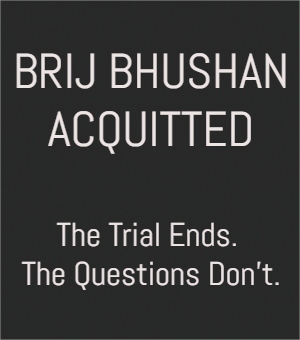
Brij Bhushan Walks Free. The System He Represents Does Not
 Editor-in-Chief of indiacommentary.com. Current Affairs analyst and political commentator. Author of Cyber Scams in India, Digital Arrest, The Money Trap and The Human Hack
View all posts by this Author
Editor-in-Chief of indiacommentary.com. Current Affairs analyst and political commentator. Author of Cyber Scams in India, Digital Arrest, The Money Trap and The Human Hack
View all posts by this Author
By Sunil Garodia
First publised on 2026-08-03 11:24:34
About the Author
Editor-in-Chief of indiacommentary.com. Current Affairs analyst and political commentator. Author of Cyber Scams in India, Digital Arrest, The Money Trap and The Human Hack
View all posts by this Author
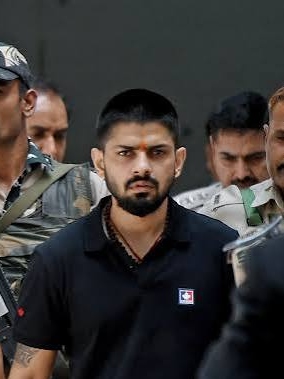
A Delhi court has acquitted Brij Bhushan Sharan Singh in the sexual harassment case filed by women wrestlers, including Vinesh Phogat, Sakshi Malik and Bajrang Punia. The former Wrestling Federation of India chief and six-time BJP MP has been cleared of charges under Sections 354, 354A, 354D and 506 of the IPC. Phogat has called it the logical end of a process rigged from the start. She has announced an appeal. Both statements deserve to be taken seriously, and separately.
The acquittal is a legal fact. It must be respected as one until a higher court says otherwise. But a court clearing an accused of criminal liability is not the same as a system clearing itself of complicity. The two questions are different, and conflating them is one way power protects itself in this country.
Start with the timeline. In January 2023, the very wrestlers who had won India Olympic medals found themselves sitting on a Delhi footpath demanding an FIR against a sitting MP of the ruling party. It took four months, a Supreme Court intervention and sustained public pressure before Delhi Police registered two FIRs. One of them carried a POCSO charge, involving a minor complainant. That charge was quietly dropped later, on the strength of statements from the complainant and her father. No explanation of what changed their minds was ever placed before the public with the same visibility as the original allegation.
Through the trial, the pattern was consistent. Security cover for the complainants was withdrawn in the middle of proceedings, forcing them to approach the court again just to be protected while testifying against a man with the run of the ruling establishment. Singh, for his part, treated the gravity of the charges as a public spectacle. He offered narco tests as a dare rather than a submission to process. He compared Phogat to Manthara, the scheming maid of the Ramayana, at a public rally while the case was still being investigated. This is not the conduct of a man behaving as though he feared imminent legal consequences. It reflected the confidence of a politician who appeared to believe the political system around him would remain firmly behind him.
None of this proves guilt on the specific charges the court has just examined. Trials turn on evidence that survives cross-examination, not on public conduct or political optics. If the prosecution could not establish its case beyond reasonable doubt, an acquittal was the legally correct outcome. The trial court was concerned only with whether that standard had been met; it was not adjudicating the conduct of governments, police or political parties.
The point is what happened around the trial, not just inside it. A six-time MP facing multiple sexual harassment complaints, including from Olympic medallists, remained a free man throughout, saw the BJP field his son, who retained the Kaiserganj seat in 2024, and never faced a single public reprimand from his party. Compare that to the wrestlers, who had to sit on the road in Delhi's winter, get manhandled by police at Jantar Mantar, and fight for their own security cover while deposing against him. The imbalance of power was never in doubt. What remains unresolved is whether that imbalance influenced the process long before the court weighed the evidence.
Phogat's charge that the government and the system protected Singh from the start is not an idle accusation. It is a description of sequence: the delay in registering the FIR, the dropping of the POCSO charge, the withdrawal of security, the silence of the Prime Minister when directly asked about the issue in 2023. Each of these facts is on the record. Taken together, these events inevitably invite questions about institutional conduct. Whether they amount to deliberate protection is a matter of public debate rather than something this judgment resolves.
The wrestlers have said they will appeal. They should, and the appellate court owes them a hearing on the merits, not a formality. But the appeal alone will not settle the larger issue this case has exposed: that a woman accusing a powerful man in India still has to first survive the system before she gets to test her case against him. Brij Bhushan Sharan Singh has been acquitted by a court. Whether the process that surrounded him was fair is a verdict the country is still waiting for, and one no court judgment can substitute.
T