

The Judge Who Held A Gas Agency: A Sixteen-Year Question Nobody Asked
 Editor-in-Chief of indiacommentary.com. Current Affairs analyst and political commentator. Author of Cyber Scams in India, Digital Arrest, The Money Trap and The Human Hack
View all posts by this Author
Editor-in-Chief of indiacommentary.com. Current Affairs analyst and political commentator. Author of Cyber Scams in India, Digital Arrest, The Money Trap and The Human Hack
View all posts by this Author
By Sunil Garodia
First publised on 2026-07-16 08:10:04
About the Author
Editor-in-Chief of indiacommentary.com. Current Affairs analyst and political commentator. Author of Cyber Scams in India, Digital Arrest, The Money Trap and The Human Hack
View all posts by this Author
A Delhi High Court judge who went on to become Chief Justice of the Manipur High Court remained the holder of an LPG distributorship through nearly his entire judicial career. That is what Bharat Petroleum's own records show. A show-cause notice, a suspended distributorship, and a widow's petition now pending before the Delhi High Court have put the question on record. The judiciary's own ethics code was supposed to answer it years ago. It did not.
THE FACTS AS THEY STAND
Justice Siddharth Mridul was allotted an LPG distributorship, "Kitchen Flame," in 1984. Two years later he enrolled as an advocate. He was elevated to the Delhi High Court in March 2008, became Chief Justice of the Manipur High Court in October 2023, and retired on November 21, 2024. Through all of it, according to BPCL's records, the distributorship agreement kept getting renewed. 1995. 2005. 2010. 2015. And again on September 29, 2025, this time for another five years, well after he had left the bench.
BPCL issued a notice on May 29 this year asking him to explain why the distributorship should not be suspended, citing violation of distributorship terms. He did not respond, according to reports. The dealership was suspended on July 6.
There is a second thread to this. A former manager of Kitchen Flame moved the Delhi High Court in December 2025 with a petition raising issues of public importance. She alleges that Mridul, while a sitting judge, did not ensure compliance with a court's own order on a proprietorship dispute involving her, and that she was harassed for pursuing it. The Delhi High Court has issued notice on that petition.
One thing is worth being honest about. Nothing in the reporting so far tells us whether Mridul actually ran Kitchen Flame day to day, or whether it was family or staff at the counter while the licence sat in his name. That may end up mattering to whatever he says in response. It does not change the question this story is really asking.
WHY THIS IS NOT A TECHNICALITY
The Supreme Court's own Restatement of Values of Judicial Life, adopted in 1999, says a judge must not enter into a business relationship, or continue one, that could compromise judicial independence. It says a judge must avoid even the appearance of a conflict between judicial duty and personal financial interest. Holding, and repeatedly renewing, a commercial LPG distributorship while serving as a High Court judge is hard to square with that. Doesn't matter who was managing the counter. A gas distributorship is a licensed commercial operation. It comes with statutory compliance, consumer disputes, labour relationships, and an ongoing commercial relationship with a public sector undertaking that itself shows up in court over tax and contract disputes. The licence-holder has skin in the game. That's the plain fact of it.
The Restatement carries no criminal penalty. It is not a statute. But it is the standard the judiciary set for itself, and a self-imposed standard only means something if someone actually checks it. Sixteen years of unbroken renewals. Enrolment as an advocate, elevation to the High Court, elevation again to Chief Justice of another High Court, and at no point did that business interest get flagged.
THE ACCOUNTABILITY GAP
Some judges do voluntarily publish asset declarations. But there is no uniform, mandatory, independently verifiable disclosure regime in India covering judges' business interests. None. A sitting judge could hold and renew a commercial licence for a decade and a half and nothing in the system was built to catch it. It surfaced because BPCL's compliance process flagged a dispute over distributorship terms, not because any judicial ethics mechanism was watching. That is the gap that matters here. Not that BPCL acted. That nothing else did, for sixteen years.
BPCL doesn't come out of this clean either. A public sector company renewed a distributorship agreement five times over three decades with a sitting judge. Nobody apparently raised the conflict at any of those renewals. The company moved only once its own commercial terms were allegedly breached, not when a judge holding a PSU licence might have warranted a second look, years before this.
WHAT SHOULD FOLLOW
None of this needs new legislation. Three things would do it. A mandatory, standardised, public disclosure format for judges' business interests, not just immovable property, updated every year. A conflict-check requirement at PSUs and regulated licensors before they renew anything held by a sitting judicial officer. And a Delhi High Court inquiry into the December petition that actually reaches a public conclusion, instead of the quiet fade that in-house judicial inquiries tend to manage.
A judge is supposed to be the last word on other people's conflicts of interest. When that standard doesn't visibly apply to the judge, judicial independence stops protecting the public. It starts protecting the judge.
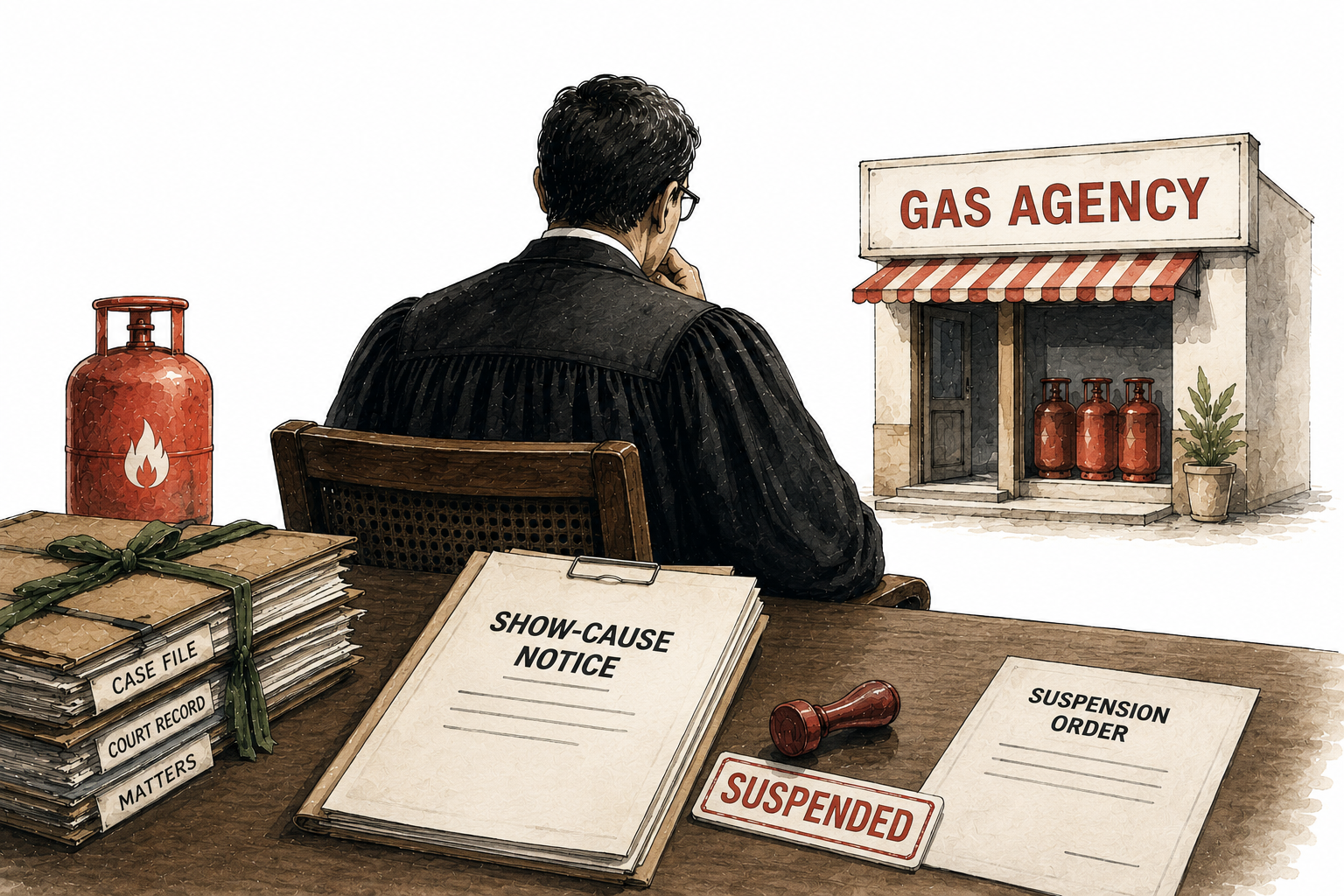
The lead image is AI-generated