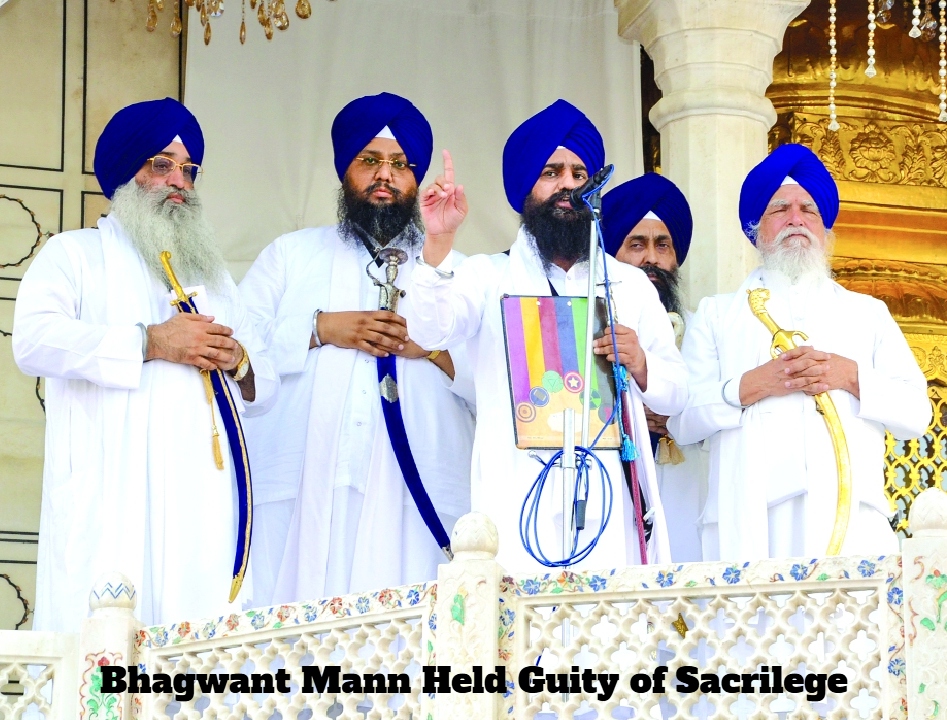
The Akal Takht's order against Punjab Chief Minister Bhagwant Mann has done more than create a political controversy. It has revived a question Punjab has never fully resolved.
The order declares Mann a "Guru dokhi" and "Khalsa Panth virodhi." It stems from a video that surfaced earlier this year and was alleged to depict an act of sacrilege. Mann dismissed the footage as fabricated and insisted that he was not the person shown. The Akal Takht has said forensic examinations found no evidence of tampering. Mann has rejected that conclusion and accused his political opponents of orchestrating a campaign to discredit him. The dispute over the video's authenticity may never be settled to everyone's satisfaction. But that dispute is no longer the only thing at stake.
The Akal Takht occupies a position unlike that of any other religious institution in India. As the highest temporal seat of Sikh authority, its directives carry weight that extends well beyond the faithful. When it moves against a serving chief minister, it does not merely make a religious pronouncement. It enters the political arena, whether it intends to or not.
Punjab has seen this before. In February 1987, Chief Minister Surjit Singh Barnala was excommunicated after his government allowed security forces to enter the Golden Temple complex during an anti-militancy operation. Barnala refused to submit and continued in office. The confrontation exposed a tension that no constitutional provision has ever resolved. Religious authority rests on faith and tradition. Democratic authority rests on the ballot. When the two come into direct conflict, there is no established mechanism to decide which prevails.
That tension now surrounds Bhagwant Mann. The order arrives at a moment of political consequence. Arvind Kejriwal had recently projected Mann as the Aam Aadmi Party's chief ministerial face for the next Assembly election. The Akal Takht's directive has handed the opposition, particularly the Shiromani Akali Dal, a weapon it will not hesitate to use. Whether it moves voters is uncertain. What is certain is that Mann must now fight on two fronts simultaneously.
The deeper risk lies elsewhere. Punjab's history shows that religious and political authority do not simply compete when they clash. They can feed each other in ways that become difficult to control. The years surrounding the rise of Jarnail Singh Bhindranwale demonstrated how quickly competing claims over religious legitimacy can overwhelm every other consideration. The state spent decades recovering from that period. The present situation bears no comparison in scale or violence. But the pattern of religious authority being drawn into political contest, and political contest being fought through religious authority, is one Punjab recognises and has reason to fear.
The Akal Takht faces its own test here. Its moral authority depends on the perception that it acts on principle rather than political calculation. Every intervention in a charged political dispute invites the question of whether that perception can be sustained. Supporters will argue that the institution has no choice but to act when religious principles are at stake. Critics will argue that the timing and target suggest otherwise. Both arguments will circulate in Punjab for as long as this controversy lasts.
The real question is what comes next. If the dispute hardens into a prolonged confrontation between the state government and Sikh religious authority, the costs will not be borne only by Bhagwant Mann or the Aam Aadmi Party. Punjab's recent history offers enough examples of how quickly such conflicts can consume public discourse while more pressing problems recede into the background.
Punjab has spent decades debating where religious authority ends and political authority begins. The Akal Takht's order against Bhagwant Mann shows that the answer remains as contested today as it was in Barnala's time.


 The India Commentary view
View all posts by this Author
The India Commentary view
View all posts by this Author