
oppn parties Rahul Gandhi Is A Habitual Offender Where His Security Protocol Is Concerned
News Snippets

  • Supreme Court questions the continuing relevance of two-child norms. The Court observed that falling fertility rates have weakened the population-control rationale behind laws disqualifying people with more than two children from contesting local body elections. It referred the issue to a larger Bench for consideration
  • Supreme Court declines to shift Tirupati laddu case outside Andhra Pradesh. The Court rejected a plea seeking transfer of the trial, despite arguments that political statements by Andhra Pradesh's Chief Minister and Deputy Chief Minister could affect the fairness of proceedings
  • Supreme Court transfers Azam Khan's fresh ED bail plea to Allahabad High Court. The apex court declined to consider the Samajwadi Party leader's bail request in a fresh Enforcement Directorate case and directed that it be listed before a division Bench of the High Court on November 16
  • Two killed in Delhi building collapse; contractor booked. Two bodies were recovered after a building collapsed in Chawri Bazaar. Delhi Chief Minister Rekha Gupta said the contractor had been booked and the concerned junior and assistant engineers suspended
  • Uttar Pradesh voter rolls show a 2.4-crore discrepancy. A difference of approximately 2.4 crore names has been reported between the state's panchayat and rural Assembly voter lists. The Election Commission has ordered the two sets of rolls to be matched
  • Gujarat announces 3% dearness allowance hike. The state government announced a three-percentage-point increase in dearness allowance for government employees and pensioners ahead of Diwali
  • Sensex and Nifty post their strongest single-day gains in months. The Sensex surged 2,008.61 points, or 2.60%, to close at 79,310.01, while the Nifty 50 climbed 576 points, or 2.40%, to 24,536.60. Financial and automobile stocks led the rally, supported by falling crude prices and renewed foreign investor buying
  • Maaya Rajeshwaran reaches WTA-level quarter-final. The 17-year-old Indian defeated Poland's Weronika Falkowska 6-4, 6-3, becoming the first Indian woman since Sania Mirza in 2012 to reach a quarter-final at a WTA Tour-level singles event
  • Tanvi Patri reaches Youth Olympics badminton final. The 15-year-old defeated Japan's Yuzuno Watanabe in the semi-final, assuring India of a medal and becoming the first Indian badminton player to reach the girls' singles final at the Youth Olympics
  • India beat Pakistan 3-2 in SAFF Championship. India defeated Pakistan in a closely contested match, having led 3-0 before conceding two late goals. The victory was reported as a significant result for India's second-string side
  • India beat Japan 4-1 to win a record sixth Asian Champions Trophy. India recovered from an early deficit to defeat Japan in the final at Mohali, extending its record as the tournament's most successful men's team
  • The Supreme Court issued notice to the Centre and the Election Commission on a petition challenging Section 16 of the Chief Election Commissioner and Other Election Commissioners Act, 2023, which grants the CEC and Election Commissioners protection from legal proceedings for acts performed in their official duties. The petition argues that such blanket immunity could leave citizens without an effective remedy for alleged wrongdoing by the Commission
  • The Supreme Court told voters whose names were deleted from Delhi's draft electoral rolls not to be apprehensive about seeking re-enrolment through Form 6, after the Election Commission assured it that such applicants would not be prosecuted merely because their names had appeared in earlier rolls
  • Congress leader Rahul Gandhi opened the party's campaign for the 2027 Punjab Assembly elections with an Insaaf rally in Sangrur, Chief Minister Bhagwant Mann's home district, accusing the AAP government of failing to control drugs, gangster violence and corruption. Congress president Mallikarjun Kharge outlined six commitments, including a drug-free Punjab, protection of farmers, employment for young people and action against corruption
  • Rahul Gandhi accused the AAP government of running Punjab through a remote control from Delhi and questioned Bhagwant Mann's ability to tackle drug abuse, making personal allegations about the Chief Minister's conduct during their time together in Parliament
Stock markets on fire due to US results, Sensex gains 2008 points to reach its highest level in 8 months
oppn parties
Rahul Gandhi Is A Habitual Offender Where His Security Protocol Is Concerned

By Sunil Garodia
First publised on 2025-09-12 13:57:13

About the Author

Sunil Garodia Editor-in-Chief of indiacommentary.com. Current Affairs analyst and political commentator. Author of Cyber Scams in India, Digital Arrest, The Money Trap and The Human Hack

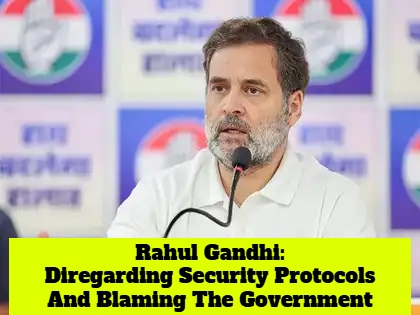
The controversy over Rahul Gandhi's foreign trips and his Z+ security has now broken into the open. The CRPF has formally recorded what has long been evident: Gandhi repeatedly undermines his own security by ignoring established protocols. The Congress, instead of addressing this, has chosen to turn it into another political charge against the government.

As Leader of Opposition, Rahul Gandhi gets Z+-category protection. This level of protection is not ornamental. It is the most elaborate security cover available in India, entailing a full contingent of over a hundred personnel. It comes with codified obligations. The "Yellow Book" protocol lays down that protectees of this category must give advance notice - often two weeks - for any foreign trip, so security can be coordinated with host nations. Rahul Gandhi has repeatedly skipped this requirement, flying out without adequate intimation.

This is not a one-off slip. Security records show over a hundred such breaches since 2020. These include major foreign tours - to Europe, the Gulf, and Southeast Asia - where he either gave no notice or provided information too late for meaningful arrangements. Each such lapse left his security contingent scrambling and created exposure to potential risks, both for him and the personnel assigned to guard him.

The Congress narrative is that Rahul Gandhi's security has been "diluted" and that the government will be held responsible for any incident. But the facts do not bear this out. The security cover has not been cut back. The lapses come from the protectee's own conduct - moving into crowds against advice, disregarding cordons, and leaving the country without timely notice. These are violations documented, not invented.

The real issue is accountability. Security is not a personal entitlement to be bent at will. It is a national resource, paid for by the public, and managed through strict protocols. When those protocols are repeatedly ignored, it is not just self-indulgence - it is reckless misuse of State resources. The protectee cannot demand the full privileges of Z+ cover while treating the rules as optional.

Nor is this only a domestic matter. Foreign security arrangements depend on advance liaison with host governments. Sudden, uncoordinated travel by a Z+ protectee risks creating friction abroad and undermines India's credibility. For someone positioning himself as a statesman, this casual approach is not merely careless, it is diplomatically irresponsible.

The Congress line is designed to shift blame. It has sought to paint Rahul Gandhi as a victim, but it sidesteps the hard truth: a protectee who disregards his own security protocol cannot credibly accuse the government of negligence. The courts will look at records, not rhetoric. And the records show habitual breaches, formally noted and communicated.

At bottom, this is about the paradox of Indian opposition politics. Leaders want the full trappings of State protection, but without the discipline that comes with it. They rail against the establishment while drawing deeply on its apparatus. They ignore the rules yet expect impunity. This cannot stand.

Rahul Gandhi is free to travel where he wishes. But freedom has conditions when you carry Z+ security. If he chooses to treat those conditions lightly, he should accept the risk as his own, not dump the consequences on the agencies tasked with his protection. Security is not a prop for politics. It is a compact between State and protectee. Break it often enough, and the breach lies squarely at the door of the one under protection.