


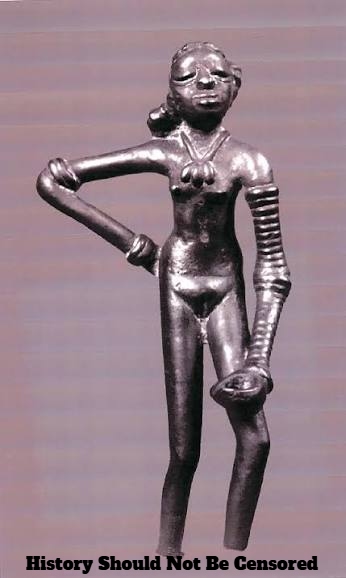
The Dancing Girl Doesn't Need a Moral Guardian
 The India Commentary view
View all posts by this Author
The India Commentary view
View all posts by this Author
By Our Editorial Team
First publised on 2026-06-16 06:00:57
About the Author
The India Commentary view
View all posts by this Author
The controversy over the exclusion of the famous Mohenjo-daro Dancing Girl from school textbooks is about far more than a single artefact. It exposes a growing impulse among curriculum planners to sanitize history in order to satisfy contemporary notions of morality and propriety. In doing so, they undermine not only scholarship but also the civilizational confidence they claim to promote.
The bronze Dancing Girl, unearthed at Mohenjo-daro in 1926, is among the most iconic artefacts of the Indus Valley Civilization. Barely 11 centimetres tall, she stands with one hand on her hip, chin raised, adorned with bangles, radiating confidence and individuality across nearly 4,500 years. She is not merely a figurine. She is evidence. She is history cast in bronze.
History, however, is increasingly being treated not as a record of human civilization but as a carefully curated moral lesson. The result is a dangerous temptation to remove, conceal or downplay anything that may appear uncomfortable, controversial or inconsistent with present-day sensibilities. The Dancing Girl has become one of the first casualties of this sanitization of history.
The first principle of historical education is simple: history is not obliged to conform to contemporary social preferences. Ancient civilizations did not exist to satisfy the moral expectations of twenty-first century textbook committees. Their artefacts, sculptures, paintings and cultural practices must be understood in their own context, not judged according to the anxieties of our own age.
If a bronze figurine from the Indus Valley Civilization can be considered problematic because it depicts the human form in a manner some find immodest, where does the logic end? Must students be shielded from the sculptures of Khajuraho? Should the magnificent temple art of Konark be hidden? Should classical Greek sculptures be censored? Should Renaissance masterpieces be covered up because they depict nudity? Such reasoning quickly descends into absurdity. Civilizations are not built on denial. They are built on understanding.
Beneath such decisions lies an unmistakable paternalism, the assumption that students are incapable of viewing a historical artefact without moral corruption or confusion. This underestimates young minds and misunderstands education itself. The purpose of schooling is not to shield students from the past but to teach them how to understand it.
The role of education is not to protect students from history but to equip them to engage with it critically and intelligently. A textbook is a gateway to knowledge, not a facility for managing moral discomfort. Once educational authorities begin removing historical artefacts because they may offend contemporary notions of propriety, they replace scholarship with ideological gatekeeping.
There is also a deeper irony at work. Those who seek to celebrate India's ancient achievements often simultaneously seek to hide some of the most important evidence of that antiquity. The Dancing Girl is among the strongest visual symbols of the sophistication, artistic skill and cultural confidence of the Indus Valley Civilization. Marginalizing her does not strengthen civilizational pride. It weakens it by erasing the very proof on which that pride must rest.
History does not need to reassure us. Its purpose is to tell us who our ancestors were, with honesty and without flattery. That means engaging with the full record of human experience, not a version trimmed to suit the comfort of curriculum committees. To selectively celebrate only the convenient parts of a civilization is not pride. It is propaganda.
The Dancing Girl has survived for millennia beneath the soil of the Indus Valley. She survived the fall of cities, the rise of empires and the passage of centuries. It would be an extraordinary irony if a civilization that prides itself on its ancient heritage chose to hide one of its most celebrated artefacts from its own children.
A confident civilization does not censor its history. It confronts it, studies it, debates it and learns from it.
The Dancing Girl belongs in India's textbooks for the same reason every great historical artefact belongs there: not because it conforms to contemporary standards of respectability, but because it is true. And truth, not prudery, is supposed to be the foundation of education.