

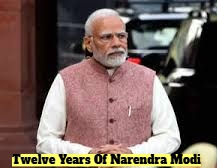
Twelve Years of Modi: The Search for a Post-Nehru India
 The India Commentary view
View all posts by this Author
The India Commentary view
View all posts by this Author
By Our Editorial Team
First publised on 2026-06-11 05:37:38
About the Author
The India Commentary view
View all posts by this Author
Twelve years in office is long enough for a Prime Minister to become more than a political leader. He enters the realm of history. The question is no longer whether he has changed India. The question is what exactly he has changed - and whether those changes will outlast him.
When Modi entered office in 2014, he promised development, efficiency and decisive governance. Over the next twelve years, his government delivered a series of reforms and initiatives that altered the landscape of Indian public life. Infrastructure expanded on a scale that became one of the defining features of the Modi years. Welfare delivery became increasingly digitised, with direct benefit transfers reducing leakages that had plagued predecessor governments for decades - though critics contend that these gains came alongside consolidation of executive power and a narrowing of institutional independence. The abrogation of Article 370, the Ram Mandir and a more assertive foreign policy reflected a government willing to pursue objectives that previous administrations either avoided or postponed.
Yet the significance of the Modi era lies not merely in specific policies. Governments build roads, launch schemes and pass laws. What distinguishes a transformative leader is the ability to redefine the assumptions under which politics operates. Modi's greatest achievement may be that he has shifted the centre of gravity of Indian politics itself.
More significantly, he has transformed the BJP from a party that once competed with the Congress system into the principal organising force of Indian politics. For much of the last decade, elections have been fought either for or against Modi, a distinction that few Indian leaders have managed to sustain for so long.
This is where the Congress charge of a "Nehru fixation" becomes relevant. Congress leaders argue that Modi repeatedly invokes Jawaharlal Nehru because he seeks to erase the achievements of India's first Prime Minister and rewrite the story of independent India. They point to the frequency with which Nehru is cited in political speeches and parliamentary debates as evidence of an unusual preoccupation.
The accusation deserves examination. Modi has arguably made Nehru a more central figure in contemporary political debate than any Prime Minister since Nehru himself. But the reason may be larger than personal fixation. Nehru is not merely a historical figure; he symbolises a particular vision of India â one rooted in secular nationalism, centralised planning, elite institutions and a specific understanding of statehood. Challenging Nehru is therefore not simply about revisiting the past. It is about challenging the intellectual foundations of the post-Independence political order.
Here the more important question arises - one that the government's own record has yet to answer convincingly. Critique is not the same as construction. Modi has been consistently effective at challenging the Nehruvian framework: its institutions, its cultural assumptions and its claim to represent the default vocabulary of Indian nationhood. What remains less clear is whether the alternative being assembled constitutes a coherent governing philosophy or whether it is, at its core, a set of oppositional impulses - powerful enough to win elections, but not yet consolidated into a framework capable of outlasting the leader who champions it. The Nehruvian consensus took decades to calcify. It may be too early to judge whether what is replacing it will prove equally durable.
What cannot be disputed is that Modi has succeeded in making this the defining debate of contemporary India. The terms of public discourse today are markedly different from those that prevailed before 2014. Questions of civilizational identity, welfare delivery, national security and cultural confidence occupy a far larger space in politics than they once did. Whether that represents genuine ideological renewal or a disruption still in search of settled form is a question the next decade will answer.
After twelve years, one conclusion is difficult to escape. Narendra Modi's legacy will not be measured merely by the projects he completed or the elections he won. It will be measured by whether the framework he has worked to build proves capable of governing India without him.