


AI Did Not Invent Exploitation, It Industrialised It.
 Linus tackles things head-on. He takes sides in his analysis and it fits excellently with our editorial policy. No 'maybe's' and 'allegedly' for him, only things in black and white.
View all posts by this Author
Linus tackles things head-on. He takes sides in his analysis and it fits excellently with our editorial policy. No 'maybe's' and 'allegedly' for him, only things in black and white.
View all posts by this Author
By Linus Garg
First publised on 2026-07-12 07:51:45
About the Author
Linus tackles things head-on. He takes sides in his analysis and it fits excellently with our editorial policy. No 'maybe's' and 'allegedly' for him, only things in black and white.
View all posts by this Author
Three women in Arizona have sued men who allegedly turned their Instagram photographs into AI-generated pornographic "influencers." The lawsuit says the men then sold courses teaching other men how to do the same thing. The allegations remain to be tested in court. The business model they describe is becoming disturbingly familiar.
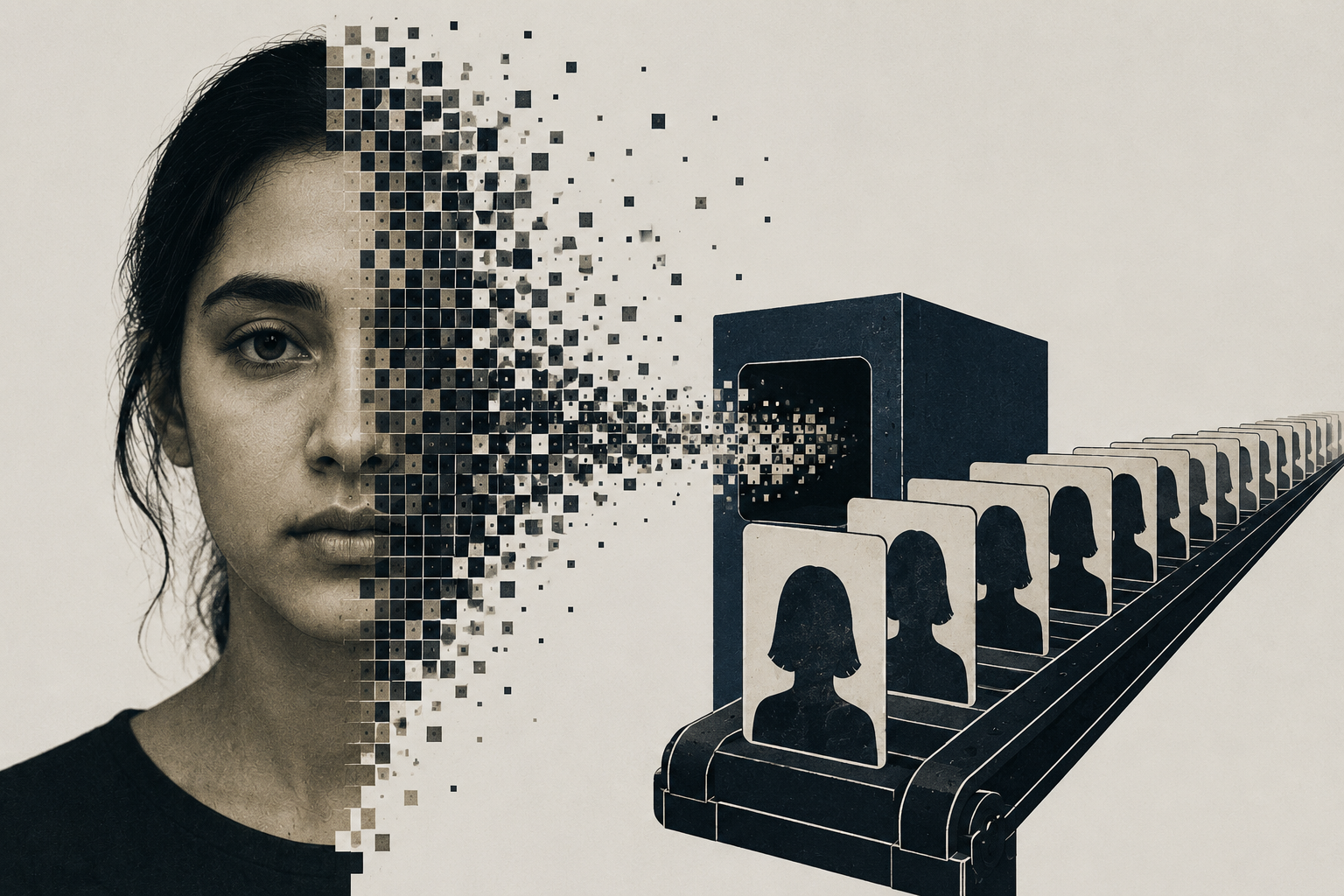
Photography once made voyeurism possible. The internet made revenge porn possible. Social media made harassment scale. Generative AI has lowered the final practical barrier. It no longer needs intimate photographs. A publicly available face is often enough. From that single input, a machine can manufacture an entire fake identity, complete with a body, a personality and an income stream for someone else.
This is not a new evil. It is an old one, made cheap. At its heart, this is a story about consent. AI has made it possible for a person's likeness to be copied, altered, sexualised and monetised without that person's knowledge or permission.
The numbers are not random
A widely cited 2023 analysis found that 98 percent of deepfake videos circulating online were pornographic. Women made up 99 percent of the people targeted. These figures will shift as more data comes in. The direction will not. AI-generated abuse follows the same fault lines as every exploitation industry before it. It is not evenly distributed. It is aimed.
Exploitation has become a business model
What makes this moment different from earlier waves of image-based abuse is not the abuse itself. It is the supply chain around it. Stolen photographs feed AI generators. Generators produce fake personas. Personas attract subscribers. Subscribers generate revenue. And the people who built the pipeline sell tutorials teaching others to replicate it. Every stage creates incentives for the next.
Abuse has become scalable, and scale changes everything. What once required individual malice now requires only a product manual.
The law was built for cameras, not for machines that invent images
Much of Indian law governing intimate images was drafted on the assumption that the offending image had been captured by a camera. Section 66E of the IT Act penalises capturing or publishing images of a person's private parts without consent. It was written for cameras, not for software that generates a naked body that never existed, wearing a stolen face.
This gap matters. If an image was never taken, was it ever "captured"? If the body in the image belongs to no one, whose privacy was violated? Existing criminal law largely punishes the misuse of real images. AI now enables the creation of synthetic images that never existed but can inflict the same humiliation and reputational harm.
Courts and legislators will have to answer questions the law never anticipated. Does a person own their digital likeness the way they own a copyright? Can a face be licensed, the way a song or a photograph can be? Should synthetic sexual imagery of an identifiable person be treated as a distinct offence, regardless of intent to distribute?
These are not abstract questions. They are the difference between a woman having legal recourse and having none.
India has taken steps to curb online abuse through the Information Technology Act, provisions of the Bharatiya Nyaya Sanhita relating to obscenity and voyeurism, and intermediary due diligence rules. Yet these frameworks were largely designed for an era in which an image recorded reality. Generative AI has blurred that distinction, exposing gaps that Parliament may soon have to address explicitly.
Platforms cannot only react
Removing content after a complaint is not a safeguard. It is a formality. By the time a takedown request is processed, the image has usually already travelled. Platforms that can detect copyrighted music within seconds of upload have no excuse for failing to detect synthetic intimate imagery before it spreads. The technology to identify these images exists. What has been missing is the will to deploy it at the point of upload rather than after the damage is done.
AI developers carry a parallel responsibility. Models capable of generating sexual imagery of identifiable individuals should be harder to misuse by design, not easier to monetise by omission.
This is not a case against AI
None of this is an argument that artificial intelligence is inherently harmful. The same technology is accelerating diagnosis in medicine, expanding access to education, and giving a voice to people with disabilities who had none. The problem is not the tool. It is the gap between how fast the tool has advanced and how slowly the law has moved to protect the people it can be used against.
A country that protects a company's intellectual property with speed and rigour, and leaves a woman's likeness undefended, has its priorities reversed.
The Path Ahead
AI did not create the impulse to turn women into products. That impulse predates every technology built on top of it. What AI has done is strip away the cost, the expertise and the risk that once limited how far that impulse could travel. A stranger with a laptop can now do in an afternoon what once required intent, access and effort.
Technology has advanced at exponential speed. Accountability has not. Unless that changes, AI will continue to amplify humanity's oldest abuses with unprecedented efficiency. Innovation without accountability is not progress. It is merely efficiency applied to old injustices.
The lead picture is AI-generated