

E20 Isn't the Issue. Public Trust Is
 Linus tackles things head-on. He takes sides in his analysis and it fits excellently with our editorial policy. No 'maybe's' and 'allegedly' for him, only things in black and white.
View all posts by this Author
Linus tackles things head-on. He takes sides in his analysis and it fits excellently with our editorial policy. No 'maybe's' and 'allegedly' for him, only things in black and white.
View all posts by this Author
By Linus Garg
First publised on 2026-07-06 02:00:55
About the Author
Linus tackles things head-on. He takes sides in his analysis and it fits excellently with our editorial policy. No 'maybe's' and 'allegedly' for him, only things in black and white.
View all posts by this Author
The rollout of E20 fuel had been running into trouble for weeks before the carmakers decided to speak. Videos of stalled engines, corroded fuel lines and stranded motorists had flooded social media. A Toyota Innova Hycross owner claimed his vehicle broke down because of ethanol blended petrol. Another motorist named Manish Kashyap posted a video, viewed over five lakh times, showing his car in a workshop and blaming E20 for the damage. Then the Attorney General told a court that the ethanol programme was an experiment whose results would only be known next year. The remark rapidly became the focus of online discussion and added to existing public anxiety over the rollout.
Within days, seven of India's largest vehicle manufacturers stood together at a press conference in New Delhi and delivered a coordinated verdict. E20 is safe. There is no engine damage. There is no rise in insurance claims. There is no corrosion. Whatever a customer saw on his workshop floor, it was not the fuel's fault.
The press conference was organised not by an industry body but by the Ministry of Petroleum and Natural Gas, in collaboration with the Ministry of Heavy Industries and the Ministry of Road Transport and Highways. Three ministries brought together six carmakers and a former public sector executive on one stage. The very decision to convene such an unusually broad joint press conference reflects how seriously the government viewed the growing public concern. It is also true that governments routinely organise such briefings precisely because misinformation spreads fast and needs a united, authoritative response. Both readings are available, and it is worth holding them side by side rather than picking one.
Rahul Bharti of Maruti Suzuki said the company had serviced 2.84 crore vehicles in the last financial year and found no E20 related damage among them, even in 1.5 crore vehicles that were more than three years old and never certified for E20. Toyota's Vikram Gulati said the viral Innova Hycross case was traced to contaminated fuel, not ethanol. Hero MotoCorp said its warranty data across six million two wheelers a year showed nothing unusual. Hyundai's Puneet Anand dismissed the entire controversy as social media noise. The striking similarity in the language used by different manufacturers, including the repeated phrase statement of confidence, inevitably created the impression of a coordinated communication strategy. That impression may or may not reflect what actually happened behind the scenes, but it is the impression that has taken hold, and it is one the government and the industry will need to address rather than dismiss.
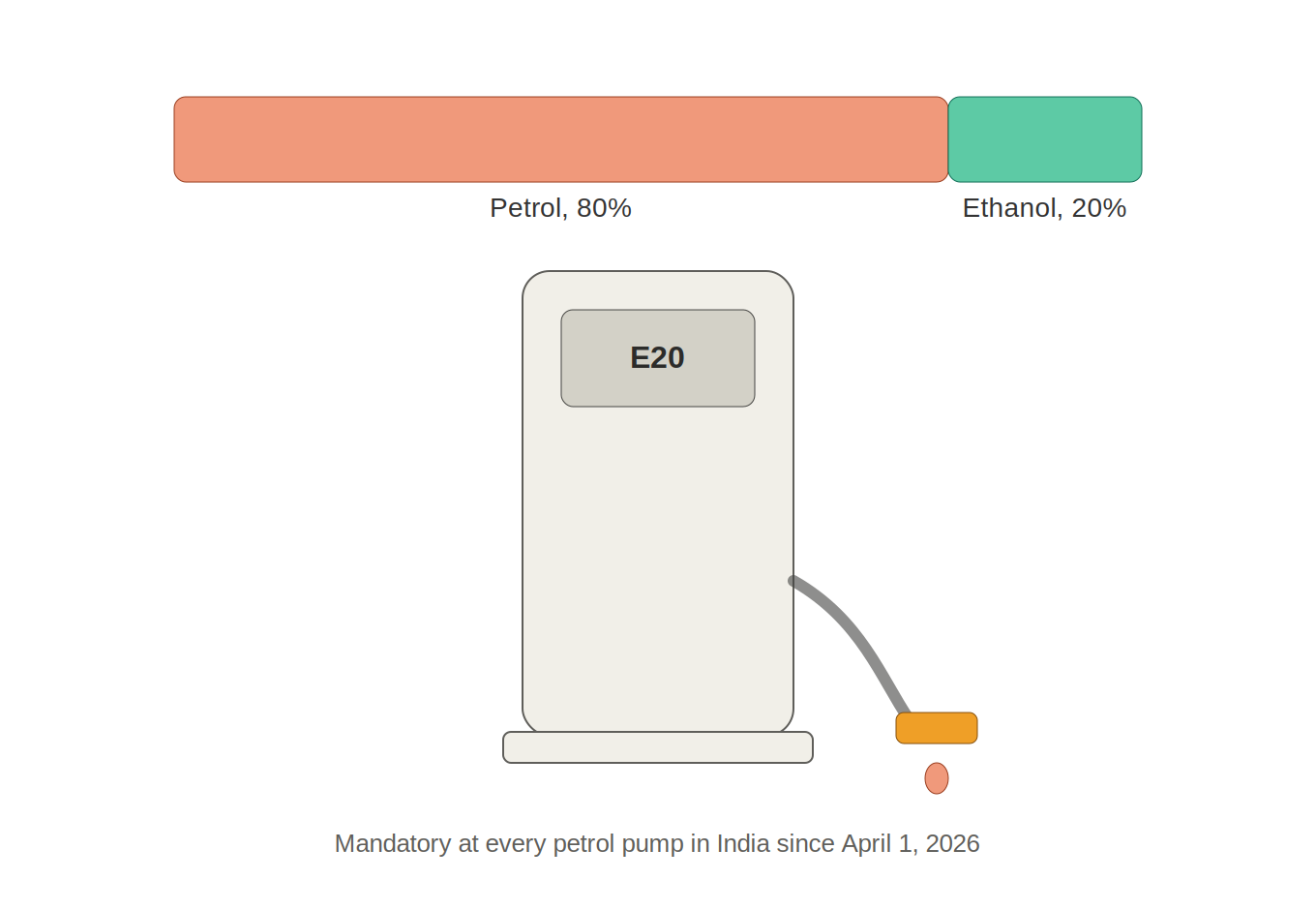
None of this means the underlying scientific claim is false. Ethanol blended fuel has been used safely in large parts of the world for decades, and the evidence backing E20 is not manufactured for this crisis. But Congress leader Priyank Kharge asked a fair question when he said the government cannot challenge citizens to prove damage when its own data is still pending. There is also something uncomfortable in asking automakers to defend a fuel policy they did not design. Maruti Suzuki, Toyota, Hyundai, Hero and Bajaj did not decide India's ethanol blending targets. The Ministry of Petroleum did, through the 2018 National Policy on Biofuels and the 2021 Ethanol Roadmap, which pushed India from E10 to E20 years ahead of the original schedule. When the policy ran into public resistance, the government ended up relying on the car industry to reassure consumers, rather than fronting the defence itself through the officials who wrote the roadmap.
What the world actually did with ethanol
India is not doing anything unprecedented by mixing ethanol with petrol. Brazil began blending ethanol into its fuel supply in the 1970s, after the oil shock of that decade forced the country to look inward for energy security. Brazil today runs on a blend that varies between 18 and 27.5 percent ethanol. What sets Brazil apart is not simply a policy choice to blend ethanol but a parallel investment in flex fuel vehicles. Brazil coupled its high ethanol blends with widespread adoption of flex fuel technology, allowing consumers to switch between petrol and hydrous ethanol without any compatibility concern, since the vehicles themselves were engineered to read and adjust to whatever fuel was in the tank. More than 80 percent of new cars sold in Brazil today are flex fuel vehicles. That is a materially different proposition from mandating a blend and expecting an existing fleet, designed for an earlier specification, to simply cope.
The United States took a slower path, shaped by several overlapping factors rather than any single motive. The Renewable Fuel Standard of 2005, expanded further in 2007, mandated growing volumes of ethanol in the fuel supply, but the country settled at E10 for the vast majority of its pumps. E15 has been legally available since 2022, yet even now it accounts for barely a tenth of American fuel stations. The slow uptake reflects the size and age of the legacy vehicle fleet, the cost of upgrading blending and dispensing infrastructure, refinery economics, sustained litigation between automakers and the EPA over compatibility and labelling, and a degree of consumer caution that built up over years of public debate. No single explanation accounts for the pace.
Europe has generally moved with more caution as well. France, Germany and the United Kingdom have adopted E10 as their standard, but many European markets retained E5 alongside E10 for a prolonged transition period, giving consumers with older vehicles a fallback option even as the newer blend was introduced. The extent of that overlap has varied by country, and it would be inaccurate to describe it as a uniform continent wide arrangement, but the general pattern of a phased, consultative rollout holds.
This is where the Indian experience differs from the other major ethanol transitions, at least in degree. Brazil built a vehicle fleet that can handle any blend by design. America and Europe both preserved some room for older vehicles during their respective transitions, however imperfectly. In India, the rollout has not been uniform. E10 continues to be sold in some regions even as E20 has become the standard grade at a large and growing number of outlets elsewhere. But for a great many motorists, particularly in cities where E20 has already become the only fuel on offer, there is effectively no alternative to fall back on. A Maruti Alto or a Hyundai i10 bought in 2018 has no flex fuel sensor and no ability to request E10 at a pump that no longer stocks it. The consumer in those areas has to trust that his engine, designed for one fuel specification, will hold up on another.
That is the real grievance beneath the viral videos, the insect swarm rumours and the exaggerated mileage complaints. It is not that ethanol is inherently dangerous. It is that a meaningful number of Indians who bought a car under one set of assumptions are now being asked, after the fact, to place their confidence in a different set of assumptions, and the loudest voices reassuring them are the very carmakers who sold them the original vehicle.
Who carries the burden of proof
The controversy also raises a larger consumer protection question. When a product sold years earlier is expected to operate with a materially different fuel specification because of a later government policy, who bears the burden of proving compatibility? Should that burden rest on individual motorists documenting engine failures on their own time and expense, or on the state demonstrating in advance, with transparent and accessible data, that legacy vehicles can safely operate under the revised standard? The answer to that question goes beyond ethanol. It goes to the heart of how much responsibility a government owes citizens before it changes the terms on which an existing product must perform.
None of the scientific defence offered at the press conference is necessarily wrong. The calorific value argument, that E20 delivers three to three and a half percent lower mileage because ethanol carries less energy than petrol, is basic chemistry and has been demonstrated in ARAI's field trials over 40,000 kilometres for cars and 20,000 kilometres for two wheelers. Toyota's explanation of the Innova Hycross breakdown, that it was water contaminated fuel rather than ethanol, is a plausible and fairly common cause of engine trouble regardless of blend. But plausible explanations delivered through a government sponsored press conference land differently from the same explanations delivered independently, and the Attorney General's use of the word experiment, however narrowly he later claimed to have meant it, had already punctured public trust at exactly the moment the government needed people to believe the transition was fully tested and fully safe.
Ethanol blending is not the villain in this story. It cuts India's crude import bill, gives sugarcane farmers a stronger market and reduces tailpipe pollution in cities that badly need cleaner air. Those benefits are real and worth pursuing. But a policy of this scale needed the kind of consultation, phased rollout and fallback options that Brazil, America and Europe each built into their own transitions, however differently each of them went about it. India compressed that timeline, and when public anger caught up with the pace of the rollout, the government leaned heavily on the automobile industry to carry the public reassurance. That is the part of this story that deserves continued scrutiny, not the chemistry of ethanol itself