

Cut Money Will Not Be Returned If It Was Not Taken
 Linus tackles things head-on. He takes sides in his analysis and it fits excellently with our editorial policy. No 'maybe's' and 'allegedly' for him, only things in black and white.
View all posts by this Author
Linus tackles things head-on. He takes sides in his analysis and it fits excellently with our editorial policy. No 'maybe's' and 'allegedly' for him, only things in black and white.
View all posts by this Author
By Linus Garg
First publised on 2026-06-02 06:45:29
About the Author
Linus tackles things head-on. He takes sides in his analysis and it fits excellently with our editorial policy. No 'maybe's' and 'allegedly' for him, only things in black and white.
View all posts by this Author
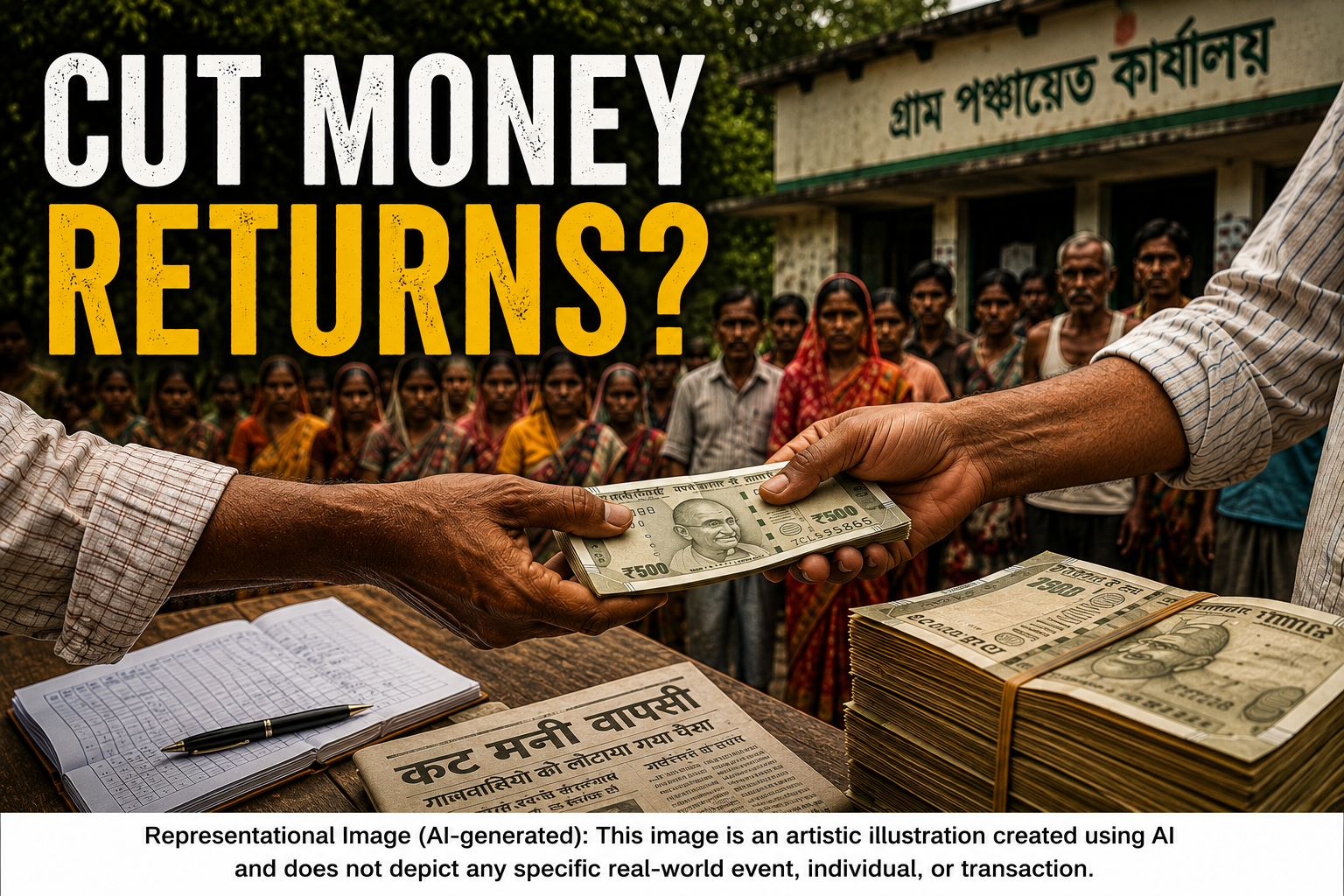
People rarely return money they insist was rightfully theirs. That is why the wave of repayments sweeping Bengal's districts carries such political significance. Trinamool Congress leaders, scared and cornered after their party's 2026 election defeat, are returning cut money to villagers. In doing so, they have offered what appears to be the most damning acknowledgement of all - that the money was taken.
The scenes are extraordinary. In Mathabhanga's Fakir's Kuthi area in Cooch Behar, TMC leaders quietly gathered villagers at a school field and began returning money. Residents alleged that nearly Rs 85 lakh had been collected from them since the 2021 Assembly elections - taken on various pretexts, primarily around land transactions and disputes. In Dubrajpur, Birbhum, a TMC councillor's aide was stripped and beaten by an enraged mob over cut money allegedly collected under the Pradhan Mantri Awas Yojana. In Cooch Behar, villagers turned loudspeakers on a local TMC leader, giving him a deadline to return what he had allegedly taken. Across the state, in cases where TMC leaders have fled, their families have come to pay up in their place.
This is not protest theatre. This is reckoning.
The term "cut money" has a precise meaning in Bengal's political economy. It refers to the commission that TMC functionaries - panchayat members, councillors, booth-level leaders - allegedly extracted from beneficiaries of government welfare schemes. Pradhan Mantri Awas Yojana housing grants. MGNREGA wages. Ration entitlements. Agricultural subsidies. Critics argue that the practice became so widespread across districts that it ceased to be individual misconduct and began to resemble an institutionalised system of extraction, with beneficiaries frequently alleging that a portion of their entitlement was diverted as commission.
For years, the TMC denied this systematically. The denials became harder to sustain in 2019, when Mamata Banerjee was compelled to publicly ask party leaders to return cut money - an implicit acknowledgement that the problem existed at scale. She threatened police action under Sections 384 and 386 of the IPC, which govern extortion. But the pressure faded, the leaders stayed in their posts, and the complaints continued.
Among the many factors that contributed to the TMC's landslide defeat in the 2026 Assembly elections - anti-incumbency, organisational fatigue, perceptions of arrogance, consolidation of the opposition vote - allegations of cut money appear to have been one of the most politically damaging. An analyst who visited all 294 seats in the months before the election described the anti-incumbency as tectonic. He cited local-level corruption and the culture of impunity as the two forces driving it. More than 20 TMC leaders and ministers were defeated. The party that had held Bengal for fifteen years was voted out.
What is happening now in the districts is a mass acknowledgement extracted not by courts or commissions but by the arithmetic of electoral defeat. Many villagers see the refunds as confirmation of what they always knew. These leaders are returning money because the protection of power is gone. For fifteen years, the TMC's organisational machine ensured that complaints went nowhere. Police were loyal. Whistleblowers were warned. The party was the state, and the state was the party.
That equation has now reversed. And the refunds are the receipts.
The TMC's national leadership will claim these are isolated incidents. That a few rogue leaders do not represent the party. That cut money was a problem the party itself tried to fix. Each of these defences is difficult to sustain. The scale - multiple districts, hundreds of cases, crores of rupees - is inconsistent with aberration. The pattern - extracted from welfare beneficiaries, demanded under government schemes - suggests something more systematic than personal misconduct. The fact that Mamata Banerjee herself felt compelled to publicly address it in 2019 suggests the party's own leadership understood its scope.
A party does not lose power in a state it has held for fifteen years because of bad optics or a media narrative. It loses because every person who was shortchanged, every family that received half a house instead of a full one, every farmer who got a fraction of his entitlement - every one of them went to the booth and recorded their response.
The refunds, arriving now in fear and haste, appear to be the admission the party never formally made. The electorate delivered its verdict first. The refunds are merely the explanation arriving later.