

Hawkers In Kolkata Have Crossed All Limits - Supreme Court Is Right To Take Cognisance
 Editor-in-Chief of indiacommentary.com. Current Affairs analyst and political commentator. Author of Cyber Scams in India, Digital Arrest, The Money Trap and The Human Hack
View all posts by this Author
Editor-in-Chief of indiacommentary.com. Current Affairs analyst and political commentator. Author of Cyber Scams in India, Digital Arrest, The Money Trap and The Human Hack
View all posts by this Author
By Sunil Garodia
First publised on 2026-06-24 05:17:11
About the Author
Editor-in-Chief of indiacommentary.com. Current Affairs analyst and political commentator. Author of Cyber Scams in India, Digital Arrest, The Money Trap and The Human Hack
View all posts by this Author
The Supreme Court has declared the right to walk a fundamental right. It is a welcome declaration. But in Kolkata, the more pressing question is not whether citizens have the right to walk - it is who has the right to profit from the space where walking is supposed to happen. Because on the footpaths of this city, that question has long been settled, and the answer has nothing to do with the public.
Stand on Chowringhee and look at the frontage of the Oberoi Grand. It is one of Kolkata's most recognisable buildings - a Victorian-era heritage property that has anchored the city's most prestigious address for over a century. Its shopping arcade draws guests, tourists, and the city's older commercial class. Its presence on Chowringhee is not merely architectural. It is a statement about what Kolkata has been, and what it aspires to be.
Now look at the footpath in front of it.
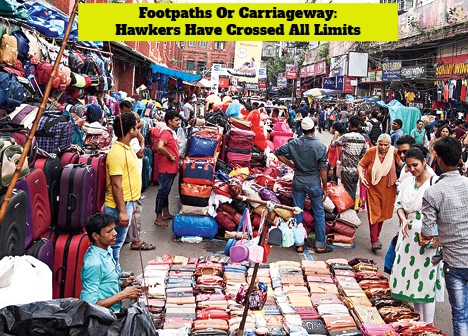
What you see is not a footpath. It is a market. Hawkers have occupied the pavement leading to the arcade in a density and permanence that makes clear this is not casual or temporary. These stalls have been there through governments, through court orders, through periodic enforcement drives that achieve nothing lasting. The Left Front could not move them. The Trinamool Congress did not move them. They are, in the only sense that matters on the ground, immovable - not because of any legal protection they enjoy, but because the informal system that sustains them is more durable than any administration's will to disturb it.
The issue is not that a heritage hotel suffers an aesthetic inconvenience. The issue is what the Oberoi Grand's pavement says about this city to every foreign dignitary, every international business traveller, every investor who arrives hoping to find a city that takes itself seriously. Kolkata speaks constantly of its cultural capital, its heritage, its aspiration to reclaim the commercial prominence it once held. A city that cannot keep the footpath of its most famous hotel clear is not a city that takes those aspirations seriously. It is a city that has quietly conceded that certain interests are beyond the reach of civic governance, and that the rule of law applies selectively - and not in favour of the law-abiding.
The Oberoi Grand is, at least, capable of absorbing the reputational damage. It has resources, management, international standing. It endures. The trader who cannot endure - who is being quietly destroyed by the same system - is the licensed shopkeeper whose entrance is blocked by the very pavement that the state built at public expense and was legally obligated to keep clear.
Consider what this person has done to establish his business. He has paid a substantial security deposit - often several months' rent upfront - to secure his tenancy. He pays monthly rent to a landlord. He has obtained a trade licence from the municipality. He pays GST, property tax, electricity charges, and every other statutory levy the state has seen fit to impose on those who choose to operate within the formal economy. He complies because compliance is what the law demands, and because he has calculated â reasonably - that operating within the law offers some protection.
It offers none. Or rather, it offers protection against everything except the one threat that actually confronts him: the hawker who sets up directly outside his shop, on the public footpath, selling the same goods at half the price.
The arithmetic of this competition is not complicated. The hawker pays no rent, no security deposit, no trade licence fee, no GST on his transactions, no property tax. His only overhead is the informal payment that purchases his right to occupy public land without interference from the enforcement machinery that is nominally tasked with removing him. That payment is a fraction of what the legitimate trader pays merely to exist within the law. The hawker is not cheaper because he is more efficient. He is cheaper because the state has allowed him to externalise every cost that the legitimate trader must absorb. The footpath - funded by the taxpayer, maintained notionally by the municipality, and supposed to be protected by the police - has become a subsidised commercial platform whose beneficiaries are determined not by law but by patronage.
This is the aspect of the footpath occupation debate that politicians who invoke hawker livelihoods are most careful to avoid. The standard argument runs that street vending empowers the poor and must be protected. It is an argument that collapses on examination. Footpath space in prime commercial locations is not distributed among the deserving poor. It is controlled by established hawker networks that have held their positions for years, accumulated multiple spots, and in many cases sub-let those spots to the actual vendors who set up stall each day. A recurring complaint among vendors themselves is that the marginal hawker - the one the politician photographs during election season - pays rent to a more powerful hawker family for access to public land that belongs to no one. The poor are not the beneficiaries of this system. They are among its victims.
The legitimate shopkeeper is its most invisible victim. He files his returns, meets his obligations, and watches the system that took his taxes deploy its police and its municipal inspectors to collect informal payments from the person who is putting him out of business. He has no recourse that is not more expensive than the injury. He cannot petition a court for relief without spending money he may not have on litigation whose outcome, even if successful, will not survive the next change of political winds. He absorbs the loss, reduces his margins, and eventually either closes or finds a way to join the informal economy himself - at which point the state loses a taxpayer and gains another encroachment.
The Supreme Court's ruling gives citizens a constitutional instrument. Municipal bodies are now under a declared obligation to maintain obstruction-free footpaths. Violation of that obligation is actionable. Whether the legitimate traders of Kolkata - those whose shops are being strangled by pavement encroachments - will find in this ruling the means to compel enforcement is a question that only sustained civic pressure will answer. The ruling exists. The footpaths remain occupied. The distance between those two facts is the measure of how much work remains to be done.